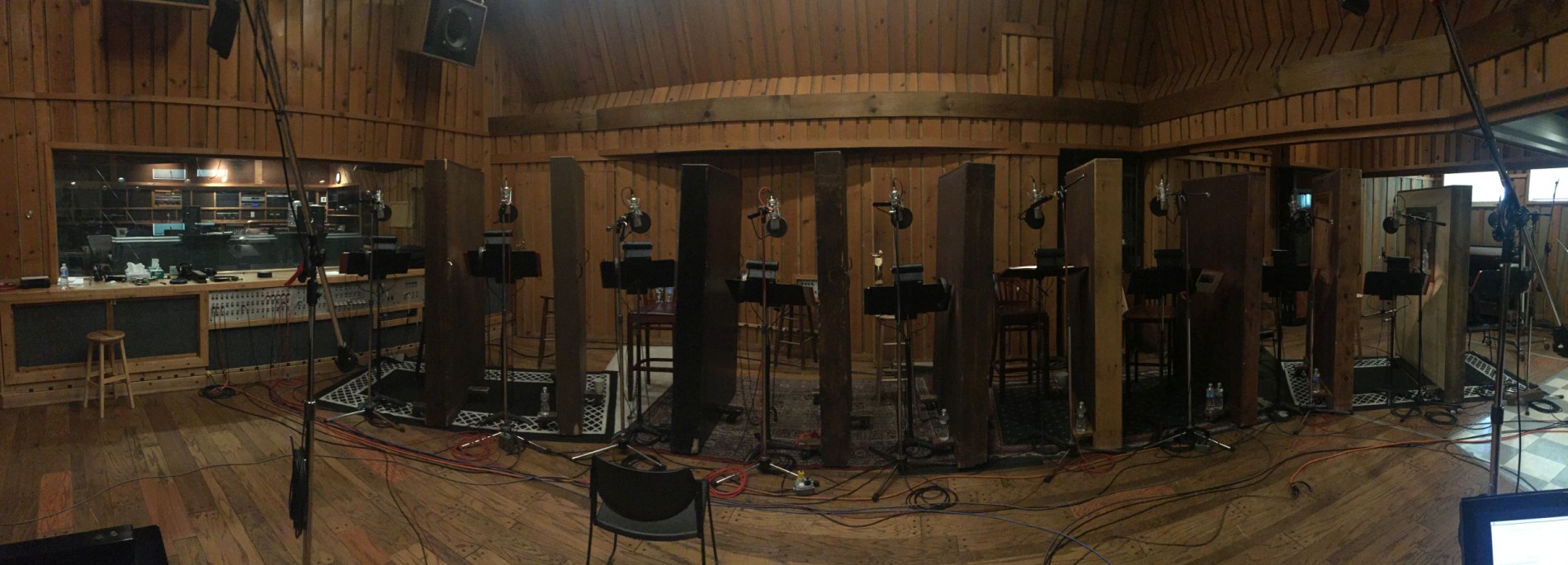
JOHN STORYK

John Storyk

One of the world’s most distinguished studio designers opens up about his life and career. Unscripted. Unframed. Unfiltered.

An outtake from Filter magazine #3.

Following his design of the famous Electric Lady Studios in New York in the late sixties, John Storyk has become one of the music industry’s most famous and celebrated studio designers. However, becoming an acoustician and studio designer wasn’t on Storyk’s radar when he was a young man. In 1968, he had just completed his architectural studies at Princeton and Columbia Universities, and started work at an architecture office in New York.

“It was a relatively typical architectural job,” recalls Storyk, “for a wonderful firm, though not terribly interesting. But I was getting paid and it was what seemed to be the start of a design career! When I graduated from college as an architecture student, I actually thought I was going to be a musician. I grew up playing piano, clarinet, and sax, and by 1968 I was in a 12-piece blues band, and we were pretty good. We were performing three times a week, and I was having the time of my life. It was the late sixties in New York City, and you can connect the dots: it was very exciting!”

“Then my life suddenly changed, in a very short amount of time. It really was a fluke set of events that led to a small commission designing an experimental night club in lower Manhattan. The club, Cerebrum, became quite well-known very quickly. It made the cover of Life magazine within a few months; and was visited by almost everyone in the art scene at that time in New York.”

“Once Jimi Hendrix visited! He loved the design and wanted to know who was responsible. The next thing I know, he asked me to design a club for him. But Eddie Kramer, his engineer and producer, convinced Jimi to scrap the club and build a studio instead. I wanted to strangle Eddie, as I watched this amazing project disappear as fast as it had arrived.”

“Eddie had talked Jimi into building a recording studio, reminding him and his manager that his recording bills for the year were over $300.000, which was a lot of money in 1968. So Eddie suggested that instead of designing a club, I could ‘stay on and do the studio.’ I commented, ‘Guys, I’ve never even been in a studio!’ But they replied, ‘You’ll figure it out. Maybe you can learn.’ So I quit my job, became an intern for an acoustician who was designing radio stations, and tried to learn from him.”

“Electric Lady was built with just six hand-drawn pencil drawings! I’m not sure you can build a kitchen with just six drawings today. I borrowed the isolation details from my internship mentor. He was particularly good, and he knew a lot about masonry and sand-filled walls. So we decided we were going to build masonry sand-filled walls, which gave tremendous isolation. We needed that between the two studios.”

“It took one and a half years to build, and before it was finished, I was already asked to build four other studios. Then I went back to school for a year. I don’t think I was doing any kind of serious acoustic calculations until maybe studio number 10 or studio number 12 that I built.”

Electric Lady became an extremely successful studio, and more than fifty years later it continues to be among the most iconic studios in the world. Storyk went on to enjoy a stellar career as a studio designer, and in 1987, he founded the Walters-Storyk Design Group with his wife Beth Walters, an interiors and textile designer. They had met a few years earlier, and quickly became partners in life and in business.

WSDG has supplied architectural and/or acoustic designs and consulting for close to 4000 projects all over the world, ranging from audio and video studios to theatres, educational facilities, railway stations, airports, football stadiums, and more. Storyk and WSDG have designed countless private studios — for legends like Bob Marley, Bruce Springsteen, Alicia Keys, Jay-Z, and many more — and many commercial studios, including new facilities for Spotify, Sony and RCA, plus iconic places like the Swiss Parliament, Maracana Stadium in Brazil and the Jazz at Lincoln Center in New York.

Today, at the age of 76, Storyk is the world’s eminence grise of acoustic design, and he shares his knowledge in various educational centres around the US, for example as an adjunct professor at the Berklee College of Music in Boston. He also has lectured on this subject at numerous schools in the USA and abroad.

During the more than six decades that Storyk has been active, he has been instrumental in extending the scientific knowledge base that is the foundation of studio design today. His admission that he had little technical acoustic knowledge when he built Electric Lady therefore is a little surprising. With hindsight, what did he get right 53 years ago?

TECHNICAL DRAWINGS BY HAND

johnstoryk2

“The iconic Studio A live room is basically still the same room, apart from that they’ve painted it a little bit and so on. Why is that room still working after 53 years? Some people say it’s the river that runs under the studio, or Jimi’s vibes in the wall, or the subway 300 meters away, which they say can occasionally be heard on records. Although all of these ideas may be true, I am not sure about the science associated with them. In fact, one of the reasons why the room works is because the reverb time goes down at low frequencies rather than up. That’s the primary acoustic signature in that room.”

“Why did that happen? It was a little bit of luck. The ceiling has a spiral shape that I had fallen in love with in architecture school, and we made it with very thin plaster. We used commercial eggbeaters to make it very, very thin, and then we troweled that onto this shape. I knew very little about membranes but inadvertently we had made a giant low-frequency membrane absorber in the ceiling, which squashes the low frequencies. It took another 25 years before I even had the knowledge and tools to measure this.”

“This story illustrates why one of my favorite words in life is still serendipity. It is a privilege to continue to be able to visit Electric Lady Studios, which remains successful due to its amazing leadership, particularly its manager for many years, Lee Foster. Studios serve musicians and nobody understands that better than Lee. A fluke moment in life leads to a club design leads to meeting Eddie Kramer, leads to Jimi and morphs into a lifetime’s work… seriously?”

Storyk explains that the industry only started to develop reliable technology that could predict acoustic behavior in a particular space by the late 20th century, and even that was only for the frequencies above the Schroeder frequency, and not for low end. So how has studio design and acoustic science developed over the years?

“Well, of course we kept getting smarter every year,” says Storyk, “and the knowledge has increased. There has always been architecture, acoustics and audio, and there’s also the art of building a studio. In all this, there’s a fundamental agreement that rooms basically need to be acoustically neutral. So over the years there’s been a process of intuition, guessing, measurements, using your ears, and then you improve with the next studio you build, to achieve this aim.”

“You have to remember that all the great cathedrals we know today are the ones that did not fall down. Half of the cathedrals that were built collapsed. People learned from their mistakes, and got better. In our case, some studios we made did not work, so we made them better next time. One general mistake in studio design is making control rooms too dead, possibly making them non-musical. And for years, people, myself included, were designing what became known as compression ceilings.”

“You put the speakers up high, encapsulate everything in wood and hard baffling, and then you have the ceiling come down, also in wood. The result was that you got 3 to 6dB more gain in the room. It was a very clever way of getting extra low frequencies, which was good news. The bad news was that you got horrible comb filter reflections from the horns in the listening position. For years people did this, even while knowing it wasn’t sounding good. This was in the late seventies and early eighties.”

COMPRESSION CEILINGS

“Then, all of a sudden, half a dozen people realized that the compression ceiling design concept was wrong. What should really happen is an expansion ceiling, and it should be baffled and soft in the front, and probably be diffusive in the back. From that idea somebody one day came up with the live end, dead end concept, and gave it an acronym, LEDE.”

“When LEDE came along in the early eighties, it became popular because it was an easy acronym to grasp. It was the same with the importance of reverb time. Other concepts emerged as well, like the reflection-free zone, initial time delay gap [ITDG], and more. Nobody ever said small, critical listening rooms were easy to design!”

“Although everybody jumped onto the LEDE concept in the eighties, I always thought that it should be called FDLEDE, which means Frequency Dependent Live End Dead End. LEDE is only for certain frequencies. People say things like, ‘the reverb time of my room is 0.3s.’ However, that means nothing. You have to know for what frequency it is 0.3s. You need to know the reverb time over the entire frequency range.”

“Moreover, the reflection-free zone idea states that in the listening position there’s no energy arriving in the first 15ms that’s within 10dB of the direct sound. That’s an aim that’s not so easy to achieve, and led to new developments in acoustic design.”

“More recently, two important trends have impacted studio design. One is that people have become more and more interested in low-frequency content. It’s to do with hip-hop and urban music. Our musical interest in low end in 2022 is not the same as it was in 1950. Just listen to a Buddy Holly record!”

“The other is that studios are getting smaller. Real estate is expensive, and most people are mixing on smaller consoles, or not on a console at all. More and more studios are private, because the great era of commercial studios has stopped growing. Chris Stone, who founded The Record Plant, predicted over 20 years ago that there would be motherships and satellite studios. He said that there would always be a handful of large iconic studios, and thousands and thousands of smaller studios, privately owned and producer-oriented. It’s exactly what has happened.”

“For the studio design community it means that we are busier than ever before, but it also poses challenges. These smaller studios, now paying more and more attention to low-frequency information and accuracy, are harder to design. As counter-intuitive as this might seem, the science bears this out.”

“The Schroeder frequency gets higher as rooms become smaller, so there’s a larger low frequency range that’s problematic to predict. The combination of stronger interest in low end, and rooms getting smaller, has created a perfect storm for us. It was another reason why we developed the NIRO software, to try to predict how the low end behaves.”

Returning to the topic of the predictive tools that have emerged over the last 25 years, they include the ODEON Room Acoustics program, and the CATT Acoustic [Computer Aided Theater Technique] program for frequencies above the Schroeder frequency, and very recently WSDG’s NIRO program. Overall, it means that today there’s not only a multi-disciplinary approach, but also a multi-concept approach to studio design.

“We have half a dozen industry standards and design parameters now,” elaborates Storyk, “like reflection-free zone, reverb time across the frequency spectrum, frequency response, which needs to be as flat as possible, ITDG, and so on. And we have improved predictive software to help us deliver rooms that are as acoustically neutral as possible. However, there’s no such thing as a completely flat room, nor should there be.”

“For starters, our clients do the final tuning to their own preferences. Every room will have an acoustic signature – it is the nature of music and it is the nature of design. Engineers in broadcast studios often like to have their rooms a little bit dead, particularly at the high end, so that content that leaves their studio is a little bit on the hot side. We had one well-known artist who doesn’t hear the same in both ears, and asked to have one side of the room tuned differently to the other. The client obviously has the final word on how we tune their studio, and this is a subjective judgement.”

“Good engineers put something up, and when they say, ‘Yeah, it’s translating,’ it’s a nice moment for us. That’s as good as we need to get. Some engineers think our rooms are a little bit on the bright side. I guess that’s a little bit of a signature of ours. Generally speaking, most people appreciate that. The rest is vibe, aesthetics, making sure that everything works, and that the place is comfortable. We should never forget that studios are work places. They are like workshops – they are supposed to be a bit messy and ready for change at all times.”

“There will always be moments when intuition trumps science in the design process. We’re always going to have people disagree with our software: ‘I don’t care what it says, this is where the door has to be.’ You’re dealing with building codes, construction realities, and the fact that studios are also living spaces. If you ask me, ‘what interests you now at age 76?,’ it’s to improve the predictive side of acoustic design. At the same time, I don’t want to ever lose sight of the intuitive, artistic part of studio design.”

This article, written and edited by me, is an exclusive outtake from Mix With The Masters’ Filter magazine.


Miles Beyond – Chapter 1

milescrop

Below Chapter 1 from my book Miles Beyond, the Electric Explorations of Miles Davis, 1967-1991. In a review, Allaboutjazz.com wrote: “The chapter, ‘Listen,’ is captivating and charismatic. It’s like an elevator, taking the reader up to the 26h floor where the rest of the story will be told.”

LISTEN

“I was put here to play music, and interpret music… I might do a lot of other things, but the main thing that I love, that comes before everything, even breathing, is music.” – Miles Davis.  

“Listen.” Miles, The Autobiography, opens with this word, immediately hitting bull’s eye. It goes straight to the heart of Miles Davis.

Listen before breathing. Miles had a different way of listening. To music. To sound. To people. To the rhythm of the times. To time and space. To understand Miles, we have to listen to the way he expressed himself, in music, words, life-style, and life-choices. Listening is central. It’s what he taught the musicians who played with him. It’s what he taught his audiences as well.

Bassist Gary Peacock described Miles as “by far the greatest listener that I have ever experienced in a musical group.”  His colleague Dave Holland observed that Miles had “the best understanding of time, space, and movement of anybody I have ever worked with.” Keyboardist Adam Holzman stated, “It may be a funny thing to say for a musician, but Miles taught me how to listen.” Percussionist Badal Roy said that the main thing he learnt from Miles was “to play from the heart and to listen.”

Miles used to tell his musicians, “When you play music, don’t play the idea that’s there, play the next idea. Wait. Wait another beat, or maybe two, and maybe you’ll have something that’s more fresh. Don’t just play from the top of your head, but listen and try to play a little deeper.”  Miles also advised his musicians, “Don’t play what’s there. Play what’s not there.”  He might have said: “Don’t listen to what’s there, listen to what’s not there.”

Aside from during the second half of the ‘80s, Miles rarely rehearsed his bands, instead instructing his musicians to practice on the bandstand. He got angry with them if they practiced at home or in their hotel rooms, saying, “How are you going to rehearse the future?”  He wanted them to be fully present with, to listen to, the music in the present moment. “Of all of those in the band, Miles is the most easily influenced by outside events. He reflects everything he feels in his playing immediately,” remarked an unnamed band member.

Miles wanted his sidemen to enter into a relationship with music with what Zen calls “beginner’s mind,” never on auto-pilot, never just following habit energy, but always alert, ready for the unexpected, right here, right now. “Miles did not want me to come to the rehearsals,” guitarist Pete Cosey recalled. “He wanted to keep things fresh. Part of that is knowing what to play and what not to play. The way you do that is to be able to listen what is going on around you. When you come into any situation, it’s the best thing to do: to listen. That is how you learn.”

Listening requires awareness, paying attention. Miles taught both by example. A word used by many musicians who worked with him is “focus.” Dave Holland said, “There was a tremendous sense of focus coming from him that influenced everybody. We were all drawn in by it, it was almost like a vortex. Once you were in its sphere of influence, there was a certain magic that seemed to be happening.” Drummer Jack DeJohnette remarked, “Playing with Miles was about being focused. And about being open to where the music takes you. His sound focused your attention on him and the music. Sometimes this meant leading and sometimes this meant following. He just had that magic, he had that power, that special gift.”

Miles’s unique listening awareness rubbed off on the musicians around him. In his presence they often found themselves raising their awareness and playing to new and unexpected heights. In doing so they exemplified Miles’s adage: “Play what you know and play above what you know.”  Guitarist Sonny Sharrock only played with Miles one day in 1970, but this was enough to change his approach to the guitar, making him realize that playing music is about “really listening, the way Miles listened; to hear the piece to the end right from the first note, and to see what the space is going to be in the piece.”  Guitarist John McLaughlin commented, “Miles has the capacity to draw out of people things that even surprise the musicians themselves. He’s been a guru of sorts to a lot of people. He was certainly a musical mentor to me.”

Miles stated that when listening to his music, “I always listen to what I can leave out.”  He listened to what’s not there, to the space behind the notes, the silence from which music emerges and in which it is framed, trying to find the best balance between that space and the notes that furnish it. One of Miles’s big discoveries was that this often requires fewer notes, rather than more. As a result, his economy of playing and usage of space became legendary. Miles always played between the lines, implying notes, suggesting a mood with minimal material, stretching the “less is more” maxim to new levels.

Early 1985, when working on the album Aura, Miles told a Danish interviewer: “I don’t believe in wasting any phrases, no matter how small, how soft. With phrases comes rhythm. I don’t waste rhythm either. The rhythm can throw off the melody and it gets lost. So you have to know what the phrases mean, what the notes mean. A lot of musicians don’t! They play a note, and they don’t know what it means, they just know ‘that’s a raised 9th, that’s a…’ whatever. You should tell them what it means, then musicians won’t go to sleep. That’s very important.”

Guitarist John Scofield said, “He expressed himself in a virtuoso way, but not with a lot of notes. He had this ability to strip things down and to make it profound. When most people play just one note, it’s not so hot. But he found the right one to play. It was impossible for anybody else to do what he did because he was so unique. He was a teacher for us all.” Jack DeJohnette, Gary Peacock, and Keith Jarrett wrote, “Miles was the authentic minimalist (where, although there are so few notes, there was so much in those notes). No matter how much noise there was around him, Miles always came from silence, the notes existing in a purity all their own.”  Producer and arranger Quincy Jones, concurred, “Miles always played the most unexpected note, and the one that is the perfect note.”

By contrast, many musicians tend to overplay, and Miles joked that because “they play too many fucking notes,” they need to go to “Notes Anonymous.”  He spent much of his life teaching musicians the virtues of space, of silence, of phrasing, of waiting, of economy of notes and ideas, and most of all, of focus and listening. He remembered about percussionist Airto Moreira, “When he first came with me he played too loud and didn’t listen to what was happening with the music. I would tell him to stop banging and playing so loud, and just to listen more.”   According to Moreira, Miles just instructed him with the one-liner, “Don’t bang, just play,”  leaving him to figure out what this meant. Moreira concluded,  “He wanted me to hear the music, and then play some sounds.”

Illustrating how his listening awareness was always present, not just in music, but in everyday life, Miles once remarked, “Rhythm is all around us, even if you stumble.”   An anecdote from his time in Malibu in the late ‘80s illustrates the same point. One day Miles was stopped for speeding. “My speedometer isn’t working,” Miles proclaimed. “So how can you know how fast you’re going?” the police officer asked. “I can hear it,” Miles replied.

***

“Listen. The greatest feeling I ever had in my life—with my clothes on—was when I first heard Diz and Bird together in St. Louis, Missouri, back in 1944… Music all up in my body, and that’s what I wanted to hear… I’m always looking for it, listening to it and feeling for it, though, trying to feel it in and through the music I play every day.”

Throughout his life, Miles’s main focus was unearthing the meaning of music, delving for the feeling of that moment in 1944, which is the ultimate a musician can experience. Guitarist Robert Fripp described it as the point at which “we are fully alive in the present moment and totally alert to the musical impulse.”  Miles was single-minded and ego-less in the pursuit of this aim, saying, “You gotta get rid of your ego,”  and, “Men have the biggest egos! … All of them will listen, but if they do it, they’ll do it once. Then the ego comes back. A man’s ego is something else.”

Jo Gelbard, the artist who worked with Miles when he got into painting during the ‘80s, and who was also his life partner from 1986 to his death, commented, “He had no ego in music. That’s why he had his back to the audience, because he could hear the band better and direct them. As opposed to, ‘This is Miles Davis, and who cares who’s behind me.’ It was never just about him and his horn. He was always part of the group that was with him.”

Lydia DeJohnette, wife of Jack, knew Miles well. “In music there was no arrogance to his ego,” she remarked. “Being on stage was never about him, but always about musical inspiration, no matter where it came from. It made him happy to feel that inspiration. Sometimes he’d look at Jack and said, ‘You know?’ and Jack would go, ‘Yeah, I know.’ There was a knowing that they shared about the musical field, and it is where Miles felt connected with other people.”

Jack DeJohnette added: “People were often worried about their personal contributions and their egos, but Miles was thinking of it as a team. He also knew that whatever was going on, the sound of his horn could galvanize everything. Miles heard the finished thing.” Keyboardist Herbie Hancock made a similar point: “Miles is an incredible team worker. He listens to what everybody does, and he uses that and what he plays makes what everybody does sound better.”

Miles’s talent to focus and raise the level of awareness and of his bands was perplexing. Countless musicians who worked with Miles recounted stories of how he had a life-changing impact on them, and many talk about him in near-transcendental terms. DeJohnette, Peacock, and Jarrett called Miles “a medium, a transformer, a touchstone, a magnetic field.”  The interviewees in this book used words like “mystical, “guru,” “sorcerer,” “shaman,” “teacher,” “magician,” “Merlin,” and “Zen teacher.”

“Miles gave me myself,” bassist Michael Henderson said. “He gave me something that belonged to me. When I came to play with him, I became ‘me.’ Like everybody else who was with him. We all found ourselves. We found exactly who we were and what we should be doing as far as being in the music industry, and in life.”

“I found my musical identity through playing with Miles,” echoed Henderson’s colleague Marcus Miller. “The first time I played with him, in 1980, I was scared like hell. We were recording a track called ‘Aida.’ He played me F# and G and said, ‘that’s it.’  So I asked, ‘that’s it?’ ‘Yeah.’ So I played only F# and G. Miles stopped the band and said, ‘What are you doing, man? Are you just going to play these two notes, is that all you’re going to do?’ So I started to do all sorts of variations. He stopped the band again, and asked, ‘man, why are you playing so much, just play F# and G, and then shut up’. So I thought: ‘Oh, he’s just playing with me, this is a test.’ I realised I just had to play and not worry about him. That’s what I did and this time he let the whole take go by. Miles had great people skills in the sense of bringing out the best in you as a musician. He was great precisely because he wasn’t communicating that much verbally. He made you find it on your own. Just like those martial arts teachers who point you in a direction and tell you a puzzling story that you have to analyze yourself. Or like those student-master relationships where the student can’t understand why the master has him painting fences, and later on realizes, ‘Oh yes, it’s because…’ It was the same thing with Miles.”

Miller’s analogy with fence painting is taken from the movie The Karate Kid, in which a Zen-like Asian martial arts teacher has his pupil painting fences as part of his apprenticeship. John McLaughlin drew a similar parallel, saying, “Miles in the studio directed very closely, but with very obscure statements. He was like a Zen master. He would give you very strange directions that were very difficult to understand, very obscure. But I think that was his intention, as it is with a Zen master. They will say something to you, and your mind will not be able to deal with it on a rational level. And so he made you act in a subconscious way, which was the best way. He had this great gift of pulling the best things out of people, without them even realizing.”

Palle Mikkelborg, the Danish trumpeter and composer who worked with Miles on Aura, wrote on in his cover notes, “Musically, Miles is to me what a Zen teacher is spiritually.” Mikkelborg explained, “I have talked to a lot of people who have been to Japan and who have studied Zen. They say that sometimes in Zen you’ll be told things which you don’t understand, but you just have a feeling that what they say… is right. The same with Miles, he often said things that were very cryptic, but had a deeper meaning. During our first rehearsal for the performance of Aura in December 1984 he said to me about the drummer, ‘Let him play as if he plays to a tap dancer.’ We were working on ‘Violet,’ the last piece for the album, a very very slow piece. I told the drummer what Miles had said and he asked me: ‘What does he mean?’ And I said, ‘I don’t know.’ We thought about it, and we guessed that Miles wanted him to keep some energy back, and play with a mental awareness of a hidden, faster energy. It changed something in our attitude, and made the very slow rhythm lift off. I don’t see it as anything else than a way of getting the best out of the present musical situation. I think it was an intuitive feeling he had for getting where he wanted to go. He once said to me, ‘When you conduct an orchestra, you have to smell good.’ At the time, I thought, ‘What the hell does he mean?’  Later on I understood that it means to be ‘on’ all the time. ‘Smell good’ means ‘be aware,’ awareness. He was ‘on’ all the time.”

By being “‘on’ all the time,” Miles exemplified the unsurpassed dedication and concentration with which he approached music. His attitude expresses a deep reverence and respect, demanding his total, ego-less, here and now presence, almost as if music was sacred to him. Pianist Chick Corea touched on this when he said,  “Miles set an example by the way he loved to make music. He was about making music. That kind of attitude created an atmosphere in which we all joined, because we all wanted to make music in such a very concentrated way.” Guitarist Robben Ford recalled, “His presence created such an edge. I’d never been with anyone who could be so demanding just by his mere presence.”

Twenty-five years after working with Miles, saxophonist Sonny Fortune’s voice dropped to a whisper when he said: “The whole time I worked with him I was in awe over the magic he had. I walked away from the experience of playing with him feeling that it was something that I would never forget. I can’t explain it at all. Because of this magic, he didn’t have to say much, and he didn’t say much. He was one of the persons that I’ve met who expressed the least amount of trivia. He didn’t talk about much, he didn’t gossip, he didn’t seem to be affected by a whole lot of things. He was a cat that only said one or two phrases, but it would summarize what you were trying to get to. And he had a knowing about music that you could sense and feel, even as it wasn’t necessarily visible or describable.”

These quotes all describe the same essence, the same attitude, from different perspectives. The analogy with Zen, alluded to by Miller, McLaughlin, and Mikkelborg, is a good way of portraying this. It makes it possible to draw together the perspectives from many observers, and create a comprehensive framework for understanding the many characteristics that made Miles such a great musical teacher and innovator. The importance of minimalism, of here and now presence, of being awake, of awareness, of going beyond habit energies, of ego-less service to a greater purpose, of teaching by example, are all at the heart of Zen. Miles’s love of boxing also has parallels with the martial arts  aspects of Zen. And like Miles, Zen teachers are traditionally men of few words, whilst Miles’s penchant for cryptic one-liners has parallels with Zen koans.

The listening sense, especially inner listening, is often associated with Zen, and spiritual awareness in general. “Be still, and know that I am God,” is a central phrase in Christianity. The original title of The Tibetan Book Of The Dead contains the word hearing, and its most used invocation is “Listen, ye man of noble birth.”  In his book The World Is Sound, the German author and jazz critic Joachim-Ernst Berendt elaborated on many aspects of the listening sense in a widely known chapter called “The Temple In The Ear.” Behrendt argued that our TV-obsessed culture has become overly focused on the visual sense, reducing the ears to an “auxiliary organ.”  He quoted scientific evidence suggesting that the listening sense is more pronounced in women, and reasoned that it reflects feminine qualities of receptivity and awareness, whereas the penetrating and projecting visual-spatial sense is a masculine trait. According to Behrendt, re-valuing our listening sense is crucial if we want to rebalance and heal our off-kilter culture, and he saw Zen practice as one way of achieving this, since it is about “wakefulness,” and “listening to silence.”   With his focus on the listening sense, Miles contributed to this re-balancing process.

***

The aim of introducing spiritual perspectives and making the analogy with Zen is not to put Miles on a spiritual pedestal. To his great credit, Miles undermined any attempts by others to turn him into a guru. “I stood next to him in Japan when somebody began kissing his feet, literally,” Lydia DeJohnette remembered. “Miles was like, ‘Stop it!’ Miles was aware of levels that other people aren’t, he understood the vibration of music, what Jack called the ‘essence’ of music, so he could have been a guru if he wanted to. The ‘60s and the ‘70s were the era of gurus. But he didn’t want to be a guru. I think some of his obnoxious side came from that.”

The era of gurus may be over, but the spiritual and transcendental aspects of Miles’s being are hinted at too frequently to be ignored. Things transcendental get dozens of mentions in Miles’s autobiography, for example in how he believes in “mystery and the supernatural,” in “superstition” and “numerology,” and can “predict the future.” Miles also stated, “I do believe in being spiritual and do believe in spirits … music is about the spirit and the spiritual, and about feeling, ”  and repeatedly referred to his clairvoyant side.

Eric Nisenson related how Miles often knew who called before picking up the phone and could sense someone walking towards his house when they were still a block away. “Real Twilight Zone stuff,”  Nisenson commented. Quincy Troupe claimed in miles and me that Miles had a “spiritual, mystical” effect on him, and related how Miles talked to Gil Evans, Coltrane, Parker and others after they died. “He saw and understood things differently,” Troupe wrote, “and he seemed to feel and know things spiritually, almost to the point of having extrasensory perception.”

Miles always seemed to know much more than he articulated, and his often short expressions were so enticing because they always hinted at a much larger, hidden awareness, an intuitive “knowing,” as Sonny Fortune and Lydia DeJohnette called it. Miles’s nephew, drummer Vince Wilburn Jr., said, “It was innate, a ‘knowing’ gifted people have. With Miles it was almost a clairvoyant thing.” And Miles’s partner of 1969-1971, Marguerite Eskridge, remembered how he always gave the impression of knowing much more than he expressed. She added “I honestly couldn’t say whether this was because he was searching for the right words, or didn’t want to talk about it, or maybe thought something like, ‘doesn’t everybody also know these things and understand them?’”

Spirituality does not necessarily overlap with organized religion, for which Miles had little time. “He was not one for God,” Jo Gelbard commented. “But he was convinced that all the concerts and all the sounds he’d ever made were still there, floating around somewhere. That, for instance, his concert on November 12th, 1956 was intact somewhere in space, and that they would one day invent a machine to play it again. He loved that idea!” Miles’s idea of music floating around in eternity conjures up associations with the notion of “music of the spheres,” and has a striking parallel with the idea of the “Akashic Records” (an alleged huge cosmic database of everything that ever happened, and a popular concept in New Age circles).

***

Robert Fripp, who, like Miles, has a predilection for cryptic but captivating statements, wrote about the difference between the “understanding musician” and the “knowing musician.” “Knowing is an ordering of experience on the outside of our perceptions; understanding is an ordering of our experience on the inside of our perceptions.”

In this sense, Miles was a “knowing musician.” When listening to the essence of music, Miles had the capacity to hear things that eluded others. He heard “meaning” in notes other musicians missed. He was the aural equivalent of a visionary. This made Miles a great teacher and a great musician. It gave him the ability to spot potentially great musicians, and also to play the kid in the story of the emperor’s clothes, ruthlessly pointing out when music or musicians were out of touch with “the musical impulse.” Yet crucially, his strength was not in musical conception. He didn’t conceive of the many musical innovations that he spearheaded. Instead he recognized the unique creative possibilities in what was being done by his contemporaries, appropriated and developed these in highly imaginative ways, and communicated his findings to a world-wide audience.

Miles’s role was reminiscent to that of the English writer John Aubrey, who, one day in 1648, walked up a hill next to the English village of Avebury, looked down, and saw something that no one had ever seen before. As long as people could remember, Avebury had included a mysterious circular earthwork and a collection of huge stones. On that day Aubrey suddenly saw the meaning of the stones and earthworks: they made up a pre-historic site — a larger sister to Stonehenge. When his contemporaries went up to have a look they invariably recognized it too, and could hardly believe that they had never noticed it before.

A shift in perspective like this is often known as an “aha” or “eureka” experience, we suddenly “get” something. Moreover, insofar as the new outlook also changed the view the villagers had of themselves and of their world, it can be called a “paradigm shift.” The scientist Thomas Kuhn introduced the idea of “paradigm shifts,” defining paradigms as sets of fundamental assumptions and concepts on which particular views of the world are based. For most of the time, human knowledge is deepened by working from a particular set of generally agreed premises. But periodically new paradigms emerge. For example, at one point describing the movements of the sun and the planets became too complex from the premise that the earth is the centre of the universe, and a new scientific paradigm was accepted that sees the earth as circling around the sun. What made this into a paradigm shift, rather than just a shift in perspective on a particular issue, were the enormous ramifications for the way mankind looked at itself and its place in the universe. Another, very literal, example, is the discovery of the law of perspective in the early Renaissance. Suddenly, all earlier drawings and paintings with their wrong perspectives appeared hopelessly naïve. Human evolution progresses through these kinds of paradigm shifts. The term can apply as much to new ways of looking at the world, at art or music, as to, on a smaller scale, new ways of looking at our village, or our personal life. To discover, say, that we have a different father than we thought we had, can be a paradigm shift for an individual.

Paradigm shifts are usually preceded by a prolonged period of personal, political, or cultural turmoil, signalling that the old paradigm doesn’t fit anymore. We tend to forget about these wider cultural contexts in which paradigms shifts occur, only remembering the individual pioneers. Their names are familiar. Einstein brought about a paradigm shift in our thinking about the universe, at a time when the natural sciences were feverishly trying to find new solutions to emerging problems. As part of the rising political awareness in the ‘60s, Martin Luther King Jr. helped shift the American psyche on race issues. Darwin changed our thinking about our origins in a society that was trying to make sense of the data provided by numerous fossil finds. The Beatles, embedded in the historic events of the ’60s, brought about a paradigm shift in the music and culture of their era.

Miles Davis, surrounded by the cascading musical and political developments of 1945-75, was one of the select group of 20th century musicians who initiated several paradigm shifts. He had a remarkable capacity for capturing and transforming the zeitgeist, for pointing his finger at the stone circle at a time when people were ready to recognize it. It was this that made him into one of the great artists of the 20th century, rather than an obscure visionary remembered only by music historians.

Miles’s cool jazz, hardbop, and modal jazz experiments each changed the musical perspective of the jazz-community, leading respected jazz writer Leonard Feather to proclaim, “He has manifestly changed the entire course of an art form three or four times in twenty-five years—an accomplishment no other jazz musician can claim.”   Miles’s explorations into jazz-rock and ambient jazz were paradigm shifts that did not only affect the jazz community, but also those beyond. In the context of a visually-orientated culture, his listening awareness can also be described in paradigm terms.

In addition, being the first black jazz musician who consistently crossed over into other music genres, other cultures, and other countries, Miles transcended the paradigm of musical, cultural, and racial segregation. He was one of the first truly universal musicians, who went beyond categories, boundaries, and borders of any kind. The effects of his musical and personal odyssey rippled into the whole of 20th century music and culture, and are still with us today.

And finally, Miles instigated a paradigm shift on his musical instrument. Before Miles, the trumpet was mostly played with a bright, brassy sound, rich in vibrato. But through Miles’s stylistic developments we today hear the trumpet very differently, sounding more vulnerable, soulful, like a cri du coeur. Trumpeter Olu Dara observed, “He’s singing rather than playing the trumpet. He was using it like the human voice. He transformed the mechanical aspect of the instrument. He made it sound like a breath.”  Saxophonist Wayne Shorter remembered simply, “They called him the guy with the strange sound on the trumpet.”

The absence of vibrato was the most characteristic aspect of Miles’s style, resulting in an unadorned, introverted sound, often with a crack at the beginning of his notes, giving the impression of vulnerability. Miles also tended to play in the gentler, rounder-sounding middle and low register, because he couldn’t “hear” the trumpet’s high notes. And in 1954, Miles popularized the sound of the trumpet played with a Harmon mute without the stem. Combined with the lack of vibrato, and played closely to a microphone, it allows for an intimate, tender, but very expressive sound.

There is a widespread misunderstanding that Miles conceived of these approaches because of limitations in his trumpet technique, but he already displayed awesome chops on some recordings in the ‘40s.  It is more likely that his innovations emerged from his astute listening awareness, which made him recognize the significance of sound. “Sound is the most important thing a musician can have, because you can’t do anything without a sound,” Miles remarked. “If a musician is interested in his sound, then you can look for ward to some good playing.”

Miles kept developing as a trumpeter until he reached his technical peak in the late ‘60s, playing a more extroverted and virtuoso form of power trumpet that included its high register. He also established a very personal, wah-wah inspired electric trumpet style in the ‘70s. Both his power and his electric trumpet styles retained recognizable elements of his characteristic, cracked, voice-like, vibratoless sound, but neither was as influential. In the ‘80s Miles returned to his original trumpet style, often sounding more cracked and vulnerable than before, because his technique only occasionally rose to its previous heights.

It was Miles’s “strange” cri du coeur on the trumpet that had the most universal resonance, and added another color to the palette of human experience. Even if he hadn’t spearheaded several musical revolutions, his place in posterity would be secured purely for introducing this horn sound. It was the focal point, the pivot that drew everything he did together, the common thread at the heart of all the disparate musical styles and experiments that he traversed during his epic 46-year long recording career. In an echo of the Pied Piper of Hamelin, the charismatic sound of Miles’s horn made millions follow him into the undiscovered territory he probed.

“When Miles played his horn, everything fell into place… [and] he spoke to the whole world,” Jack DeJohnette remarked. His wife Lydia added, “Miles spoke more with his horn than with his mouth. His inner life came out in his music. When you listen to his horn you can hear sadness, you can hear pain, you can hear everything else. This is where he revealed himself.”

Miles’s touching, deeply human trumpet sound is so moving and compelling because of its apparent contradiction with the tough, inscrutable, macho persona that he displayed to the world. The poignant irony of the hard man with the legendary rough, raspy, almost demonic voice –the aftermath of a throat operation in the ‘50s—playing his instrument with voice-like lyricism, has inflated this contradiction to almost mythical proportions.
Miles’s many contradictions, his fierce independence and his leadership abilities, his sensitive, vulnerable sound, his awareness and his listening capacities, and his violence and drug addiction, epitomized some of the extremes of our human nature

Marguerite Eskridge recounted how Miles expressed aspects of these extremes privately. “Miles was the epitome of the Gemini, Jekyll & Hyde personality. The positive one was golden; would give anybody anything that they needed, open his door and take in guys who were out of work, or homeless. The opposite one was just as extreme, had a very violent temper, and could be very violent.”

A sense of unfathomable darkness and imminent danger often surrounded Miles. It is hinted at by the more ominous epithets that he received, such as “dark magus,” “prince of darkness,” and “a puzzle wrapped in an enigma.”   But the melancholy and vulnerability always shone through. In Miles’s horn sound we can always sense the delicate sensitivity that was also there. We sense his spiritual qualities, the fire of his creativity and the light of his honesty and “knowing,” as much as the surrounding looming shadows. We sense his deep humanity, which makes us feel for him and sympathize with him, and we sense the “unexplainable,” larger-than-life qualities that urged him to go into places where most of us wouldn’t dream of going. He was both one of us, and a stranger in a strange land. He was someone on the brink of several paradigms conveying mysterious tales to which we can not but listen.

© 2001, Paul Tingen.

Amsterdam Beethoven Marathon 40 Years Ago Today

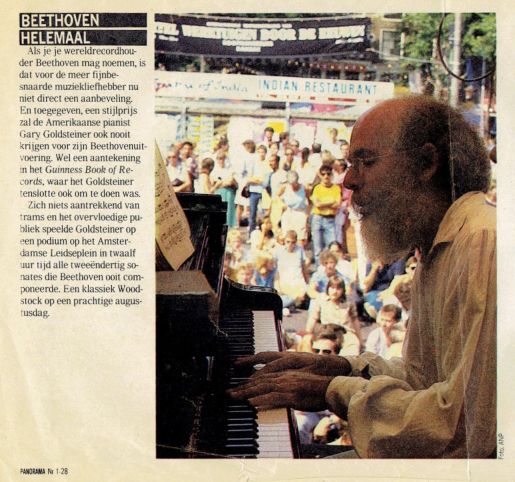
Today it is 40 years ago that American pianist Gary Goldschneider played all 32 Beethoven sonatas in one outdoor concert, on the Leidseplein in central Amsterdam. This obviously entirely crazy venture was promoted as the Beethoven Marathon, which was perhaps ill-advised, as it emphasized the athletic rather than the artistic. The August 19th 1984 marathon concert nonetheless had a huge impact. It changed The Netherlands, at least for that month, but perhaps even the decade. An estimated 10.000 people attended, and it was front cover news in pretty much all Dutch newspapers and magazines. It even made the prestigious six o’clock national TV news.

Mention in the overview of the most important events of 1984 in Panorama magazine, January 1985

Mention in the overview of the most important events of 1984 in Panorama magazine, January 1985

The concert was so unique, outrageous and attention-grabbing, that pretty much every Dutch person who was on the day of the concert in The Netherlands and old enough to read the press would remember it years, and even decades, later. Today many older Dutch people will still recall the event. I organized the concert, in six weeks, starting with absolutely nothing but an ambitious, outrageous, seemingly unattainable vision.

Dutch prime time TV crew on stage

Dutch prime time TV crew on stage during the concert

I already posted a brief blog about the Beethoven Marathon on this site on April 24, 2022,  describing the main details of the event itself. That blog only scratched the surface of what really happened. In fact, I have two stories to tell about the Beethoven Marathon. One is the story of how it came into being. This story traces what I was doing from the moment I first had the idea for the Beethoven Marathon, early May 1984 at 8am in a cafe in San Francisco, sitting at a table with someone who looked and talked like a madman, claiming that he was a reincarnation of Bach, Mozart, and Beethoven (no less), a genius (obviously) and had done two Beethoven Marathons, one in Philadelphia, and one in Nevada City, northern California.

Goldschneider during marathon

Goldschneider during the marathon

The other story partly overlaps with this one, but is far longer, and more personal. The Beethoven Marathon was the culmination of an epic one and a half year journey, both inward and outward. I’d spent that time hitchhiking around Europe and the US, encountering many more people who said and did things that were at prima facie completely pretty bonkers, but who also had slivers of truth and genius. Many of the dreamers, poets, and madmen I met on my journey, including one house-hold name rock star, seemed as sane if not saner  than most of the Dutch people I knew back home, and while they often told me things that seemed completely bizarre, some of it made perfect sense.

Add many meaningful coincidences, similar to the ones I encountered while organizing the Beethoven Marathon, and it led me to dramatically re-evaluate the deeply materialistic worldview I had until that point. I realized that I knew far less than I had hitherto assumed, and that I had to re-asses pretty much everything I had taken for granted. It taught me the value of ‘I don’t know,’ and to suspend judgment. Beginner’s Mind is the first requirement when hanging out with dreamers and poets, and particularly seeming madmen.

Altogether, the experiences were life-changing. For one and a half years I lived in a reality that was completely different to the one I came from in The Netherlands. I was exploring undiscovered territory and along the way discovering many inexplicable things that nonetheless seemed to be valuable. In some respects my journey was similar to that described in Joseph Campbell’s seminal book, The Hero With A Thousand Faces.

An essential part of a journey into the unknown, is having something to show for it when returning. In my case that was organizing the Beethoven Marathon. It gave substance to all the strange discoveries I had made, and to what otherwise would just have been a set of improbable stories and wild ideas without any consequence.

During concertI have long thought of writing a book about my journey, and how it culminated in the Beethoven Marathon. Instead I wrote a book about Miles Davis, and was for a long time busy writing, playing music, and raising kids. Now, as the kids are about to leave home and I have more time on my hands, it’s time to write down my story. It’ll be in the form of a series of blogs, with photos. Do return here soon if you want to read these blogs, and my story…


Gary Goldschneider’s Amsterdam Beethoven Marathon, August 19, 1984

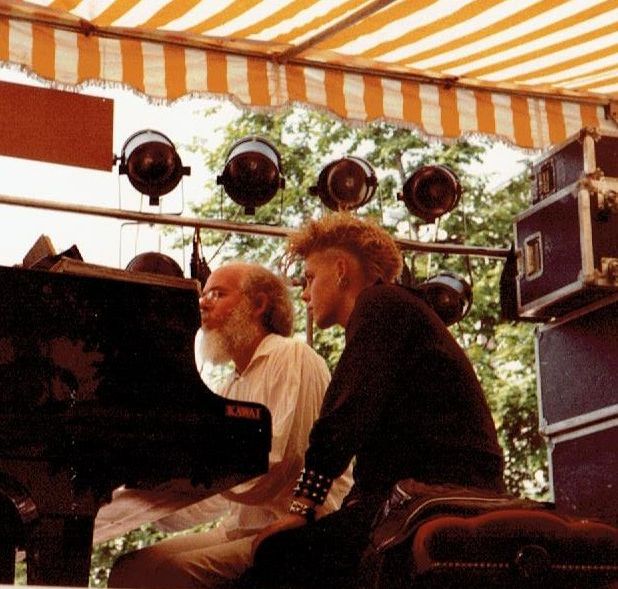
On August 19, 1984, American pianist, composer and author Gary Goldschneider made history. On a beautiful sunny Sunday, he played all 32 Beethoven piano sonatas, outdoors, with amplification, on the Leidseplein in Amsterdam. He started at 1pm, and a few short breaks aside, continued playing until 1am.

Goldschneider and I just before the concert

Goldschneider and I just before the concert

I had met Goldschneider in California, on May 13, 1984, and when he told me about the Beethoven Marathon on that day, I immediately had the Leidseplein in mind. I returned to Amsterdam early July 1984, with the plan for the marathon, but my friends in Amsterdam thought I had gone completely crazy and just laughed. And they worried about having to pick me up once the disappointment of a failed venture would sink in.

The story of how the Beethoven marathon came into being, to the complete bewilderment of my friends and pretty much everyone who saw it come into being, warrants an entire article, perhaps even a book. The concert ended up being sponsored by KLM Airlines, all cafes on the Leidseplein, and several other local organisations.

Despite widespread skepticism and eyebrow-raising, the concert was an astonishing success. The Dutch quality press was full of interviews with Goldschneider before the event, with major features appearing in NRC Handelsblad, Trouw, Haagse Post, and other news outlets.

nrcinterviewaug1984lr

On the 19th, the Leidseplein was full, and an estimated 10.000 people attended the free concert. Twelve page turners and dozens of press photographers were in action. Some people arrived from other parts of Holland early in the morning with fold-out chairs and books with the score for all 32 sonatas.

The concert was called a cross between a classical recital and a rock concert

The concert was called a cross between a classical recital and a rock concert

The concert was broadcast live by the only Amsterdam classical radio, the Concertzender, and at 5pm, to my utter surprise, a crew arrived from the prime time Dutch television news. They interviewed Goldschneider and myself, and the footage was broadcast on prime time TV several times that evening.

Dutch prime time TV crew on stage

Dutch prime time TV crew on stage

In the evening there were stage lights, and as Goldschneider continued playing, with trams passing by 30 yards away, and thousands of people watching with open mouths, the atmosphere turned truly magical.
Evening

The next day, there were reviews and reports in pretty much every single Dutch newspaper, and later in the week in every single weekly magazine. Some reviews were critical, but most praised the event, and Goldschneider’s playing. At the end of 1984, the concert was mentioned in many year-overviews in the Dutch press. The marathon had a huge impact on Dutch cultural life, and to this day, if you meet a Dutch person who has not heard of the event, you can be sure it’s someone born after 1974 or so, or who was on holiday on August 19th, 1984.

Billboard on the Leidseplein

Billboard on the Leidseplein

The concert also had an enormous impact on Goldschneider’s and my life. A year later we did the same feat again, with a Mozart marathon in a rain-drenched Vondelpark in Amsterdam. This time Goldschneider stayed in Holland, as he had fallen in love with the well-known culinary writer Berthe Meijer, and he ended up marrying her. I was best man at the wedding.

Goldschneider and I continued to work on getting his own music out to the people, and I organized several more concerts, and was involved in recording sessions at Yamaha Studios and Power Plant Studios in London. They led to a multi-million dollar contract offer from A&M Records, that was withdrawn at the latest moment for reasons that never really became clear.

Goldschneider and I after the concert

Goldschneider and I after the concert

Later, in 2001, I produced recordings of Goldschneider’s music with a full orchestra and him on piano, in Bulgaria. But by this time Goldschneider had become more known for his best-selling The Secret Language of Birthdays book, which ended up totally overshadowing his musical activities. I always thought this was a pity, as Goldschneider was a brilliant composer, and his Beethoven and Mozart marathons were genuinely boundary-breaking.

I plan to write at more length on the crazy and surreal events that surrounded my association with Goldschneider in 1984, and the years after. I’ll also publish many more press cuttings, including English translations, and many of the photos that I have. For now, below a few scans of the countless press cuttings that I have in my possession.

Interview in de Haagse Post

Interview in de Haagse Post

Interview in Trouw

Interview with Goldschneider in Keyboard magazine, 1985.

Interview with Goldschneider in Keyboard magazine, 1985.

Review in NRC Handelsblad

Review in NRC Handelsblad

Mention in the overview of the most important events of 1984 in Panorama magazine, January 1985

Mention in the overview of the most important events of 1984 in Panorama magazine, January 1985

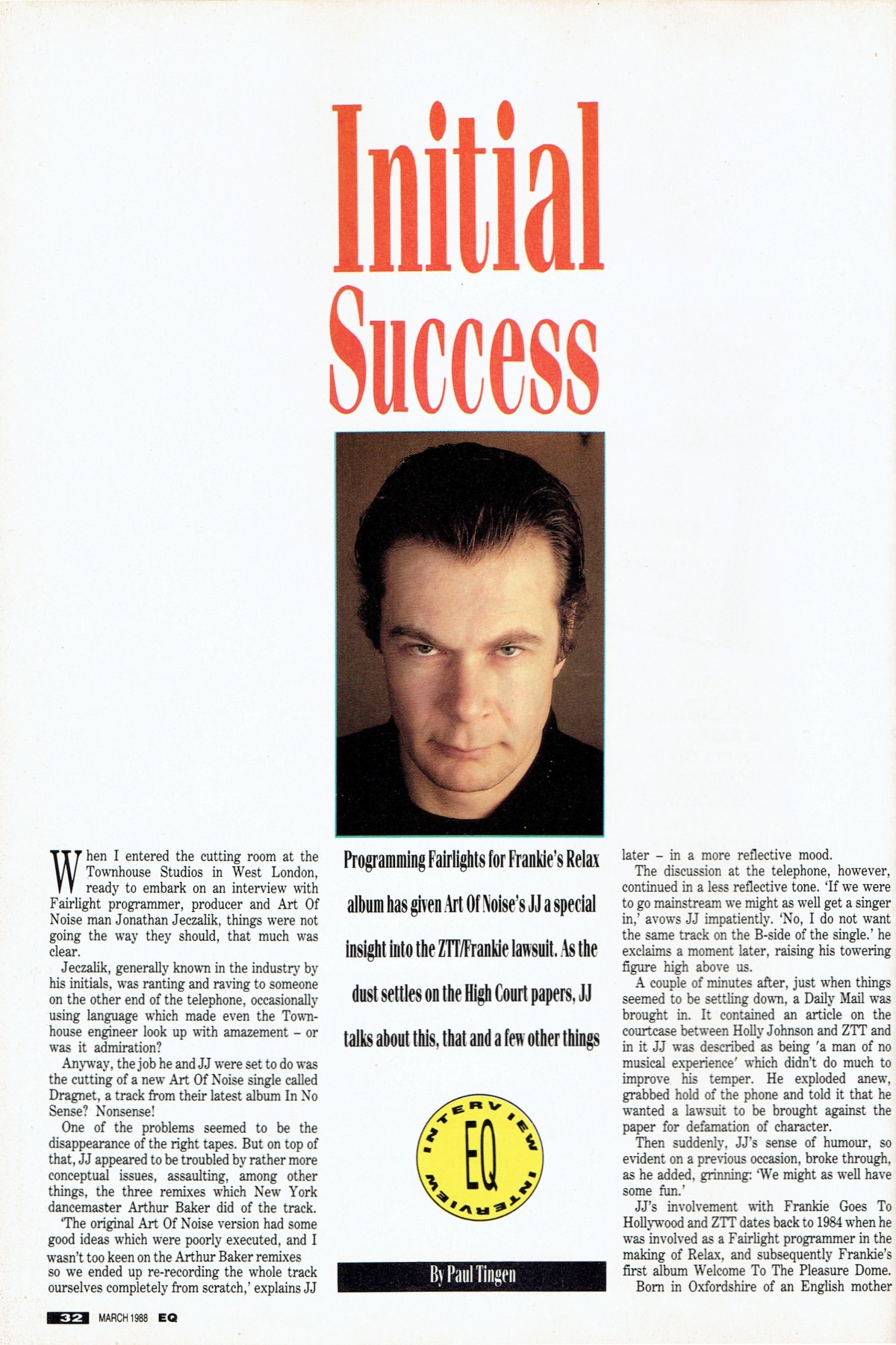
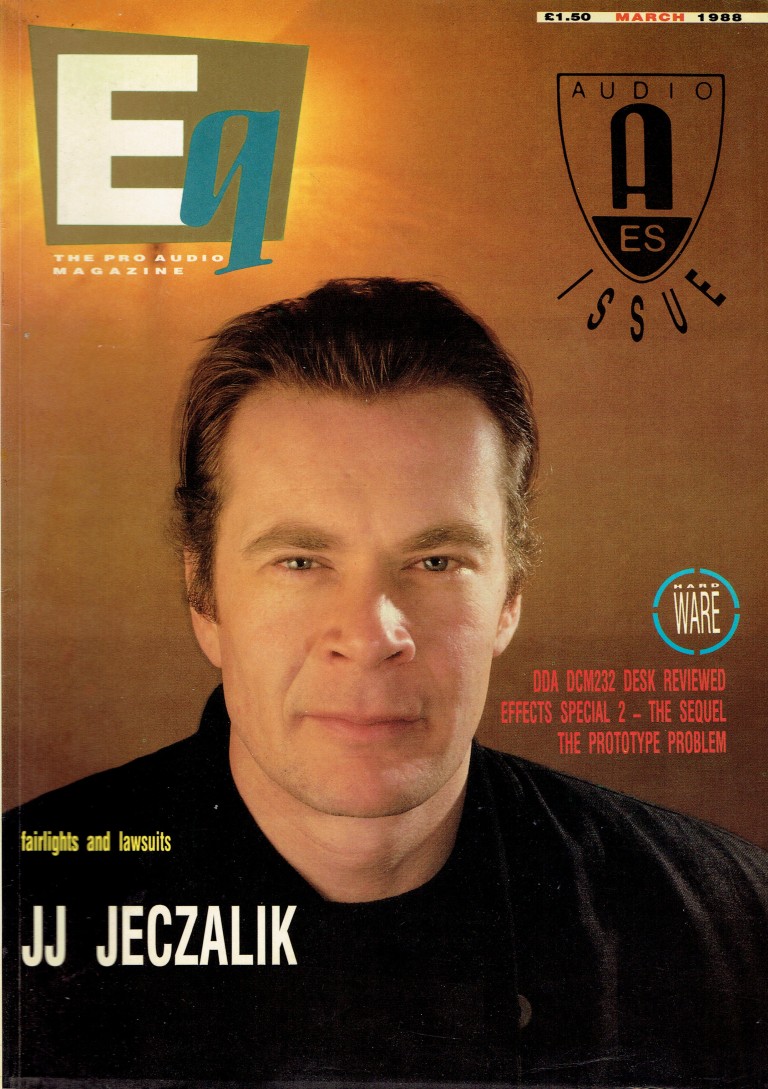
1988 – from the archives:JJ Jeczalik fumes about Fairlights and Lawsuits

JJcovertransparant500

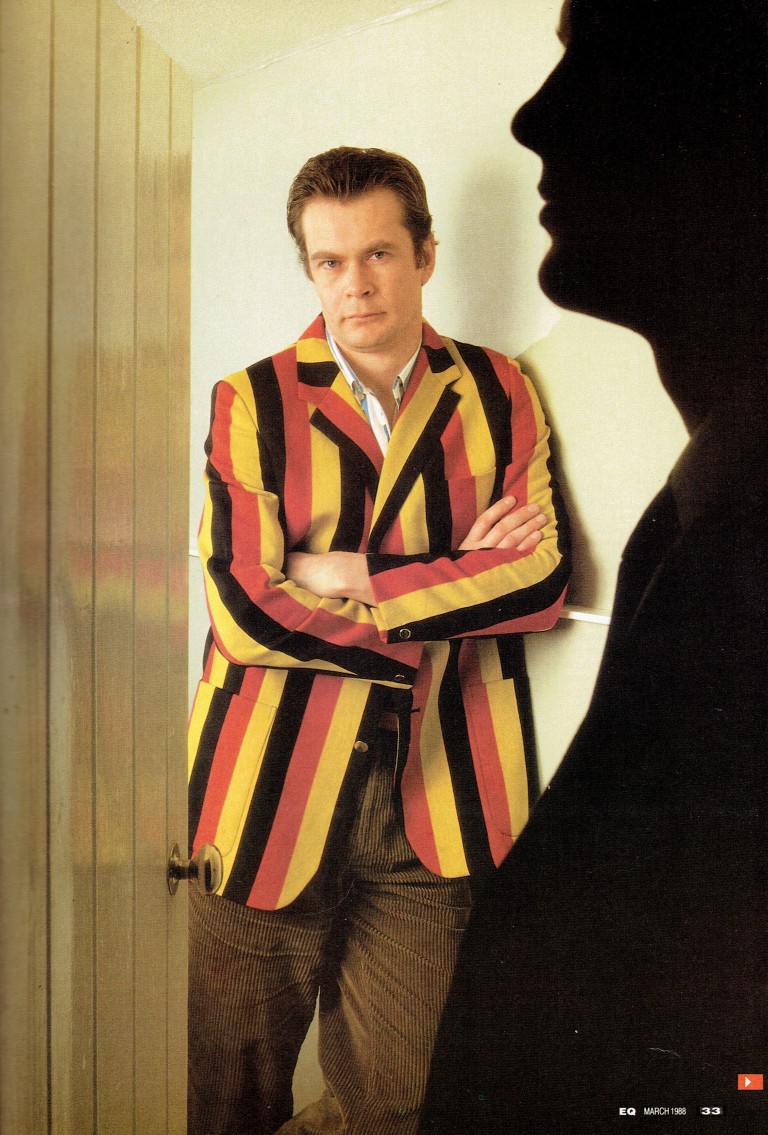
HERE’S A GEM FROM THE EARLY DAYS OF MY WRITING CAREER.  IT’S A COVER STORY IN THE MARCH 1988 ISSUE OF EQ MAGAZINE ON SELF-DECLARED “NON-MUSICIAN” JJ JECZALIK, WHO WAS A MEMBER OF THE ART OF NOISE AND PROGRAMMED THE FAIRLIGHT CMI SAMPLER ON MANY BIG 1980’S HITS, BY YES, ABC, AND MOST NOTABLY ON FRANKIE GOES TO HOLLYWOOD’S “RELAX.” THE HILARIOUS STORY EPITOMIZES THE HEADY DAYS OF THE 1980S, AND HOW EMERGING MUSIC TECHNOLOGY WAS ALREADY ROCKING THE VERY FOUNDATIONS OF THE MUSIC INDUSTRY. SMALL WONDER, GIVEN JJ’S BAD-TEMPERED STATE OF MIND AT THE TIME, THAT HE EVENTUALLY (RE-)TIRED FROM THE MUSIC INDUSTRY AND WENT ON TO TEACH IT AT OXFORD HIGH SCHOOL.

JJJ1JJJ EQ 1988 4 768widthJJJ EQ 1988 5 768width

Photos by Barry Marsden

The glossy pics were taken by Barry Marsden, and presumably commanded a hefty fee. Those were heady days for music mags as well!

JJJ EQ 1988 3 768width

Doc McKinney: working on The Weeknd’s Starboy

Doc McKinney in his Toronto studio. (Photo credit: Zoe Prinds-Flash)

CANADIAN PRODUCER AND GUITARIST ‘DOC’ MCKINNEY HAS WORKED WITH MANY BIG NAMES. ONE OF HIS MAIN ACHIEVEMENTS WAS CO-WRITING AND CO-PRODUCING THE WEEKND’S STARBOY ALBUM. FAMOUSLY MEDIA SHY, MCKINNEY LIFTS THE LID ON HIS WORKING METHODS IN THIS EXCLUSIVE INTERVIEW

Once upon a time—well, it does seem like an alternate universe these days—people wrote songs with pen & paper, and a guitar or a piano. As a general rule, songs were written by one or two people. However, it appears that with each development in music technology this number has gone up. The introduction of drum machines and samplers in the 1980s allowed non-musicians to write music, and to sample and/or reconstruct existing songs. This led to longer song writing credits as both the creators of the original sample and of the new work had to be credited.

The 1990s saw the rise of the DAW, which seemed tailor-made to create whole swatches of one-man bands and should have heralded an era of bedroom songwriters flooding the world with each song written, recorded and arranged by a single individual. Strangely, the total opposite has happened, in the pop/R&B genre at least, where songs are credited to ever-lengthening lists of song writers. The reason is that DAWs allow users to send each other files and work on them at the press of a button, with a crucial bit of help from that other bit of modern technology, the Internet.

These days the most common approach to writing pop, R&B, and hip-hop tracks is that someone comes up with a ‘beat,’ usually a combination of a drum pattern with some characteristic, hooky musical ingredient, which can be a sample, a chord sequence, or a melody. This is passed on to someone else who adds another musical bit, and so on. At some stage in the process the artist, or a topline writer, will add melody and lyrics. A sign of the times is that topline writers now form an entire subsection of the music industry. Meanwhile, the entire process is pulled together by a handful of producers, who sometimes, but not always, are the original beatmakers.

A scan of the vinyl version of The Weeknd's Starboy

A scan of the vinyl version of The Weeknd’s Starboy

A typical example of the ever-lengthening lists of song writers is The Weeknd’s third album and worldwide megahit, Starboy. Not one song on the 18-song album is credited to less than five writers, and a quite amazing 40 song writers are credited on the album in total. There also are between two and five producers per song, including well-known names such as Daft Punk, Diplo, Max Martin, Labrinth, and Benny Blanco.

A downside of this modern way of working is that quite a few pop/R&B albums with long lists of writers and producers end up as a disparate patchwork. By contrast, Starboy sounds remarkably coherent, like it was all cut from the same cloth. This is almost certainly due to the two creative people who were at the heart of its making. First and foremost there is The Weeknd himself, aka Abel Tesfaye, who is not only the album’s executive producer, but also is credited as a co-writer on all songs and as a co-producer on thirteen. At his side throughout most of the album’s making was Martin ‘Doc’ McKinney, who also acted as executive-producer, and who has a co-writing and co-production credit on 11 of the 18 songs.

On the phone from Los Angeles, McKinney confirmed that he played a central role in the making of Stargate, even as he was at pains to make sure that Tesfaye and the other contributors were given their due. “Abel is really hands-on and super-creative, and always working, and when I came into this record, there already were quite a few song ideas. Abel is a close collaborator with Max [Martin], and they had already recorded most of the two songs that were to appear on the album [“Love To Lay” and “A Lonely Night”]. Abel had also worked on the basics of the song he’d written with Benny [Blanco] [“Attention”]. Plus he’d been in Paris working with Daft Punk. So the making of this record was very different situation to that of the other records I have worked on with Abel.”

Cover of The Weeknd's first album

Cover of The Weeknd’s debut mix tape

Doc McKinney’s relationship with Tesfaye goes back to the beginnings of the latter’s career. McKinney co-wrote and co-produced, with Carlo Montagnese, aka Illangelo, five of the nine songs on The Weeknd’s debut mix tape, House of Balloons (2011). The two also co-produced all songs on The Weeknd’s follow-up, Thursday (both 2011). McKinny, unlike Illangelo, was not involved in the third mixtape, Echoes of Silence (2011), nor in the making of the Weeknd’s first two big label albums, Kiss Land (2013) and his international breakthrough Beauty Behind the Madness (2015).
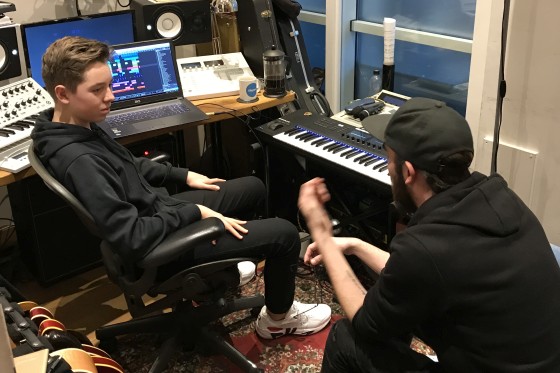
“I first met Abel very early in 2011,” recalls McKinney. “He had already been writing and recording with various people, and had put four songs on the Internet a few months earlier. Henry ‘Cirkut’ Walter and Adrien ‘AG’ Gough has been working on one of these tracks, as part of a production team that I was mentoring called The Dream Machine, and they told me to check Abel out. I invited Abel into my studio on January 1, and we very quickly established the kind of natural connection that occasionally happens in music between an artist and a producer or writer. I’m quite a bit older than him, I have two kids and a family, and his third mix tape had more sexual content and we didn’t seem to be able to get that right, so I dropped out of the making of that. We also didn’t manage to connect for his first two albums, but then he asked me to come on board and produce the new record.”

McKinney currently is 45 to Tesfaye’s 27, so there’s a generation difference between the two men. It meant that Tesfaye could lean into 25 years of music writing and production experience on the part of McKinney, who has therefore in places been referred to as his mentor. At the same time McKinney has throughout his career always been at the vanguard of music, and working with a younger artist like Tesfaye came and still comes very natural to him. He has said in another interview, “What people don’t understand about me is that I don’t give a fuck. I grew up punk rock as hell. I squatted on the Lower East Side of Manhattan when I was 13, 14.” And as a result, “I’m not motivated by money, so the music for me means everything. My main thing is developing artists.”

Doc McKinney in his Toronto studio. (Photo credit: Zoe Prinds-Flash)

Doc McKinney in his Toronto studio. (Click to see full-size. Photo credit: Zoe Prinds-Flash)

McKinney was born in Canada, but grew up in Minneapolis, where he started his music career playing guitar in punk-rock bands. It was during his first tour at age “13, 14” that he squatted in Manhattan. Growing up as a black kid playing guitar elicited sneering responses, but at least he could point to nearby guitar-slinger Prince as another example of music not being bound by skin colour. In 1994, in his early twenties, McKinney decided that there wasn’t much space for him to grow as a musician in Minneapolis, so he moved to Toronto. It was here that he began the duo Esthero, with singer Jenny-Bea Englishman—their debut album Breath from Another (1998) became a trip-hop classic.

From there, McKinney went on to work as a co-writer and producer with artists like Kelis, Raphael Saadiq, Stiffed, and Santigold. Because of his background as a musician and a guitar player, he says, “there’s a lot of room for me to be creative when I’m working with new artists. I definitely have a lot of ideas and like to be involved in every aspect. I collaborate on every aspect with the artists I work with, at least in the beginning stages.”

Although McKinney wasn’t involved in the beginnings of the making of Starboy, he was involved in all levels of its making: song writing, engineering, playing, programming, producing and executive producing. Some of the song writing with Tesfaye took place at McKinney’s own studio in Toronto. But for seven months they were based in Conway Studios in Los Angeles, where they had a lock-out of the entire studio and beatmakers and musicians were coming in and out and working in all rooms.

“Abel and I had not worked together for a long time, so we were initially just fooling around with ideas and playing with different sounds and from there beginnings of songs started to come together. He loves doing music, and he was also preparing for a world tour, so things were a bit crazy and we really had to work hard to make sure all the material was really strong. The modus operandi of how we wrote changed all the time. Some of the stuff he and I wrote from the ground up, some of it was built on ideas that he or I had previously, or we’d expand on ideas from other collaborators.”

The Weeknd and Daft Punk

The Weeknd and Daft Punk

Delving a bit more deeply into the song writing process, McKinney began by elaborating on the point as above, namely that song writing in pop and R&B is a very collaborative process. “Writing in pop and traditional song writing are very different now. Producers and beatmakers have turned into writers and anyone who contributes a musical idea gets a credit. It’s not like in country music, where one person comes up with the lyric and melody and chords and is the sole writer of each song. In contemporary pop many different producers add things to the production. If someone comes up with a cool two words, he’s a writer. So you now see many writers per song. The situation on Starboy is typical.”

“In the beginning, it was just Abel and myself working at my studio. He’s a very strong song writer, but he likes to collaborate with many different people. So at Conway we had a core team, of Abel, Ben [Billions, aka Benjamin Diehl], Cashmere, Cirkut, and then other people dropped by, and they’d be writing and doing production in different rooms. Sometimes all three rooms would be filled, but a lot of the time it was very empty. Abel is very private. But most of the production took place at Conway, and then obviously Daft Punk did their thing in Paris, Max Martin at his compound, Benny in New York, and so on. But many of them also came to Conway at some stage.”

Mckinney elaborated on how a number of the most striking songs on Starboy came into being, like for example the guitar-driven and punk-like “False Alarm.” “That was one of the first ideas Abel and I developed when we got back together and were writing. We were just talking and listening to music and then we got a vibe we’d start wailing away on guitars or keyboards or drums. That song in particular started out as a punk jam session, with me on guitar. So yes, many songs resulted from actual playing, rather than programming, and musician friends of ours would drop by and play along, vibing with us. We were not serious about trying to create a pop song or a punk song. We were not trying to fit things into genres. Instead we just tried to make great music and create something that made us feel something.”

Another guitar driven track, sporting a number of guitar solos, is “Sidewalks.” “That’s me playing the lead guitar! I also play some of the guitars in ‘False Alarm’.’ I rarely credit myself for instruments on records. I don’t like these credits that go like, ‘hi-hats programmed by X, bass in the bridge by Y.’ It’s too much. But ‘Sidewalks’ started with an idea I laid down maybe a year earlier, together with a producer called Bobby Raps, and I did the drums and guitar and Bobby killed the bass line. Abel liked it, so we worked on getting it to the next level. We got Ali Shaheed Jones-Muhummad from A Tribe Called Quest in who did some cool orchestral stuff on it, and Kendrick [Lamar] did an amazing job. I was stressed out, because he wanted to start tracking so fast, and I was still in Ableton, so I had to cut his vocals in that. Ableton is not an ideal DAW for cutting vocals on, but of course it came out amazing.”

Daft Punk as they appear in the "Starboy" video

Daft Punk as they appear in the “Starboy” video

Sometimes extraneous elements made it to the album, for example the Ethiopian vocal sample from Aster Awake that connects the songs “False Alarm” and “Reminder.” The sample is a reminder of Tesfaye’s Ethiopia roots, but Ethiopian music is not otherwise an influence on Starboy. Nonetheless, explained McKinney, Tesfaye’s love of Ethiopian music was “another chamber of inspiration. As we tried to create the story of the record we put that in because thought it sounded cool.”

And most of all there are the eye- and ear-catching two tracks co-written and co-produced by Daft Punk, which bookend Starboy. These two songs were the opening title track, which was the lead single from the album, and the album closer “I Feel It Coming,” which sounds like an out-take from Random Access Memories. In an interview with Zane Lowe, Tesfaye explained that on the last song in particular Daft Punk were trying to get as vintage as possible, going as far as using vintage mics and signal chains, similar to the way Random Access Memories was a homage to the funk and soul music of the 1970s.

Many questions have been asked of those who worked on Starboy about the working methods of the secretive French duo, but McKinney said that he couldn’t elaborate much. “Abel had already worked on “Starboy” with them in Paris, and they got the bulk of it down. Cirkut and myself then did some additional stuff on it, and when the Daft Punk guys came over we put the final touches on it. They recorded ‘I Feel It Coming’ in LA with live musicians, but I was not at those sessions. We also then finessed that track together at Conway.”

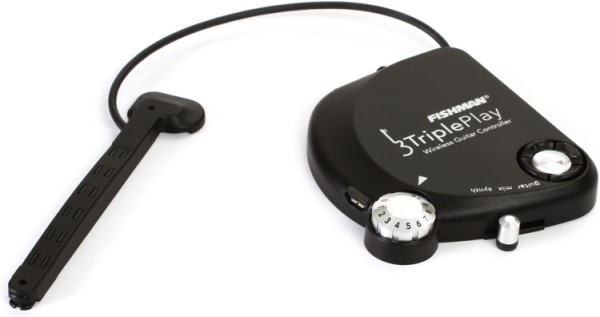
The Fisman Triple Play, McKinney's preferred guitar midi interface

The Fisman Triple Play, McKinney’s preferred guitar midi trigger

Having already referred to his use of Ableton, McKinney went into more detail on his tools of the trade. “I’ve been primarily working Ableton for the last 10 years, even as I also use Logic and Pro Tools. Ableton is very transparent for writing and production. It’s very flexible when you’re changing things like pitch and tempo. But if I was scoring a movie, I’d use Logic, which is great for midi and composing. Pro Tools is the best for cutting live instrumentation and vocals. Many different people cut Abel’s vocals for this record, by the way. If the spirit catches him, every way works for him. If I recorded him, I used a vintage Neumann U67, which sounds amazing on him, and a Urei 1176 Blue compressor. Sometimes a Shure SM7 or SM57 also works great on Abel. But Max Martin or Daft Punk might have used a different mic and recording chain.”

A very unusual aspect of McKinney’s approach to writing and arranging is that he does everything on a guitar, as opposed to the keyboard midi trigger virtually every other beatmaker uses. “I use a midi guitar to do all the keyboards and even the drums. I also have real drums, bass, and keyboards in my studio, but whether I use them depends on what the project needs. My midi trigger is the Fishman Triple Play, which has the fastest latency of any midi guitar, short of the ones that work with buttons. I’ve been working with midi guitar for so long that I’m used to latency, but the Fishman is totally workable. I used it a lot on this album, as well as playing regular guitars. I’m lucky that Abel is a big fan of guitars, so many of the ideas we came up with started on guitar.”

McKinney continued his exposé of the making of Starboy by explaining that virtually all tracks on went through a process of lengthy and repeated re-writing and re-arranging. “With artist-driven records, like this one, you often come up with you’re the basis of your songs with a core of collaborators. Sometimes it takes five minutes to come up with a melody and a chorus, but then after that you can play around with that for a week or a month or longer. You keep making changes to the vocals and sometimes the song itself, until the very end. Sometimes we’re close to the end, and the bridge still hasn’t been written, or it’s not quite right yet. And then you have that moment of inspiration. We play with pitch, tempo, sometimes we try a melody or a song over a trap beat or a house beat or whatever. You’re constantly playing with the song. The production may change, the key may change, and inspire another change, and so on.”

Antares' AutoTune plugin, indispensable and ubiquitous on modern pop records

Antares’ AutoTune plugin, indispensable and ubiquitous on modern pop records

One major production decision was the extravagant use of Antares’ Auto-Tune on Tesfaye’s vocals, despite the fact that he’s an excellent singer whose vocals don’t normally need tuning. “We had lots of conversations about this, remarked McKinney. “Abel’s voice is beautiful and he can sing, so he doesn’t normally need Auto-Tune. Instead we used it to creating a certain vibe. It was not about trying to sound cool. You can be a great guitar player on the acoustic guitar, or you can be a great electric guitar player. They are two different things. It’s the same with singing with or without Auto-Tune. In the case of a song like ‘Sidewalk,’ which has a classic soul type sound, there have been so many soul-type covers with that vocal style, for Abel to have sung that without AutoTune would have made it sound derivative. So yes, it did also help make the record sound more current.”

Making the album sound current was one major brief during the making of Starboy, but by the end of the seven-month gestation process at Conway there was another concern. McKinney and Tesfaye now had whittled the writing process down to 18 songs, often in very different styles, with substantial parts of the sessions recorded in various places across the world. Pulling it all together into a cohesive whole was a substantial challenge.

“Practically speaking we spent a lot of time on what we called pre-mixes, with for most tracks Cirkut doing rough mixes in the box before he handed things over to the two mix engineers, Manny Marroquin and Serban Ghenea. Cirkut likes to work in Cubase, and before things were sent off for the final mix they were transferred to Pro Tools. But 18 songs is a lot of material, and to draw that all together was difficult. There are few other artists, perhaps only Prince and Michael Jackson, who can go from pop to rock to hiphop and be convincing. Fortunately Abel also is comfortable in all these genres, and he has the ability to use different aspects of his voice and different vocal sounds. We also had a great team and we were working in a great facility, , continually chipping away at things, carving things out and so on. But most of all, Abel has the ability to still be excited about songs after five months of working on them and to keep things fresh. He really is a visionary.”

© 2017 Paul Tingen.

Previously published in Audio Technology (Australia) and as the cover story of Sound & Recording (Germany) magazines in 2017.

The Making of the Justin Bieber “Despacito” Remix

bieberrecordplant600

“DESPACITO WAS THE BIGGEST SUMMER HIT OF 2017.  ITS ENORMOUS SUCCESS WAS MADE POSSIBLE WITH SOME HELP FROM A CERTAIN JUSTIN BIEBER AND HIS ENGINEER AND MIXER JOSH GUDWIN. IN THE EXCLUSIVE INTERVIEW BELOW, GUDWIN RELATES THE INSIDE STORY OF THE MAKING OF THE BIEBER VERSION OF “DESPACITO,” INCLUDING HOW HE MIXED THE TRACK IN AN AIRPORT LOUNGE.

“Despacito” was the second best-selling single of 2017 (after Ed Sheeran’s “Shape Of You”) and broke many records as a rare example of a worldwide hit sung in Spanish. The song was a number one in over 40 countries, in many cases hogging the top spot for weeks, if not months. In Australia it spent 16 weeks at #1 on the Aria singles chart, and in the US 15 weeks at the top of the Billboard singles charts. Already last July, “Despacito” was declared the most streamed-song in history, and one unexpected illustration of the impact the extraordinary success of the song has had is that it has reportedly increased tourism to Puerto Rico this year by a staggering 45%!

One of many publicity shots of Louis Fonsi and Daddy Yankee for Despacito

One of many publicity shots of Louis Fonsi and Daddy Yankee for Despacito

The latter is the result of the fact that the original version of the song was released in January of 2017 as a single by Puerto Rican singer Luis Fonsi, featuring fellow Puerto Rican rapper Daddy Yankee (the two co-wrote the song with Panamanian singer and songwriter Erika Ender). This original Spanish language version already was a big hit in most of South America by the time it received the Midas touch from Justin Bieber, and his trusted right-hand studio man, Josh Gudwin. As has been the case with several other songs during the last two years, Bieber’s involvement steered “Despacito” into the worldwide stratosphere, adding to the singer’s seemingly endless chart presence, with the top of the singles charts everywhere often featuring several songs that bear his name.

Bieber’s astonishingly high-profile run as a featured guest singer started in 2016, after the staggering success of his fourth album, Purpose, released in November 2015, which itself spawned four big, worldwide hit singles—“Where are Ü Now,” “What Do You Mean,” “Sorry,” and “Love Yourself.” Since then Bieber’s involvement helped propel songs to the top like Major Lazer’s “Cold Water,” DJ Snake’s “let Me Love You,” “Despacito,” DJ Khaled’s “I’m The One” and most recently David Guetta’s “2U.” Gudwin was the main engineer, the mixer and the album producer on Purpose, and also was at Bieber’s side for the recording and production of the singer’s vocals in each of the above-mentioned guest appearances. Gudwin called these collaborations “strategic planning,” that help keep Bieber in the public eye.

Josh Gudwin. Photograph by Brian A. Petersen.

Josh Gudwin. Photograph by Brian A. Petersen.

According to Gudwin, all Bieber’s collaborations came into being in a different way. In the case of his and Bieber’s “remix” of “Despacito” it involved the epitome of 21st century album-making, with Gudwin flying around the world with just a laptop, an expansion chassis, and headphones, editing and mixing on them, with files being sent around the world via the Internet. The entire process, from the first phone call on April 11 to the remix release on April 17, taking a mere six days! Via Skype from his mix room at Henson recording studios, Gudwin retraced one of the most intense weeks of his already extraordinarily busy music career, which started with a phone call from Bieber’s manager, Scooter Braun, just as Gudwin was preparing to go on holiday.

“Last April, Justin was on tour in South-America and heard the song. He really liked it and wanted to do a remix. So when he was in Columbia he called Scooter, and on Tuesday, April 11th, Scooter called me, saying: ‘have you heard from Justin? He needs you to cut this remix for him.’ I asked whether it could wait until Monday when I’d be back from a short holiday I had booked to go to Parrot Cay, at the Turks and Caicos Islands in the Caribbean, but the answer was, ‘please go to Bogota tonight if you can.’ So I took a 3am flight from LA to Bogota, took a nap after I arrived, and went straight to Estudios Audiovision there to meet Justin.”

Back in LA, while Gudwin was on his way to Bogota, Jason “Poo Bear” Boyd, one of Bieber’s main writing collaborators on Purpose, was working on the melody and lyrics for Bieber’s contribution to “Despacito.” By the time Gudwin and Bieber arrived in Audiovision, the vocal producer and mixer had received Boyd’s outlines for Bieber to work with, as well as an instrumental version of “Despacito,” and Bieber and Gudwin were ready to go.

Josh Gudwin looks on as Justin Bieber sings a take at the Record Plant in LA. This picture was taken during the sessions for the Purpose album.

Josh Gudwin looks on as Justin Bieber sings a take at the Record Plant in LA. This picture was taken during the sessions for the Purpose album.

“I always travel with my laptop and an expansion chassis with HDX and UAD cards, which fits in a small duffle bag,” explained Gudwin. “So I plugged my laptop in the studio’s I/O and looked around Audiovision for mics and mic pres. They had some nice vintage mics there, and I picked a Neumann U47, a Neve 1081 mic pre and a Tube-Tech CL1B compressor to record JB with. It’s a chain I also used to record his vocals on Purpose. Justin and I then worked on the parts, with help from Juan Felipe Samper, who coached him with his Spanish pronunciation. After four hours we were done. I went back to the hotel, comped the vocal, did some last-minute bounces for Justin, so he could listen to what we had done, checked out of the hotel, and flew to Miami, on my way to Turks and Caicos.”

The recording session in Bogota was only the start of Gudwin’s work on the remix of “Despacito.” Next up were re-arranging and remixing the song, all of which he did while he continued to be on the road. Gudwin is an eminent vocal producer, who has studied with the great Kuk Harrell (Mary J Blige, Rihanna, Celine Dion), but for logistical reasons he sent his vocal comp of his recordings of Bieber’s vocals to Chris “Tek” O’Ryan, an engineer who also has a stellar reputation as one of the world’s foremost vocal producers, and who specializes in vocal tuning—something which he has done for the likes of Bieber, Katy Perry, Mary J. Blige, Ciara and Mariah Carey. Fitting Bieber’s comped and tuned vocals in with the track also involved some re-arranging work. For this, Gudwin worked with a stem version of the original mix session, which had been conducted by LA star mixer Jaycen Joshua.

AA Club at Miami Airport

American Airlines Lounge at Miami Airport

“I had a five-hour lay-over at Miami International airport before my connecting flight to Parrot Cay,” revealed Gudwin, “so while I was waiting in the American Airlines lounge I completed re-arranging the track and mixed it. I was working on my laptop with the expansion chassis, and on Audio Technica ATH-M50 headphones, which sound great. I did not record any instruments for the remix. I adjusted the levels of some of the instrumental parts and needed to arrange and mute parts of the original vocals to make space for Justin. The beginning of the song belonged to him! I also turned up the levels of some stems, like of the guitars and the timbales. I did this using clip gain, and did nothing else. I did not use any EQ or things like that. I was not going to change a great mix!”

DESPACITO: THE MIX SESSION

An overview of the edit window of Gudwin's "Despacito" mix session

An overview of the edit window of Gudwin’s “Despacito” mix session

Gudwin’s “remix” Pro Tools session of “Despacito” totals 67 tracks and is very tidily laid out, with Jaycen Joshua’s stems at the top (37 tracks), then the new vocal tracks Gudwin mixed in (12 tracks), next his vocal aux tracks (13 tracks), and finally his master track. Joshua’s stem tracks break down in the instrumentation, which was realised by producers Mauricio Rengifo and Andrés Torres and include some guitar/cuatro parts played by Christian Nieves. The instrumental tracks consist of 8 percussion stems (yellow), 5 guitar stems (blue) and 11 synth and sample stems (green). Louis Fonsi and Daddy Yankee’s original vocal stems take up another 13 tracks (red), plus three reverb stem tracks (grey-green), which are prints from Joshua’s Bricasti and Lexicon 480L outboard units. Gudwin’s sonic contribution to the “Despacito” remix centers on the way he treated Bieber’s vocals (light green and light blue), as well as some new English vocal tracks by Fonsi in the third chorus (red), and on his master bus chain.

All Bieber’s vocals are sent to the $JB BUSS$ group track (purple) at the top of the new vocals section. This group track has most of the processing, with six inserts and five effect sends. JB’s vocal tracks are numbered 01-08, with 03 being his main intro vocal part, with a couple of words pulled out to track 04, for a different EQ. Tracks 01 and 02 (in light green) are individual words with SoundToys EchoBoys delay throws, one ¼ note and one 1/8 note, while track 08 is a copy of Bieber’s entire vocal part, which has the Waves REQ4 and Doubler, for a vocal widening and doubling effect in the background: the level of the track is pulled down to -20dB. The plugins on Bieber’s vocal comp tracks, 01-08, consist of just three instances of the FabFilter Pro-Q2 EQ and one Waves RDeEsser. Gudwin explained the nature of the heavy lifting on the group track…

Justin Bieber's vocal tracks in the Despacito mix session

Justin Bieber’s vocal tracks in the Despacito mix session

“First in the chain is the UAD SSL E-Series Channel Strip, doing some light compression [Ratio 3, Threshold -12], and light EQ [approx +2dB @4.5KHz and -3dB@250Hz], then the UAD LA2A Silver to smooth things out [peak reduction is 25], the Waves C6 multiband compressor with some very light EQ with compression, the Pro-Q2 fixes some weird things that were brought out by the C6 [it has a hi-pass with some cuts in the low mids], then the Waves Rcompressor again does some super-light touching [Ratio 2.13, threshold -11.1], and the FabFilter De-esser takes away some high frequencies [at 7KHz and 14KHz]. That’s it on the inserts.”

Effects on Bieber's voice

Effects on Bieber’s voice

“The sends go to a series of aux tracks that are pretty standard. Everyone uses combinations of this stuff. The first send goes to the HALL aux, on which I have the UAD EMT140 and a UAD Harrison 32 EQ. Then there’s the PING SHORT aux which has the Echoboy, Air Chorus and Waves RVerb, the 1/8 aux with the Waves H-Delay, the WIDENER aux with the SoundToys Microshift for some width and Brainworx bx_digital for a bit of an MS effect, and the DIMENSION D aux with the UAD Dimension D chorus, and Waves REQ4 and RCompressor. Other aux effect tracks which I did not use, but which are part of my template, were the PLATE aux, with the UAD EMT 140, the MILLI aux with the Waves Trueverb set to a ‘millennium’ preset, half and quarter note aux tracks both with the HDelay, and a PING MOO aux with the EchoBoy, Waves Enigma modulation effect and RVerb. There are also are SPACE FLANGE and UNDERWATER aux tracks which everyone has who’s worked with Dave Pensado.”

“I actually finalised the mix while I was on the islands, on Parrot Cay, where I was working on a Bose bluetooth speaker. I sent it out for approvals, and then first needed to make some changes, because I got a new vocal by Louis [Fonsi] while I was there, with the English text written by Marty James. Once Louis heard Justin on it, he wanted to add something himself, so I added that at the last minute. Louis’ vocals are called V and VDbl in the session, and they came in tuned. They already had the Waves D3 DeEsser on it, and the RVox, so I kept them. I then added the SSL E-Channel, the C6 and the Pro-Q2. They’re all doing light things, because Louis’ vocals also go back through the main $JB Buss$ again.”

Plugins on the Master Bus

Plugins on the Master Bus

Gudwin’s master bus chain is different from Jaycen Joshua’s, which explains why the remix of “Despacito” sounds slightly different than the original. Gudwin elaborated. “The chain starts with the UAD Neve 33609 compressor. I go back and forth between that and the SSL compressor.  Then the signal goes through the Plugin Alliance HG-2 Black Box, which has two virtual 12AX7 tubes, and adds a kind of tube vibe. It’s a cool box that lifts everything up a bit. The UAD Brainworx bx_digital V3 does some light MS processing to bring some of the elements on the side forward, and spread things out a bit. The iZotope Ozone 7 Stereo Imager also helps to widen the image. Finally there are the FabFilter Pro-L and UAD Sonnox Oxford Inflator for more volume. You also can put the Inflator before the Pro-L, it works both ways.”

“I take the Pro-L off when I send my mixes for mastering, but I sometimes also include it as an option. With the Inflator I set the Effect between 5 and 15 and the Curve between 5 and 10. When you go light on it, it still works. With the Pro-L I start with a preset, and I’ll tweak it if I need to. The song was mastered by David Kutch, who also mastered the original, who told me that he used slightly different settings on our remix than he had on the original.”

End of main article.

ABOUT JOSH GUDWIN

Josh Gudwin. Photo by Sam Agbesi

Josh Gudwin. Photo by Sam Agbesi

For a long time Josh Gudwin wrote and played music as a hobby, mostly playing guitar. He spent some time in the Marines, and it wasn’t until after this, when he went to college in Miami Dade and a teacher suggested that he make a career out of it, that he took it serious. He attended Florida’s Full Sail University for a year in 2005/6 and then moved to LA to pursue a career as an engineer and mixer. His first step was to be an intern at Track Record Studios, then an assistant engineer at the Record Plant, where he worked with songwriter Esther Dean. He later worked for two years with top vocal producer Kuk Harrell. A recording session with Justin Bieber in 2010 changed Gudwin’s career path, and he has worked on almost every Bieber release since then.

When he’s not working with Bieber, Gudwin is engineering, (vocal) producing and mostly mixing for others. He currently works from his own room at Henson Studios in LA, where he monitors using ATC SMC25A, NS10 and little Bose Freestyle monitors, and where he has a small but choice collection of outboard, including preamps, compressors, a summing mixer. His recent credits include Diplo, Skrillex, Blood Pop, Carla Rae Jepsen, Pete Yorn, Dua Lipa, Bebe Rexha, and 5th Harmony.  At the time of writing Gudwin’s mix of Dua Lipa’s most recent single, “New Rules,” was a number one in the UK and a #15 in Australia.

Gudwin’s gear at his studio in Henson: Avid HD io 8x8x8, Apogee Symphony 16 io, SPL Mix Dream, BURL B2, Bricasti, Neve 1073, API 3124, ALTEC 1566a, Dolby 740, Retro 176, Tube-Tech CL1b x2, Crane Song Avocet, LG 34” Display, Modular Synthesis.

© 2017 Paul Tingen.

All Despacito screen shots in original resolution

Download all Despacito screen shots of both full mix and edit windows and the above plugins, in original resolution

+LMNTS

+LMNTS, aka The Elements, are a music duo consisting of my teenage sons Joey and Raphael Tingen. The  guys are mostly inspired by modern pop, EDM, and hip-hop/R&B, and have garnered interest and kudos from people working closely with Justin Bieber, Beyoncé, Kendrick Lamar, Zedd, Future, Gotye, Adele, Rihanna, Coldplay, and many, many more (see below).

They released their first single, “My Dream Was,” in June 2017. To date they have self-released eight singles on our label In.No.Sense, all with videos, apart from for “Lockdown.” Since 2020 they are managed by Evolved Artists, and a release on a major US label is imminent. The music videos are below, in reverse order. It includes a registration of a live concert they gave in Alyth in Scotland. There’s more music on their Soundcloud page. Enjoy!

Look out for more releases in 2019 by The Elements on our label In.No.Sense.


As mentioned above, Joey and Raphael have been mentored and advised by some pretty high-profile guys, who work with the likes of Beyoncé, Kendrick Lamar, Justin Bieber, Dua Lipa, Zedd, and many more. Here’s Raphael at Tileyard Studios in London, in January 2018, with top producer Paul Whalley, who worked with Ellie Goulding, Little Mix, amongst many others.

Rafa and Paul Whalley

Here are Joey and Raphael in June 2018, talking to EDM star Niles Hollowell-Dhar, aka KSHMR.

Kshmr

And here, in August 2017, they are receiving Skype coaching from Josh Gudwin, producer, engineer and mixer of Justin Bieber.

Joey and Raphael talking to Josh GudwinFinally, here’s Joey in December 2016, doing work experience with star mixer and producer Alan Moulder (Nine Inch Nails, Arctic Monkeys) at Assault & Battery Studios in London…

Joey with Alan MoulderPlus a collage of some pics from further in the past. Top: Raphael and Joey in Sonic Vista Studios in Ibiza in 2015. On the left Raphael sits in the studio, and on the right both boys, aged 13 and 9 at the time, receive instructions from studio owner Henry Sarmiento (Lady Gaga, David Guetta). Bottom: on the left Joey and top pop mixer Manny Marroquin (Post Malone, Rihanna) are pulling faces while listening to something, and on the right Joey and Raphael with legendary mixer Jack Joseph Puig (Black Eyed Peas, U2). The bottom two pics were taken at La Fabrique in France in 2013, when they were still only 11 and 7.

rafajoeypast560


Commentaires

Nicola

« Elena offre l’une des meilleures expériences de yoga auxquelles j’ai eu le plaisir de participer. Son instruction calme, claire et consciencieuse s’étend sur les muscles que je n’ai jamais réalisés que je les avais et sa belle voix apaisante complète la classe avec la relaxation parfaite. Elle est spécialement qualifiée. »

“Elena offers one of the best yoga experiences I have ever had the pleasure of participating in. Her calm, clear and conscientious instruction stretches muscles I never realised I had and her beautiful soothing voice rounds off the class with the perfect relaxation. She is uniquely skilled.”


Françoise

« Depuis Septembre 2016, j’en fait une heure par semaine avec Elena. J’aime beaucoup ses cours, j’y vais avec plaisir, et j’en ressors à la fois détendue et pleine d’énergie. J’avais imaginé que le Yoga était une séance “relaxation”; c’est en partie vrai, mais en fait, cela demande beaucoup d’énergie.Cependant, ces séances permettent de s’étirer au maximum, de faire travailler la souplesse, et tous les muscles, même ceux qui ne sont pas souvent sollicités. Enfin, grâce à un système de respiration mis en place, et à la lenteur des exercices, cela permet de travailler en profondeur, et en conséquence, d’apaiser les tentions et les douleurs. Contrairement à ce que je pensais, pour moi, les cours de Yoga sont plus efficaces que la gymnastique traditionnelle, car cela fait travailler le corps, mais aussi la concentration, et de plus cela permet d’apaiser l’esprit. »

“I started doing yoga with Elena in September 2016. I love her yoga sessions. When I leave I’m full of energy and very relaxed. I had imagined that yoga would be for relaxation, and this is partly true, but in fact it requires a lot of energy. It helps me gain physical strength, and flexibility. It seems to me that she makes us exercise every muscle, even those we rarely use! Elena guides us with our breathing as well. This together with the gentle pace of the exercises allows me to excercise my body on a deeper level, and as a consequences any the tension and pain are greatly eased. Contrary to what I had expected, Elena’s yoga sessions are more efficient the traditional gym, because we work not only with the body but on concentration, which calms the mind.”


Adam

« Elena est une superbe enseignante. C’est une classe petite et amicale, animée par sa gentillesse et son humeur éclairante. L’ambiance général est tranquille et calme. Elle a la capacité de le porter au niveau de compétence de chaque élève. Au début de chaque séance, elle explique dans quelle partie du corps la classe se concentrera. Le rythme est facile à suivre, mais après une heure ou deux, je me suis retrouvé légèrement suant, mais je ne me sentais pas pressé ni trop exercé. Elle nous rappelle de bien respirer et nous enseigne «la respiration yogique», qui peut avoir un effet physique et mental remarquable après une heure environ. Elena nous montre la séquence et nous suivons au rythme qui est réalisable, même pour les débutants ou ceux qui ont des corps peu parfaits. Elle accompagne La séquence avec des instructions verbales qui sont faciles à suivre. Personnellement je trouve que les niveaux de concentration peuvent être très profonds, mais chaque semaine est différente. Parfois, Elena présentera une nouvelle posture. Les postures sont faciles à apprendre, et elle prendra le temps de rompre celle-ci. ; a ce stade, si un étudiant a besoin d’aide individuelle, elle intervient sur cette base. J’aime la détente à la fin de la séance. Comme le dit Elena, elle veut que les étudiants de tous les niveaux expérimentent le yoga, plutôt que de parler de yoga, alors n’attendez pas beaucoup de «blah blah». Je recommande absolument les cours de yoga d’Elena – pas de stress, seulement des commentaires positifs. »

“Elena is a super teacher. It’s a small & friendly class, animated by Elena’s kindness & light-hearted good humor.  The overall tone is quiet & calm. She has the ability to pitch it to each student’s level of ability.  At the beginning of each class, she explains what part of the body the class will be focusing upon. The pace is easy to follow, though after an hour or so, I found myself lightly sweating but not feeling rushed nor overly exerted. She reminds us to breathe & teaches us ‘yogic breathing’,  which can have a noticeable physical & mental effect after an hour or so.  Elena shows us the sequence & we follow at pace which is achievable, even for beginners or those with less than perfect bodies. She accompanies the sequence with verbal instructions which are easy to follow.  I personally that the levels of concentration can go pretty deep, though each week is different. Sometimes Elena will present a new posture, where she will take time to break this new posture down into easy to learn chunks; at this stage, if a student needs individual help, she will intervene on an individual basis.  I enjoy the relaxation at the end of the class. As Elena says, she wants students of all levels to actually experience yoga, rather than talk about yoga, so don’t expect much ‘blah blah’.  I totally recommend Elena’s yoga classes –  no stress, only positive feedback.”


Ruth

« J’ai exercé régulièrement tout au long de ma vie, mais ce sont généralement des entraînements cardio-vasculaires et des courses. Le yoga est une expérience nouvelle pour moi, et j’aurai aimer commencé quelques années avant, c’est incroyable pour le corps et l’esprit. Elena est une enseignante merveilleuse. Je peux suivre la plupart des mouvements par ses instructions sans avoir besoin de continuer à vérifier. La séance de relaxation profonde à la fin est magnifique, sa voix vous envoie comme chaque partie de votre corps se détend. Le paradis! »

“I’ve regularly exercised throughout my life but it’s usually been cardio based workouts and running. Yoga is new to me and I wish I’d started years ago, it’s amazing for the body and the mind. Elena is a brilliant teacher, I can follow most of the moves by her instruction with no need to keep looking to check. The deep relaxation session at the end is wonderful, her voice sends you off as every part of your body relaxes. Heaven!”


HomeYogaEvénementsMindfulnessCommentaires À propos

A Propos

Elena

 À propos de Elena Stevenson Tingen

Je suis né en Ecosse et j’ai grandi au Danemark et y ai vécu jusqu’en 2001 quand je suis rentré en Ecosse. En 2005, j’ai déménagé en France avec mon mari et nos trois fils.

J’ai été initié au yoga pendant la formation en tant que enseignant de maternelle au Danemark. Je me suis senti très inspiré et j’ai commencé à intégrer cette pratique dans mon travail avec les enfants et les familles.

J’ai ensuite étudié à l’Université, où j’ai découvert la méditation. Après avoir obtenu mon diplôme en tant que politologue et sociologue, j’ai travaillé pour le gouvernement national et local au Danemark, et plus tard en Écosse. Entre autres choses, j’ai travaillé comme entraîneur et éducateur dans le domaine de l’éducation des enfants et des adultes. J’ai développé des matériels didactiques et des programmes, et j’ai enseigné aux enseignants de l’école maternelle et scolaire, du personnel de soins maternels, des sages-femmes, des infirmières communautaires et des travailleurs sociaux comment utiliser le yoga et la méditation dans leur vie quotidienne et au travail.

Depuis mon arrivée en France, j’ai enseigné les enfants, les adolescents, les familles, les adultes et les seniors dans les écoles locales, les associations et les projets communautaires, ainsi que dans a domicile. J’ai été impliqué dans «Mindfulness in Education » au cours des dix dernières années et, le cas échéant, j’inclus la pratique de la conscience avec le yoga. J’aime développer mes compétences et approfondir mes expériences et je suis ouvert à l’enseignement dans d’autres endroits et pays.


About Elena Stevenson Tingen

I was born in Scotland and grew up in Denmark and lived there until 2001 when I returned to Scotland. In 2005 I moved to France with my husband and three sons. I was introduced to yoga while training as a kindergarten teacher in Denmark. I felt very inspired and integrated this practise into my work with children and families.

I later studied at University, where I discovered meditation. After graduating as a political scientist and sociologist I worked for the national and local government in Denmark, and also in Scotland. Amongst other things, I worked as a coach and educator in the field of child and adult education. I developed teaching materials and programs, and taught kindergarten and school teachers, out of school care staff, midwives, community nurses and social workers how to use yoga and meditation in their daily lives as well as at work.

Since moving to France I have been teaching children, teens, families, adults and seniors in local schools, associations and community projects, as well as in people’s private homes. I have been involved in ‘mindfulness in education’ for the last ten years, and where appropriate I integrate the practice of mindfulness with yoga. I enjoy developing my skills and deepening my experiences and I am open to travel to teach in other places and countries.

HomeYogaEvénementsMindfulnessCommentaires À propos

A Propos de Yoga

Yoga

Qu’est que le Yoga ?

Yoga est une pratique physique qui améliore la posture et la flexibilité du corps, mais pas seulement.

La pratique régulière du yoga vous assure un corps fort et souple. Une pratique régulière du yoga étire et tonifie les muscles et aide à avoir une meilleure posture.

Le yoga est une pratique physique unique parce qu’il relie le mouvement du corps et de l’esprit avec le rythme de la respiration. Relier le corps, l’esprit et la respiration permet de diriger l’attention vers l’intérieur. A travers ce processus d’attention vers l’intérieur, on apprend à reconnaître nos modèles de pensées habituels sans les nommer, les juger ou essayer de les changer. Nous devenons à chaque instant plus conscients de nos expériences. Cette conscience que nous cultivons est ce qui fait du yoga une pratique plutôt qu’une tache ou un but à atteindre. Cette nouvelle agilité du corps et de l’esprit sera équilibrée par la force, la coordination et une bonne santé cardiovasculaire, ainsi qu’une confiance physique et un bien-être.

Chaque séance se termine par un moment de relaxation totale dans la position assise ou allongée. La relaxation totale est comme un rendez-vous avec nous-même, avec la respiration bien stabilisée dans le corps. On peux se détendre complètement avec le rythme de la respiration. Ne penser à rien, ne rien faire, simplement être.

Les bénéficies de yoga en bref:

Renforce votre corps et améliore votre souplesse

Améliore la digestion

Améliore votre concentration

Permettre une bonne sommeil

Réduire votre stress et a vivre plus sereinement

Améliore votre respiration

Donne confiance a vous et vous aide a être plus présente a vous-même et au monde!

On peut faire les séances avec un thème spécifique et bien adapte pour les ages et niveaux différent. Les thèmes pour exemple ; des exercices pour le centre et l’âme forte, les épaules et le cou, la respiration, méditation et la relaxation, yoga pour le bon sommeille, ou avec des exercices en particulier pour une session du matin. Le yoga pour les enfants sont les moments ludique et amusantes.

HomeYogaEvénementsCommentaires À propos

Yoga and mindfulness

Yoga and mindfulness

Bringing the practices of yoga and mindfulness together allows you to deepen your yoga experience and your mindfulness practice.

Practicing yoga in mindfulness, with guided conscious breathing in movement and rest, makes your emotional, mental, physical experiences more present and alive.

Sessions start with sitting meditation, followed by guided yoga movements and postures,and end with a deep relaxation.

A ‘Yoga and Mindfulness’ session takes one and a half hours, and can be conducted in English or in French.

For more information, to book a session, or to join an already established group please contact:

Elena Stevenson Tingen

Lestang, 24500 Ste Innocence (5 kilometres from Eymet)

Tel 05 53 58 20 80

elena (at) tingen . org

 Return to yoga with Elena Stevenson Tingen

Two Maestros and a Bard: Rufus Wainwright, Marius de Vries and William Shakespeare

9 Sonnets

PRODUCER MARIUS DE VRIES AND MIXER NICK BAXTER TALK ABOUT THEIR ROLE IN THE MAKING OF RUFUS WAINWRIGHT’S TAKE ON NINE OF SHAKESPEARE’S SONNETS, IN AN AMBITIOUS CROSSOVER PROJECT THAT CELEBRATES THE 400TH ANNIVERSARY OF THE BARD’S BIRTHDAY

As the son of folk-music luminaries Kate McGarrigle and Loudon Wainwright III, Rufus Wainwright was always expected to carry on with the family business. But the last thing Wainwright junior wanted to do, apparently, was to also become a purveyor of folk music. Instead he wilfully and flamboyantly threw himself off any stylistic cliff imaginable, diving into genres like cabaret, music hall, Broadway musical, Tin Pan Alley, jazz, big band, Sinatra crooning, and more, as well as the slightly more obvious options such as pop, rock, and, yes, folk.

Given Wainwright’s extravagant approach to stylistic diversity, and the lush, often orchestral settings of his music, it hardly came as a surprise when the singer and songwriter veered even more wildly off course into full-blown classical music territory. The first step in this direction followed an invitation by avant-garde director Robert Wilson and the Berliner Ensemble to set a number of Shakespeare sonnets to music, for a theatrical performance called Shakespeare Sonnet’s, which premièred in Berlin in 2009. A year later, the San Francisco Symphony commissioned Wainwright to orchestrate five of the sonnets that he had put to music for the Berlin performance.

Three of these sonnets found their way in adapted form to Wainwright’s piano/vocal album All Days Are Nights: Songs for Lulu (2010). Following another rock ‘n roll-influenced outing, Out Of The Game (2012), Wainwright really went the whole classical hog with his first opera, Prima Donna (2015). It features the BBC Symphony Orchestra and four classical singers, was released on the ultimate and hyper-prestigious classical music label, Deutsche Grammophon, and sold a fraction of his previous albums. Wainwright’s transformation into a classical maestro was seemingly complete.

Just half a year after Prima Donna there’s another Wainwright Deutsche Grammophon release, Take All My Loves, 9 Shakespeare Sonnets, released last April to coincide with the 400th anniversary of the Bard’s birth day. Sequenced as one whole, incredibly multi-faceted work, Take All My Loves compromises 16 tracks, five of which are the works he wrote for the Berliner ensemble and orchestrated for the San Francisco Symphony, but in this case performed by the BBC Symphony Orchestra and sung by soprano Anna Prohaska, with Andrew Keener producing.

Gorgeous as these five tracks are, where it gets really interesting, for our purposes is in the remaining 11, on which Wainwright worked with Marius de Vries, a man who himself has made the transition from the world of pop & rock to become a classical music maestro. During the making of Take All My Loves both men drew on all the disparate genres, experiences and skills they had touched on and developed during their careers.

The 11 tracks co-produced by de Vries and Wainwright include six brief sonnet recitations by the likes of Carrie Fisher, Helena Bonham-Carter, William Shatner and others, with backdrops provided by de Vries and his son Ben. There’s one major non-orchestral, German language track that was recorded in Berlin while de Vries was busy in LA, and the remainder are four major songs, consisting of the title track, which is propelled by electronic drums and a heavy bass line and has minimalist piano and scores of vocals, a Velvet Underground-like, heavy guitar outing (‘Unperfect Actor),’ an elegant pop song sung by Florence Welch (“When in Disgrace with Fortune and Men’s Eyes”), and a delicate, moody ballad, “A Woman’s Face.” It sounds like a crazy mishmash, but the overall effect, including the orchestral tracks, is a knock-out.

Marius de Vries and Rufus Wainwright at Igloo Studios. Photo by Michael Mendelsohn

Marius de Vries and Rufus Wainwright at Igloo Studios. Photo by Michael Mendelsohn

“It’s good, isn’t it?”, enthused de Vries proudly about Take All My Loves, the moment we managed to establish a connection via Skype, with him sitting in his Berry Drive home studio in LA. He carried on to explain that it was “a funny” album to make for him, because he’s been “so deep into movie music during the last five years, that this is the first non-movie project I’ve done for a while.” He ruefully acknowledged that there’s more money in movie music these days than in his old metier, which can best be described as the making of avant-garde pop. “It’s interesting to go back into the studio without a picture in front of me,” he added. “I do it for the love of it, nowadays. The people I do music-only projects with are old friends, or they do something that’s profoundly, creatively interesting to me. Both were the case with Rufus’ Shakespeare album.”

The making of Take All My Loves was undoubtedly “profoundly and creatively interesting.” It’s a blend of myriads of genres, moods, instruments and instrumental colours, and most of all of music and, well, those sonnets, which have been the bane of quite a few English students.

“Yes, the sonnets are hard to understand,” empathised de Vries, only just, “but they’re easy to feel when spoken or performed. You can get the benefit of them without understanding every word. The truism is that you can’t rally sing poetry, because it has its own internal rhythm and melody, but Rufus is a profoundly gifted lyricist, and he has found ways in all sorts of different styles to make extremely complicated wordplay work with music. And the compositions that he had come up with in this case were so deep and interesting that they made my job as a producer easy.”

Wainwright had contacted de Vries at the end of 2015, when the latter had a break his work on the feature movie La La Land, which was to become the big success story of 2017. According to de Vries, “We had some scores and string recordings from the Berlin performance in 2009, which we incorporated later. But as a first step, Rufus came in and played me the music on piano or guitar with a scratch vocal, and I recorded that in Logic, and I then built around that, putting drums and sounds on, and he’d say, ‘I like that,’ or ‘I don’t like that.’”

“Having worked with him in the past we worked really quickly. The sketches for every single one of these four tracks came together in a day, and we then dressed them up with real instruments. Although we tried to settle on the tonal language we were going to use, I realised from the beginning that the whole thing was so eclectic that there was no point trying to turn it into one piece of cloth. The album was to become a journey with so many twists and turns that we decide at a very early stage not to be frightened of that. In the end I think it is what really makes it work.”

Nicholai Baxter and Rufus Wainwright

Nicholai Baxter and Rufus Wainwright

This first demo stage took place with Wainwright and de Vries holed up in the latter’s Berry Drive, a one-room project studio, in which he combines a mixture of 20th and 21st century technologies. “I work in Logic most of the time, using an Apogee Quartet and a Focusrite Liquid for I/O, and KRK VXT8 monitors. I use my own EXS24 sample library for many of the sounds, particularly drums, which I program beat by beat. I’m also a big fan of the U-He synths, particularly the Zebra and Ace. The box has become very good now, it really has, but I continue to do a lot of stuff outside of it. I still love my ARP 2600, and my EMS VCS3, and the MiniMoog Voyager. The tactile feel I get from touching my old synths is still very important to me. My main keyboard is the 88-key Korg Kronos, because it has a lovely feel. It also has a good array of controllers in it, which allow me to tell Logic what to do. I’ve also been really getting into the Roli Seaboard Grand, which I used on the title track of Rufus’ album. It has rejuvenated my interest in playing technique.”

In addition to de Vries’ work, additional drum and percussion programming was also performed by Eldad Guetta and Ben de Vries at his father’s Hanway Place studio in Soho in London. The next stage of the project was for de Vries and Wainwright to go and record some of these “real instruments,” which was done at Igloo Music, a large facility in LA with four main studios and several additional editing suites. Igloo is unique in that it specializes in both music and film work, and employs a whopping six full-time engineers. One of these engineers is Nicholai Baxter, with whom de Vries first worked on the Sucker Punch film in 2010. Baxter has won three Grammy Awards, divides his time 50/50 between music and film work, and also works independently. He engineered and later mixed the tracks de Vries had been involved in.

Drummer Gary Novak, bassist Chris Chaney, and guitarists Joel Shearer were all recorded at Igloo. “We did everything crazily fast, also the sessions at Igloo,” recalled de Vries. “Rufus had spent 10 years in the preparation and we spent maybe just three or four weeks in pulling it all together. We got some really great musicians in, and a fantastic engineer, and it was done before we knew it. We set up at Igloo initially for ‘Unperfect Actor,” and started by recording Gary. Joel’s guitar parts were born out of a guitar arrangement created by Dom Bouffard in Berlin in 2009, and we also used some of Dom’s parts. So there already was the idea of this repetitive, Velvet Underground-type guitar riff on one chord. Joel really went for it—his hands were bleeding by the end of that session! After that we overdubbed the bass.”

“The song ‘Unperfect Actor’ was our main focus,” confirmed Baxter, “and we wanted it to have a gritty, driving sound. After we had recorded the drums, bass and guitars for it, we backed off the compression and distortion for the overdubs on the other three songs. ‘Unperfect Actor’ was the hardest to get right, both in terms of recording and mixing, because it’s so cyclical and drone-like. To keep it interesting we had to get the drums and the guitars to build in just the right way. It grows and grows until it peaks and releases into this very gratifying tonal shift. That took a few takes, but we got it right at the end of the day.”

“For the drums I mostly used a Neve Kelso 12-channel sidecar, which has awesome pres with lots of character that compress things on the way in. I used a rock mic’ing set-up, with many ribbon mics for a fatter, grittier sound. I had 4038s for overheads, the majority of the drum sound came from them, a Neumann M49 as a mono kit mic, two Royer 121 room mics, and an RCA 44 which I really drove through the Kelso pres and used as a trash mic. I also had a Chandler compressor and Distressors on the room mics. I had an RE20 on the bass cabinet, going into an Avalon 737 and an LA2. On the guitar cabinets I had SM57s going into Neve 1073s, and then into Distressors.”

Igloo Studio D

Igloo Studio D

The final production stages on three of the four main songs de Vries worked on involved inserting the strings, which had been recorded in Berlin seven years earlier, and adding vocals. “We retrofitted these old recordings to our tracks,” explained de Vries. “I had also done sampled strings, so the live strings had to be fitted to them as well. The exact nature of the string sections varied from track to track, with some being larger than others. We had to do quite a bit of clever editing, though not using elastic audio as it changes the sound too much. It really was editing, and in some cases we had to change the pitches of some of the notes. It’s amazing what you can with Melodyne these days!”

The sonnet sung by Florence Welch did not have any strings, but, recalled de Vries, there were some other challenges. “Rufus had persuaded Florence to sing the song, and they found one day in London when they could do that. There was some frantic back and forth across the Atlantic as to what key she wanted to sing it in. In the end we recorded the song in four different keys, with Rufus doing guide vocals, which were way out of his range, so he sounded like this weird baritone Rufus! Florence chose the key, and then she went in and recorded the song, only for them to realise that they had set the sampling frequency wrong: they had recorded her in 48 rather than 44.1, so she was more than a semitone out of tune. She had to go back in and sing it again, but then she nailed it. At the very end of the recording process I recorded Rufus’ final vocals at my place, using my favourite black Neumann U87, going through an Avalon VT737SP, without compression. It’s my tried and tested vocal chain. With people who can really perform the vocal chain is always very simple!”

Other noteworthy production aspects of the four main songs include an epic crackle in “A Woman’s Face” and what sounds like telephone sounds on “Take All My Love,” at the end of which de Vries also reads the sonnet. The latter was part of a very late decision to intersperse the main music tracks with brief sonnet recitations, and in two cases—“Unperfect Actor” was the other—to integrate these recitations in the songs themselves. De Vries elaborated on the why and how…

“Haha, that crackle is pretty prominent! It is from an old break beat from my 90s sample collection, that I used just to get the song going. I can’t shed my 90s habits, in particular my Massive Attack habit! What sounds like a telephone sound on the title track is just me messing around with the ARP 2600, adding an introductory tone that seemed to work for the song. With a song like that, which is very drone-like and repetitive, you need a kind of signature sound to get people used to that language and draw it together. I also programmed the drums, with a contribution from Eldad, and played that swooping melody in the intro on the Roli keyboard. So other than Chris’s bass overdub that track is almost only Rufus and myself. We then decided on me reciting the sonnet, and because I’m very uncomfortable hearing my own voice full frequency, I used the AudioEase Speakerphone plugin, using the Bakelite preset.”

“We arrived late at the spoken word idea, but it turned out to be crucial to the record, because it gives some punctuation between the many different styles. The people who did the recitations were whoever was around at the time. William Shatner is my neighbour, so I just walked up the hill and asked him! Funnily enough he wanted to do it at his office on Ventura Blvd, where there’s a lot of traffic. I recorded him with a handheld Roland recorder, and when we got home we realised that the audio was compromised. His recitation was great, so I suggested to Ben to filter it and chop it up and make some dramatic spaces and add some echo and some abstract sounds. Rufus stayed with Carrie Fisher for a while, and we recorded her in her bedroom when she had a day off from her Star Trek duties. Helena Bonham-Carter is a friend of Rufus, and she was recorded by Ben at my house in London. Ben and I added textures behind some of these recitations because we wanted something a bit more abstract and musical. It sounded too brutal to have just spoken word in between the music pieces.”

Nick Baxter at Igloo Studios

Nick Baxter at Igloo Studios

With his last remark de Vries already hinted at what turned out to be the most difficult task of the entire project, which was sequencing and then mastering 16 tracks of material that was outrageously diverse, not only in terms of musical styles and sonic colours, but also in dynamic range. However, before they got to that stage there was the small matter of the final mixes of the four main tracks de Vries and Wainwright had collaborated on. During the recording stage, with people working on material in LA, London, and Montreal (Martha Wainwright was recorded there at her brother’s Mayk Music studio) de Vries had consistently loaded everything back into the Logic sessions at his own place, and done rough mixes, and edited, comped and sometimes tuned the vocals. The next stage was for him to convert the sessions to Pro Tools, and send them to Nicholai Baxter at Igloo…

“I started the mixes on my own in my room, Studio D,” recalled Baxter, “and then Marius and Rufus came in and we dug into the details together. Rufus had a very specific vision for the way he wanted each of the tracks to hit you. He did not want any half-measures. If a song was intended to be dissonant and aggressive, we went for it full force, and if a song was intended to be mellow, we went 100% in that direction. I used an Avid Icon D-Control during the mixes, which helps with workflow. The custom fader banks make things quicker and to still be able to grab knobs.”

“There’s tons of automation in the sessions, especially in ‘Take All My Loves’ and ‘Unperfect Actor’. In ‘Take All My Loves’ the vocals are becoming more dense throughout, and it took a long time to get that right. We needed to preserve our focal point while maintain the song’s momentum. There also was a cacophony of background vocals entering and exiting. ‘Unperfect Actor’ was difficult to mix, because of its shape and dissonance. While mixing I needed to have certain dissonant sections on loop for hours, and that became quite challenging. There are minor and major tonalities rubbing against each other for a long stretches in that song! We also did some additional overdubs during mixing, with Rufus adding some vocals, using a Neumann M149, and I added an additional acoustic guitar overdub, which I recorded with an AEA N8 ribbon. There wasn’t much mixing to be done on the spoken-words tracks, as Rufus wanted them really raw.”

“After the mixes we spent a long time sequencing and levelling the record, and making sure we had the just right spacings between tracks. It involved many passes of listening to the whole record all the way through and then making tweaks. We were all adamant about maintaining the enormous dynamic range of the record. It would not have worked had we crushed it. The record needs to breathe, so the loud sections can have the impact they are intended to have. It was a thrill for me to work on this project for this reason alone, to know that the fidelity would be maintained through mastering, which was done by Eric Boulanger, who did a great job. Sadly the loudness thing is creeping in in the film work as well, with movies getting louder and limiters being used at the dubbing stage, which never was the case before. Unfortunately, it’s starting to become fatiguing to listen to feature films as well!”

“The mastering was fantastic on this,” agreed de Vries. “We did a lot of crossfading and Eric also really helped to draw the many disparate elements that went into the making of this album together. I think the album is a significant achievement, and it is already finding an audience. People respond to it and spread the word. Meanwhile, Rufus is just carrying on doing what he does, as do I. I’m back on the La La Land project, and later this year I’ll be in London working with Chrissie Hynde on an orchestral jazz dub album. For now I’m just thankful that I have been able to contribute to another record Rufus Wainwright record!”

End of main article


MARIUS DE VRIES BIOG

Marius de Vries at his studio

Marius de Vries at his current Berry Drive home studio. Not actually in Berry Drive. And not actually the Berry Drive studio where the Wainwright recordings were done. He moved house after the Wainwright project was completed.

The pursuit of music that is, as he says, “profoundly, creatively interesting” has informed de Vries’ entire career. From South-African descent he was born in London, and received his first musical education at the St. Paul’s Cathedral Choir. He later became a keyboard player and programmer and then a co-writer and producer, eventually working with myriads of well-known artists, including Massive Attack, Madonna, Björk, Robbie Robertson, U2, PJ Harvey, and others. It’s fair to say that de Vries was one of the main architects of the wave in ‘90s music that took its inspiration from the latest developments in music technology.

Come the 00s, and de Vries’ work became increasingly diverse, abandoning obvious signs of being in the music tech vanguard, and taking in collaborations with the likes of Josh Groban, Elbow, Marc Almond, and Rufus Wainwright—he produced the singer’s 2nd and 3rd solo albums, Want One (2003) and Want Two (2004), and mixed Release The Stars (2007).

De Vries first wrote movie music for Romeo+Juliet (1996), and then in 2002 played a central role in the making of the soundtrack for the film Moulin Rouge. In 2010 he went to LA to finish off the movie score for Sucker Punch, and then found himself in San Francisco, working with George Lucas for a long time on Strange Magic. Since he came to LA, he recalled, “I’ve been involved in a constant stream of long film projects. Even as I still try to find time to make the occasional record, the synergy of music and film has become what I do.”


NICK BAXTER GIVES DETAILS OF THE MIX OF “TAKE ALL MY LOVES (Sonnet 40)”

Take All My Loves edit window detail with vocals

Take All My Loves edit window detail with vocals

1) Vocals: “In this section you can see the lead vocals at the top, entering throughout the song, and below the stacks of backing vocals. All lead vocals, in fact almost all my tracks in every session, have the Slate Virtual Console, which I use to give every track some kind of character to start out with. 7 is UAD 1176, which sounds fantastic, the best-sounding 1176 modelling plugin that I have heard. P is a Pro-Q2, Fabfilter, which is a great and versatile EQ. I had trouble using a de-esser on Rufus’ vocal, so I stopped using it and ended up using clip gain automation to take out the esses. It sounded more natural. I did the same thing on the other vocals. M the Massey de-esser, which I tried and then turned down. D is Decapitator to add some fatness, grit and character to the vocals. The sends are going to delays and reverbs. I used Echoboy delays, and an outboard TC 6000 for reverb. The bvs are all sent to a bus on which I have Cytomic’s The Glue, which is usually a 2-mix compressor but I’ll use it on busses as well sometimes. Then there’s the Pro-Q2 EQ and the Brainworks V2, which I use for width. It sounds really natural. I wanted to spread the bvs around the lead vocals, which were more in the centre. MBSR is the Massey de-esser, and TC1 is a send to my outboard TC6000.”

SoundToys Decapitator on vocals

SoundToys Decapitator on vocals

Take All My Loves edit window detail with string edits

2) Strings: “The timing edits that you can see here were done by me. This track has a 50-50 blend of live and programmed strings to give it the sound that Rufus and Marius were after, so there is a lot of getting the live strings to match up with the programmed strings and gel together. MA and MB are the room mics. The 3rd track was a weird distant room mic. Marius’ sampled string tracks are somewhere else in the session, as a stereo track. VMR is the Slate Virtual Mix rack. I have the VCC running in there, to create character and vibe, and to fatten up the strings. I also use the UAD Shadow Hills compressor, which is another compressor that adds character and is great on strings. The signal then goes to the Fabfilter MB multi-band compressor, to control dynamics and dial back features that are popping out too much. Then there’s some EQ and a Decapitator to add more character, grit and fatness wherever we could, and then a little bit of room reverb. The string recording was really tight sounding, so we needed to add a bit more space on it. The TC send also goes to the TC6000.”

Shadow Hills mastering compressor on strings

Shadow Hills mastering compressor on strings

© 2016 Paul Tingen. Posted January 2017.


This article was previously published in Audio Technology (Australia) and Sound & Recording (Japan) magazines.

First two pages of Audio Technology article

First two pages of Audio Technology article

First two pages of Japanese version (and no, I'm not responsible for the colours!)

First two pages of Japanese version (and no, I’m not responsible for the colours!)

The making of Bon Iver’s 22, A Million

Bon Iver Inside TrackIn an exclusive interview in the January issue of Sound on Sound magazine, engineer Chris Messina (left in the picture above)  and mixer Zach Hanson gave the inside story of the making of Bon Iver’s 22, A Million, thereby finally revealing what countless people have been wondering: how did they create the many wild and crazy sounds that feature on the album? And what is ‘The Messina’? And ‘The Janette’? And what do these weird credits mean?

Below additional photos and screen shots that were not published in Sound on Sound. In addition, there was no space in the magazine for Zach Hanson’s descriptions of the mix of the second single from the album “33_God_”. So they follow below, very loosely edited, and not really placed in a narrative framework. If you want to have deeper understanding of the context in which Hanson worked, and entire the story of how the album came into being, please read my article in Sound on Sound.

Justin Vernon in April Base Studio B

Justin Vernon in April Base Studio B, with his face obscured as he did not want it showing in any publicity for 22, A Million. Photo by Cameron Wittig

Zach Hanson: “I first entered April Base studio to mix the album in Studio B in May 2016. During the first week I created a skeleton, a shape, a mannequin for the songs. After that I went on tour with The Tallest Man On Earth, and, to continue the weird metaphor, while I was away Justin and the others carried on with putting clothes on the mannequin, rewriting lyrics, adding vocals and so on.”

“For the most part the adjustments that I made in the first week stuck around. Nobody tweaked them too much, and if there were tweaks they would be relatively minor things, like adding a little bit more punch or a low end to the drums in ‘33_God_. My job when I came back later was more scientific. I was like a translator for Justin. He’d say ‘this needs to be a little bit pokier,’ and I’d boost 700Hz or something.”

“Mixing this song wasn’t terribly different from the other songs, but right from the beginning it helped us pick the roles the instruments and sounds played by sending them through buses A, B or C on the SSL Duality desk I was working on in Studio B. The vocals went into Mix B, all the chordal stuff in Mix A, so on this song that mainly were the keyboards, and there’s also some banjo and some ambient stuff, like that wash at the end. The drums all went to Bus C. So we could treat those things separately as a group.”

“We had the drums going through the Slate Pro Audio Dragon compressor, and then into a Neve 2254a vintage stereo compressor to warm up the saturation of the Slate, and then back into Pro Tools. In general we did not do a whole lot of treatments to Mix A or B. On one song we used a Tube-Tech Multiband compressor on Mix B to tonally shape and calm certain parts of Justin’s voice when it builds up. The SSL bus compressor was our biggest friend on every song, it was the only thing we had on the mix bus.”

April Base live room

April Base live room. Photo by Cameron Wittig.

“The drums and bass had been tracked at April Base, using a combination of just a few microphones, or just one microphone, and recording them into Pro Tools. We panned Sean [Carey] on one side and Matt [McCaughan] on the other. We also sent the drums out to tape for a little gnarly saturation, and then brought them back into Pro Tools. Because they are each panned to the outside there is a kind of ping-pong-like effect of the drums playing off each other.”

“The ‘uh-oh’ rhythm effect that pans left and right was created by one of the band members, Andrew Fitzpatrick, who had something called The Box, which started out as one of the isorooms in Studio A and Andy set up his own little control room in there in which he did things with modular synthesis, and with the OP1. He came up with cool things like that. It is one of many things that take you out of the organic nature of everything for a moment, and that was one of his roles in the making of this record, coming up with weird little glitschy things like that.”

"33_God_" Edit Window showing drums details

“33_God_” edit window detail showing drums

“In the ‘God’ mix windows screen shots you can see the two blue or purple tracks that say ‘drums tape,’ and in some instances those faders are a pretty high, so we are deliberately saturating them, even digitally, to get artefacts out of that sound that are just different. It is all very intentional saturation, and helps make it sound very contemporary.”

“We recorded some of the vocal sections during the drop section where the drums come in, by tuning the Isochrone Trinity Master Clock down just a few cts, so Justin could sing in a little bit of a higher range, without it sounding harsh on his voice or unnatural, and then when we brought it back up. This changed the formant of his voice slightly, making it sound more feminine. But he’s still singing really masculine, so it sounds like Justin’s voice, but at the same time a little bit pitched up.”

“These screen shots really demonstrate Justin’s workflow. When he is creative it is very easy for him to move forward very quickly. He’ll create dozens of tracks very quickly, recording another layer upon layer, and sometimes duplicating tracks. That plays a huge role in how he writes and arranges songs. He will sit down with an SM7 in front of him and sing one line in one section of the song, and then he will duplicate that track, and sing another line. He will do that throughout different sections of the song. In some of these songs he ended up with 40 tracks of vocals, in blocks of six vocals in one section of a song, and eight vocal tracks in another part of the song. In ‘33’ there are tons of big blocks of piano, layer upon layer of layer. That’s how he develops the sound that he wants to hear.”

"33_God_" edit window showing loads of piano tracks

“33_God_” edit window detail showing loads of piano tracks

“You can see all the dozens of piano tracks further down. All of them go to outputs are 29-30, which is the routing from Pro Tools to the desk. If you solo them and listen to them they will be really similar sounding but they are played either on a different piano, or at a different range, with different dynamics, and they all make of the one piano sound that you hear throughout the song. I wonder whether Justin had the intention at some point of treating these many piano tracks differently, but this is how it was when I came to them for the mix. It reinforces the fact that I did not spend much time in the Pro Tools, but instead had my head down at the board, tweaking knobs, making sure things were sitting in their appropriate places. If I looked at the session itself, I might have gotten discouraged or overwhelmed just seeing that many pianos!”

"33_God_"edit window 1

“33_God_” mix window part 1

“Pedit1 at the top of the session is a piano edit, probably a little snippet from the middle of the song, the quiet verse with the twinkling of pianos. FindGod is a sample that came in from the OP1. The Cymbals are from one of the jams. Like I said, a lot of the songs come from jams that they had done over the course of a few years. Justin had brought in another originally mid-Western musician who plays in a band Megaphone, percussionist Joe Westerlund, who took an OP1 and sampled the sound of scraping the tip of a stick along a cymbal, which gets it to sing. He then played that at different pitches, which is what you hear at the beginning of the song.”

“The four sample tracks have lots of EQ1. All that stuff is going to be either high pass, or a low pass, or a notch somewhere, if there was a gnarly frequency in there. The EQ1 is something that I go to, because it is such an easy EQ, and it is pretty musical with relatively low CPU usage. A lot of those samples ended up having a lot of low end or high end and noise, with lots of background noise. There’s an EMT140 plugin on one of those. If you put it in a different space, or you wet it up a little bit, it tends to hide or mask the noise that samples can have a lot of the time. Those four tracks, and the IMSUN are the samples. The latter has a Time Adjuster on it, because when it was placed in the session it was aggressively ahead of the beat, so we delayed that a little bit. The Lo-fi on it comes in handy to grit things up and also used its lo-pass feature, which is very musical.”

“Six of the saxes tracks have the Little Altar Boy. That is such an interesting and creative tool for changing the formant, and it has pitch shift capabilities up to 1 octave above or below the original. You can change the masculinity of how something sounds, and those saxophones are very dark, and they come in and build right before the drop, and by turning the formant down with that plug-in I created something that almost sounds like saturation, but that makes it a little bit tougher sounding.  The saxophones all go to channels 11-12 on the desk, where we processed them even more. I assume we also sent it out to some outboard effects. Other than that there would be hi-pass or lo-pass EQs, or little notch filters on the saxes.”

“M1 is the Korg M1, which again has three EQ3 1’s. I find that when you use two of those instead of one EQ with two bands you get a more musical sound. I think it’s because there’s less phase distortion. Often when you notch something out, you create another notch elsewhere. When I use the EQ3 I often find that it does not happen, or if it does happen it is not as present. To me it is more musical. OGNL is the Organelle, made by a company called Critter and Guitari. In this instance, I believe it was just a keyboard patch, similar to the M1, maybe a little more granulated.”

"33-God_" mix window 2

“33-God_” mix window part 2

“OP1 snare, marching drums and Tape Mono all appear in the drop of the song. The drums tape track that you’re seeing there is the two drum sets, recorded back from tape onto one stereo drum track. The original drum recordings probably are also somewhere in there, if you look to the track list on the left, there are hundreds of tracks, many of them hidden. Tune kicks has the MoogFilter and Decapitator, and then there are three bass tracks, which are all Prophet basses. One track has the LittleLabs IBP phase alignment tool. Godsharmony are four tracks that are Sharon van Etten’s sample. The pianos are below this, and below that Justin’s vocals.”

“The reverb wash at the end was a sampled choir from The Staves, played and sped up in the OP1. The reverb wash came from several outboard reverbs. I think it ran through the spring reverb, as well as a Bricasti, probably on a bathhouse setting to get a cavernous sound, and we also used a TC Electronics 1210 Spatial Expander.”

© 2017 Paul Tingen

"33_God_" mix window part 3

“33_God_” mix window part 3, showing again some of the many piano tracks

22 A Million inner sleeve, with crazy cedits

22 A Million inner sleeve, with cryptic  credits

Below are all screen shots supplied by Chris Messina  for the songs “10 (Death Breast)” and “33_God_” in one handy zip file, plus all screen shots for “10 (Death Breast)” for easy in-line viewing.

Download all Bon Iver mix session screen shots in one handy zip file

Download all Bon Iver mix screen shots session in one handy zip file

"10 (Death Breast)" Edit window 1

“10 (Death Breast)” Edit window part 1

"10 (Death Breast)" edit window part 2

“10 (Death Breast)” edit window part 2

"10 (Death Breast)" mix window part 2

“10 (Death Breast)” mix window part 1

"10 (Death Breast") mix window part 2

“10 (Death Breast)” mix window part 2

"10 (Death Breast)" mix window part 3

“10 (Death Breast)” mix window part 3

The making of the Hamilton soundtrack album

Hamilton title page

The multiple-award-winning Hamilton, an American musical, was one of the most influential cultural events in the US of the century, so far. This was not entirely surprising, as Lin-Manuel Miranda’s music and lyrics are just sensationally good. Hamilton is credited with having revolutionised Broadway musical writing, and also provided a highly enjoyable and educative flashback to an essential period in the founding of the American republic.

Unusually for an original cast recording, which normally are done on a budget and in a hurry, the album recordings were of equally high quality. In the September issue of Sound on Sound magazine, engineer Derik Lee and mixer Tim Latham explained in great detail how they achieved a hard-hitting, hip-hop influenced sound, that at the same time was true to the tradition of Broadway musicals.

As a complement to the SOS article, below additional photos of the recording sessions at Avatar Studio 1, a pic of Derik Lee’s editing suite at Atlantic, and all the screen shots of Latham’s mix session of one of the key songs, “Non-Stop.”

Vocal ensemble recording set-up at Avatar

Vocal ensemble recording set-up at Avatar

Avatar vocal recording compressors

Avatar vocal recording compressors

Alex Lacamoire set-up at Avatar 700

Alex Lacamoire set-up at Avatar 700

String session at Avatar with musical director Alex Lacamoire directing

String session at Avatar with musical director Alex Lacamoire directing

Avatar drum recording setup.

Avatar drum recording setup.

Derik Lee's editing suite at Atlantic during mixing

Derik Lee’s editing suite at Atlantic during mixing

Download all mix session screen shots of Non-Stop in one zip file.

Download all mix session screen shots of Non-Stop in one zip file.
This includes a large number of plugin screen shots not shown below.

Non-Stop edit window 1

Non-Stop edit window 1

Non-Stop edit window 2

Non-Stop edit window 2

Non-Stop edit window 3

Non-Stop edit window 3

Non-Stop mix window 1

Non-Stop mix window 1

Non-Stop mix window 2

Non-Stop mix window 2

Non-Stop mix window 3

Non-Stop mix window 3

Non-Stop mix window 4

Non-Stop mix window 4

Non-Stop mix window 5

Non-Stop mix window 5

Non-Stop mix window 6

Non-Stop mix window 6

Non-Stop stems window

Non-Stop stems window

Non-Stop aux group tracks

Non-Stop aux group tracks


Yoga à l’école

 Que diriez-vous d’un moment sans stress à l’école un moment pour décompresser et vous ressourcer?

Vous jonglez constamment entre les élèves, les parents, les collègues, les programmes au cours de la journée ou pendant la semaine? Vous avez, peut-être, besoin d’un moment pour respirer?

Faites une pause !

Yoga à l'école

Prenez un moment pour vous. Prenez rendez-vous avec vous-même, le temps d’une séance de yoga et de relaxation pendant la pause de midi, 45 minutes ou une heure.

Ainsi vous n’avez pas besoin de baby-sitter, pour ressortir le soir après le travail, il vous suffit d’intégrer ce moment dans votre journée hors de la maison.

Arrangez-vous avec vos collègues et votre chef d’établissement pour organiser une séance de yoga et de relaxation hebdomadaire à l’école.

Contactez-moi et, ensemble, nous pouvons trouver un moment et un endroit qui vous conviennent.

Retour à yoga avec Elena Stevenson Tingen

Yoga with Elena Stevenson Tingen

Elena

Home   –  Yoga  –  Evénements  –  Mindfulness  –  Commentaires  –  À propos

Yoga pour tous les âges

La pratique du yoga c’est pour votre bien-être et pour générer de l’énergie, ainsi que pour maintenir un corps et un esprit fort et sain. En savoir plus.

Je donne des cours de yoga individuels et collectifs à Altaïr à Bergerac , à l’école, et en privé.

Yoga card French

Yoga for all ages

Practise yoga for your general well being and to generate energy as well as to maintain a strong and healthy body and mind.

I teach yoga individually and in groups at Altair in Bergerac, in schools, and privately.

I also teach yoga in combination with mindfulness.

Elena.


Making waves: Noah Georgeson on working with Joanna Newsom

Joanna Newsom making waves

NOAH GEORGESON MIXED AND PRODUCED JOANNA NEWSOM’S ALBUM DIVERS. A DIVE BEHIND THE SCENES REVEALS HOW HE HELPED THE HARPIST MAKE WAVES. 

Generally speaking, a woman with a harp is not one of the world’s most epoch-making, let alone controversial, propositions. Yet Joanna Newsom consistently manages to make waves. Her fourth album, Divers, made it high up almost all best-albums-of-2015 lists that matter. This was a natural extension of the floods of prodigiously positive reviews that followed the album’s release in October 2015, with Any Decent Music calculating a review average of 8.6 out of 10, and MetaCritic of 88 out of 100. Mainstream rock ‘n roll and pop reviewers called Divers “truly incredible “a masterpiece,” “startlingly beautiful,” and so on. This is pretty impressive for someone making largely acoustic music that’s pigeonholed with peculiar and obscure labels like “acid folk,” “New Weird America,” “psychedelic folk,” and “freak folk.”

Stronger still, the singer, harpist, multi-instrumentalist and composer also has been called “one of the most polarizing artists of the last 10 years.” While the vast majority of critics clearly adore Newsom, and many fans write in exulted admiration about her music and lyrics, there are also some that hate her music and her voice with a vengeance and are not shy of expressing their dislike to anyone who will listen. As one journalist wrote, “What ties both the love and the hate together is bewilderment,” concluding, quite rightly, that “visceral bewilderment” is rather interesting.

It’s quite something for someone with a harp to stir such strong emotions. So what’s all the ado about? Divers has been called her “most accomplished album yet,” and features Newsom playing an array of instruments in addition to harp, including piano, harpsichord, Wurlitzer, celesta, synths, and zither. Other instruments that appear on the album include violin, viola, trombone, English horn, bouzouki, baglama, drums, electric guitar, and an appearance is made by the City of Prague Philharmonic. All these colours are woven together in baroque, kaleidoscopic arrangements, over which Newsom sings almost scholarly complex lyrics and inimitably complex melodic lines with a mannered, childlike approach to singing that borrows from early Kate Bush and Björk, but is otherwise entirely her own.

Whatever Newsom’s music is, mainstream it ain’t. The fact that it strikes a chord (and, occasionally, discord) with audiences the world over is to a large degree due to the originality and cohesiveness of her song-writing and musical arrangements, as well as the way these are presented sonically. Newsom’s albums aren’t limp-sounding, folky-affairs but kick butt and despite the absence of deep bass, sound in-your-face enough to hold their own in the current loudness-saturated music-scene.

Noah Georgeson

Noah Georgeson – photo by Devandra Banhart

OLD FRIENDS, NEWSOM SOUND

Noah Georgeson is the man responsible for the sonic and production aspects of much of Newsom’s recorded output. Georgeson set Newsom’s, and his own, career on course by engineering, mixing and producing her sparsely-arranged debut album The Milk-Eyed Mender (2004). Newsom’s second album, Ys (2006) was made with Steve Albini engineering, Jim O’Rourke mixing and Van Dyke Parks co-arranging and producing, but Georgeson returned for album #3, Have One On Me (2010), recording Newsom’s harp and vocals and mixing most of the album. His contribution on Divers was even more significant, as he engineered parts of the album, and mixed and produced everything.

Georgeson is one of the driving forces in the American alt folk movement, even as he also works in other genres. He has worked with Devendra Banhart, Vetiver, Mason Jennings, Robin Pecknold (of Fleet Foxes), Cedric Bixler-Zavala (of the Mars Volta), as well as the likes of Bert Jansch, Charlotte Gainsbourg, The Strokes, and a Mexican artist called Natalia LaFourcade—the latter collaboration won him a Latin Grammy Award.

Newsom and Georgeson’s personal and musical trajectories converged early on. They both hail from Nevada City, a small town in north-eastern California full of artists, (ex-)hippies and New Agers. In the early years of this century they both studied at the liberal arts Mills College in San Francisco, were part of the band The Pleased and were romantically involved. From his home studio in Los Angeles, Georgeson recalled…

“I played music from my early teens, first piano and then classical guitar. Of course I played in shitty bands during high school, and I was always the one recording us, using both analogue and to Pro Tools. When we were at Mills together I helped Joanna record her material, at home and also secretly at a studio at Mills. In working with her I had to figure out how to record acoustic instruments, particularly the harp, which is one of the most challenging things to record, because of the way the sound comes off it. These recordings became her first album, and suddenly I was a producer! Then my friend Devendra asked me to help him with his next record [Banhart’s fifth, Cripple Crow, 2005], which turned out to be quite successful. So while the first two albums I did were both in the small indie folk world, they also went pretty big. I really lucked out. I was among a group of people who were doing great things, and my career carried on from there. I’ve never had a lack of work since then.”

“I always saw myself more as a musician and a composer, and have to admit that until doing Joanna’s first album it had never crossed my mind that being an engineer and producer was something I could do. Honestly, I am not the most technical guy. I hesitate to say I am an engineer, because it implies a technical or scientific approach, with an empirical, objective ‘right’ and ‘wrong’.’ I wholeheartedly don’t believe in approaching music that way, unless you are simply trying to document something – like a field recording or something. I think that every single aspect of music and recording is entirely subjective. I don’t have the analytical, scientific mind-set that the word engineer implies. I can get the sound I want out of pretty much anything, but am not particularly interested in how things work from a technical perspective. Instead I‘m best at making things sound a certain way, and giving my opinion. It’s kind of weird to be hired for giving my opinion, but it’s also flattering!”

Steve Albini at Vox Studios

Steve Albini at Vox Studios

ALBINI OUT, GEORGESON IN

The theme of Georgeson approaching engineering, mixing and producing in an intuitive, artistic, and non-technical way, is a leitmotif that runs through his descriptions of his work on Divers. Recordings for the album started in Vox Studios in Los Angeles in the beginning of 2013, with the legendary Steve Albini engineering. Albini, who dislikes LA and is reluctant to work away from his Electrical Audio studio in Chicago, left in April, and Georgeson took over. Recordings continued at Vox, and at other places, for another one and a half year, off and on. The project finally concluded with four months of mixing, partly at Georgeson’s home studio and mostly at House of Blues Studio in LA, and mastering finished early 2015.

In today’s low-budget climate two years, even if not continuously, is a pretty long time to be working on an album in commercial studios, particularly for someone who is not a best-selling mainstream artist. In an interview in Entertainment Weekly, Newsom explained that the recordings took so long because she “wanted the character and colours of the instrumentation to shift definitively, from song to song, which entailed a wide pool of collaborators and a lengthy collaborative process with each person.” Georgeson elaborated on how the assisted in supporting Newsom’s to achieve her vision, and why things took so long …

“In the months before I arrived, Steve had recorded the basic tracks for about two thirds of the album, and I came in literally the day after he left, with all his mic set-ups still in place. He wrote me a long e-mail detailing everything he had been doing. He has special mics that he likes, but I chose to do a reset because I guess I have a different aesthetic vision than he has. He had recorded everything to tape and dumped things into Pro Tools, and I decided to keep going purely in Pro Tools because of the workflow, but also because I wasn’t hearing the benefits of using tape. The sounds were good, but there was tape hiss, which is fine for some recordings but not for Joanna’s record.”

“For me tape saturation and compression are a large part of the charm of using tape, and there wasn’t any of that. So for me the recordings had tape artefacts that I thought didn’t work for the record, yet none of the things that I like about using tape. I am often looking for that kind of messiness, and imprecision and fuzziness that analogue can give you. But this record did not call for that call for that. It has a lot of detail in the mid and higher mid ranges, and it’s not bass heavy, so it seemed to be calling for a sound image that’s cleaner and more precise. Also for that reason it made sense to stay in digital.”

“After I came in, Joanna and I worked full-time for another couple of weeks, and from then on we worked when we both had the time. Sometimes we were not working because we were waiting for collaborators to send in their material. I either recorded the additional musicians at House of Blues, or they would record their parts where they lived, and would check with us about the arrangement and technical aspects of what they contributed. Joanna was not dictating the arrangements note for note to each player. Even as she had very strong ideas about the parts, she also gave the players options, and we’d then sort through those. Also, the classical music instruments in ‘Anecdotes’ were recorded in a studio in Northern California. There was a lot of working over a distance. The modern world allows us to do that, which is fine.”

“When I arrived at Vox the idea was to record all the overdubs, get the material in from collaborators, and then mix and be ready half a year later or so. But that turned out to be wildly optimistic. As Joanna listened to what we had, she judged the record less and less done. In some cases she did not like the performance and we were continuously trying things, putting things in and taking them out, until an arrangement felt right. As soon as that point was reached, we’d go to the next song. There were moments when it felt sprawling and where we reached a point of diminishing returns, and where we had to decide to move on to keep things going. But overall we rerecorded some things, added many overdubs, and because things took so long, we also recorded a few additional songs from scratch, like ‘A Pin-Light Bent’ and ‘Same Old Man.’”

Diverse cover

Divers cover

CLASSIC VOX TONE

The sonic palette of Divers is exceptionally rich, because of the enormous variety of acoustic instruments used, to some degree courtesy of Vox Studios, the many synth sounds Newsom contributed, with help from Georgeson, and the sound image Georgeson placed all the sounds in. “Vox is a super old-school place,” explained the producer, “with a very special old-time feeling. I don’t like the velvet and brushed-metal and scented candles aesthetic of many studios today. Instead Vox also almost has a laboratory vibe, very Spartan, very cool. The studios has a lot of crazy old gear, both recording and musical instruments. There are tons of super-old keyboards, like real Mellotrons and old synths, pianos, and pedals and so on. A lot of the unusual instruments you hear on the album happened to be at the studio and we tried them out.”

Vox Recording Studios, which bills itself as the “Oldest privately run recording studio in the World,” “since 1936,” also has some very unique studio equipment, including a Universal Audio/Api desk custom-built by Frank Demideo in early 1967, which has been used on classic records by Wing, Van Morrison, The Beach Boys, The Rolling Stones, and many others. The desk has a staggering 24 channels of UA 1108’s, 24 UA 508 EQ’s, and 20 channels of API 560, 550 and 550a EQ’s. Georgeson made extensive use of the desk, and of other vintage gear, but not for the purist, audiofile reasons one imagines…

“I don’t mind working in the box, but if there is a desk, I like to use it! But I’m not into keeping things analogue and pure. I don’t really care. For me gear is a tool to get me what I want, and I’m used to doing this in digital as much as in analogue. I find that both can be used to sculpt to the sound to be whatever you want it to be. I don’t like getting dogmatic about it. I try to stay as flexible as possible and not to get too attached to any particular piece or kind of gear. If I’m in a nice studio, I like to use the old gear, like Neve and API and so on, but in general I go very light on treating recordings on the way in. For Joanna’s record I wanted to record everything as natural and clear and uncoloured as possible, and then work extensively on them in the mix, mainly using EQ. For allo these reasons I was happy to use the UA/API desk at Vox and get beautiful, natural-sounding recordings.”

“I tend to record vocals with three microphones: a good large, diaphragm condenser, a ribbon, and a cheap dynamic, placed right next to each other, trying to get the phase right. In Joanna’s case I recorded her vocals with a Neumann M49 or Telefunken Elam 251, which gave me the detail, the ribbon was an RCA 44, which is nice and dark, and the dynamic would have been an Electro-Voice mic, which have coloured high mids, and are good at documenting things without too much detail. When you hear too much detail in a singer’s voice, it demystified things a little bit. I mean, nobody will ever be singing one inch away from your ear with ultra-clear focus. It’s not natural.”

“I like vocal mics that are dirtier and not as precise. The sound from dynamic mics can cut through and have emotional impact, and then you can add in the smoother, more romantic quality from the ribbon and the details from the large diaphragm condenser. So in the mix I balance the different qualities of the three mics against each other. I also often use a room mic, and try to find a spot where the vocals sound good, but I usually end up not using the room vocal mic. I record the mics using only EQ and some light compression on the condenser from something very basic, LA2 style. The UA/API desk is very cool, and adds a colour not matter what you do. You just plug something in, and it will have that signature sound.”

Vox studios desk

Vox Recording Studio’s 1967 Universal Audio/API desk


THIS TIME WITH HARP

Georgeson applies his approach of recording a sound source with multiple mics and then choosing the appropriate balance in the mix in extremis when recording the harp, for which he uses a whopping seven to eight mics. “The way I record the harp is still more or less the same as what I did when I began, 12 years ago. The sound comes off a harp in pretty much every direction, so it’s pretty hard to stick one mic up and get a sense of the harp as it sounds in real life. You want to get the pluckiness of the fingers pulling the strings and also the body of the instrument and the depth of the bass. So I put up two small diaphragm mics on either side of the string to pick up the string plucking. I may use Neumann KM84’s for this, or if I want to have something more rustic with high mids I may use an Electro-Voice dynamic, something that has its own colour and not too much detail and a little bit of crunchiness.”

“Next I’ll have a mic on either side of the soundboard, ie a large diaphragm one for the low end, and something detailed with a wide frequency spectrum for the high end, because the latter is where you get most of the sound of the instrument. A lot of bass comes out of the sound hole at the back of the sound board, so I’ll also put a microphone on the floor to pick that up, like an EV RE2E, nothing super-detailed, just something that can capture the power of the low end. Finally, I’ll have two ambient mics doing a stereo thing, which may be a pair of Coles mics, and maybe also a large diaphragm vocal mic, like a Neumann U47, to pick up the entire harp sound in mono. I record each microphone to a different track, and during the mix I’ll decide on a balance, for each song, or even for each section of each song. If I want to hear lots of detail and plucking I’ll go more for the close mics, but if I want a sense of the harp receding into the ensemble, I’ll back off and use the soundboard and room mics. The mix of these microphones may shift even within a single song.”

“Especially with a record like this I didn’t go too out there during the recordings. I find that I enjoy doing that more during the mixing process. It is not a matter of that I don’t like to commit early, it is just that I feel that I am better at it during the mixing stage. However, I did sometimes put up some very coloured microphones just an option. Sometimes I use these old crystal microphones that were made for truckers, like for CB radio talkback and so on, because they sound very particular. They have no high highs, but they do have high mid and they pick up the bass in a very particular, strange way, that’s kind of compressed. I like those, and then I have this old ball and biscuit mic, the STC 4021, which is pretty interesting-sounding as well. I then later mix these in with the other mics, and that automatically gives it a pretty unusual sound.”


Vox Recording Studios live room

Vox Recording Studios live room

QUAD EIGHT HOME COOKING

In between recordings, Georgeson would tinker with the Pro Tools sessions at his home studio. When the final mix stage came into view he also prepared the mixes at his own place, which has some older gear, requiring some unusual working methods. “The main thing at my studio is an old Electrodyne Quad 8 rack mixer,” explained Georgeson. “It’s from the 60s or 70s, and I think it originally was designed as a location film-rack mixer. It’s a little brighter than classic Neve stuff, but it definitely has that old-school vibe. So I mix through that. I also have a couple of LA2-style compressors, just some really basic outboard, and NS10 monitors, plus old consumer-level Advent speakers, which I bought when I was a teenager, and which are very representative of what the average person might be listening to. When I noticed that a couple of mastering places also have them I felt validated!”

“I don’t have a laptop. Instead I have an old Mac tower with Pro Tools 8. I still use that, because I fear that upgrading will take me a couple of weeks, and I simply can’t afford the time. I also don’t want to drop 20 grand for another HD system, and then suddenly plugins I like don’t work anymore and so on. So when I’m working in a commercial studio I use whatever is there, but because my system can’t open .ptx files I need to save on an old format, and then when I come home and want to work on these sessions, I strip them down so they work on my system.”

“After the sessions for Joanna’s album, I did a lot of listening and clean-up and shaping of some of the sounds at home. Most of all it was a matter of getting familiar with things, so that when we went into the studio, I could just put the sessions on the board and I’d know exactly what I had and what I wanted in terms of EQ and compression, and we can get going pretty quickly. I’ll use the plugins on my system to get a general idea of where I want to go, and in the studio I replace them with real outboard. So I do broad strokes at my studio. If I know that I’m going to do the final mixes at my house it’s a different process, of course, because I know I am committing and I will send more things through the bits of outboard gear that I have.”

House of Blues desk

House of Blues Studios’ Neve 80-series desk

MICROMANAGING A MIX

Georgeson conducted the final mixes for Divers at House of Blues Studios, noting that it’s “great for mixing, because they have an incredibly amount of gear. They have a 32-channel Neve 80 series desk, with 32 1073 mic pres, and also a 16-channel API 1604 sidecar, both of which are great. I laid my mixes out over the Neve, because I like the process of mixing through a desk, and I really like the Neve EQ that they have. They sound great. I also like using desk bus compression. You get more headroom when mixing through a desk and with some of the songs being very complicated it generally gave me a sense of having more space to work in.”

“The issue with mixing through a desk today is recall. We tried to really stay with each song while mixing it and not do a lot of recalling. Sometimes we’d have a song on the desk for five days! But I’d sometimes already start working on the next song by laying the session out over the API sidecar. I’d then later would that session over to the Neve, because it sounded better. My process in general was that I’d get all the sounds the way I wanted them and to sit in the right places and context, and then Joanna would come in and she’d have tons of feedback in terms of micromanaging levels and pan placements. At this point I’d zero everything on the board, and then I did all the volume changes in the box. So it was a kind of hybrid system.”

Noah Georgeson

Noah Georgeson playing a battered Gibson – photo by Devendra Banhart

Elaborating on his approach in getting things to sound the way he wanted them, Georgeson went into detail on his mix of the album’s opening track, ‘Anecdotes,’ which features classical music instruments like a violin, viola, cello, double bass, clarinet, bass clarinet, English horn and trombone, as well as Newsom on harp, piano, Juno 106 and Minimoog. “Yes, I approached this in a modern sound design-like way, because the instruments don’t really function as they would in a chamber ensemble in the traditional sense. Instead I tried to give each instrument its own character and function.”

“What I did was to saturate the colours that each instrument naturally has, mostly using desk EQ. The English horn, for example, has a particular reedy sound and so I tried to really bring out the middle range in that, kind of exaggerating the colours that are present in that instrument. This is not something that you would really want to do in a classical recording. I allowed the instruments’ natural dynamics to breathe in the track, but the EQ was fairly heavy-handed. Those Neve desk EQs are great because you can get pretty intense with them, and you don’t realise that the instrument has stopped sounding real until you compare it to the dry signal. You can push them pretty far and get some really interesting sounds without things sounding crazy or horrible.”

“I did not actually do many treatments on ‘Anecdotes,’ other than EQ and now and then some light compression. The main other effect was reverb, with much of it coming from the studio’s big, analogue EMT 140 stereo plate reverb. I definitely used that on Joanna’s voice. The studio also has the first digital reverb, the EMT250, which looks like a robot kind of thing and is very cool and very weird. I used some of that on Joanna’s voice, as well as the Eventide H3000, for some crazier delays and stranger reverbs. I also had either an LA2 or a Gates Sta-Level compressor on her voice. I had very little reverb on the harp, because it is so resonant of its own. Too much reverb quickly makes the harp sound like a mess. But I’d have had some 1176 on the harp string mics, treating them like an acoustic guitar to get a real sense of pluck, and I definitely used EQ on the harp. I also had Pultec EQP1A EQ on the master bus and a Fairchild 670 which hit the low notes on the harp in particular.”

“I also treated the synths with only EQ, just to bring out the mid range and warmth of the Juno, plus I probably added some bass to the Minimoog where it was supposed to supply low end. But I didn’t try to create any frequencies that that weren’t in the original material. I’m not against making things sound artificial, but for this record that just wasn’t right. The main issue that I had to address was that there were many instruments playing in a similar mid-range, and many of them in the same range as Joanna’s voice. I had to find a way for each of the instruments to live with the others, and not get in the way of the voice.”

“I did some of these treatments and effects with Joanna in the room, but in general I had already established the sonic landscape of each song by the time she sat with me and we’d started carving out levels in detail. She would have opinions on the landscape, but in general it did not change that often. With regards to the levels Joanna always has loads of very detailed notes. She really wants to micromanage the levels of instruments coming in and out, how they interact volume wise, sometimes note by note. We’d also edit things, like if we felt that a performance was a tiny bit ahead or behind in time we’d micro-adjust these things to get them to sit right. Nothing was to a click or a grid, and the edits were not designed to make things sound perfect in an objective way. It was about pushing and pulling the rhythm and the flow of the track.”

“Joanna very specific ideas about individual moments, and they are very important, but for me the broad strokes are the most critical. For me personally it’s OK if a vocal is slightly too loud or too soft. Records can easily end up sounding too conservative because everyone is focused on controlling the minutia. But for the most important questions are: ís the song effective? Is it evoking something? And that happens from the first note. You listen to old records and the hi-hat may be 10 times louder than it should be, and hard panned to the left, and that stuff is interesting to me.”

“My interest mostly lies in the bigger picture and the bolder colours, and in creating something that is unique enough to justify its existence in a world that is completely saturated by content. This can manifest in even the subtlest detail of a song or recording, or paradoxically, it can be in its simplicity or incompleteness. The Japanese phrase ‘wabi-sabi’ describes this. [Wikipedia: “beauty that is imperfect, impermanent, and incomplete.”] I only recently became familiar with the concept, but I think it perfectly describes my aesthetic and approach to music.”

© 2015 Paul Tingen.

Tomasso Colliva and Rich Costey on recording and mixing Muse’s Drones

Tomasso Colliva at his Toomi studio in London

The Inside Track in the October issue of Sound on Sound featured engineer Tommaso Colliva and mixer Rich Costey talking about their work on Muse’s Drones. The album was recorded at The Warehouse studios in Vancouver, and was mixed by Costey at his El Dorado studio in LA. Drones was co-produced by Muse with the legendary Robert John “Mutt” Lange, known for his extraordinary detailed approach to production. The SOS article, offers extensive and unique insights into the working methods of Muse, Colliva, Costey, and Lange during the making of Drones. Below a number of session photos that were not included in the article, plus additional mix session screen shots that Costey made available. All screen shots, in the original resolution, are also downloadable as a zip file.

Drums re-amping at The Warehouse

Drums re-amping at The Warehouse

Microphones on the guitar cabinet in The Warehouse

Microphone jungle on one of Matt Bellamy’s guitar cabinets


Panorama of the recording set-up at The Warehouse

Panorama of the recording set-up at The Warehouse

Overview of El Dorado, Rich Costey's studio in LA

Overview of El Dorado, Rich Costey’s studio in LA

Gear racks at El Dorado

Gear racks at El Dorado

Rich Costey

Rich Costey


The stem session for Dead Inside

The stem session for Dead Inside

Illangelo mixes The Weeknd

Illangelo SOS Inside TrackMy Inside Track in the December 2015 issue of Sound on Sound magazine features Carlo “Illangelo” Montagnese, who has collaborated for several years with Abel Tesfaye, aka The Weeknd. Montagnese played a central role in the making of The Weeknd’s most recent album, Beauty Behind The Madness, which has enjoyed extraordinary success worldwide.

Montagnese engineered, mixed and co-produced one of the big hits songs from the album, “The Hills.” He elaborates in great detail on the making of Beauty Behind The Madness in general, and his mix of “The Hills” in particular in the Sound on Sound article. To enjoy a deeper insight into Montagne’s working methods, below all the screen shots he made available of his Cubase mix session of the song. In-line below they are reduced-size popups. If you want the screen shots in full resolution, download the zip file.

Carlo Montagnese coming out of the shadows...

Carlo Montagnese coming out of the shadows…

Download all The Hills screen shots in one zip file

All The Hills screen shots in one zip file

The Hills Edit Window 1

The Hills Edit Window 1

The Hills Edit Window 2

The Hills Edit Window 2

The Hills Edit Window 3

The Hills Edit Window 3

The Hills Edit Window 5

The Hills Edit Window 4

The Hills Edit Window 1

The Hills Edit Window 5

The Hills Mix Window 1

The Hills Mix Window 1

The Hills Mix Window 1

The Hills Mix Window 2

The Hills Mix Window 1

The Hills Mix Window 3

The Hills Mix Window 1

The Hills Mix Window 4

The Hills Mix Window 1

The Hills Mix Window 5

The Hills Mix Window 1

The Hills Mix Window 6

The Hills Mix Window 1

The Hills Mix Window 7

The Hills Mix Window 1

The Hills Mix Window 8

All Lead Chorus FabFilter Vulcano

All Lead Vocals Chorus FabFilter Vulcano

All Lead Chorus SoundToys Decapitator

All Lead Vocals Chorus SoundToys Decapitator

All Lead Chorus Reel ADT

All Lead Vocals Chorus Reel ADT

808 Kit UAD EL7 Fatso Jr

808 Kit UAD EL7 Fatso Jr

808 Kit UAD API Vision Channel Strip

808 Kit UAD API Vision Channel Strip