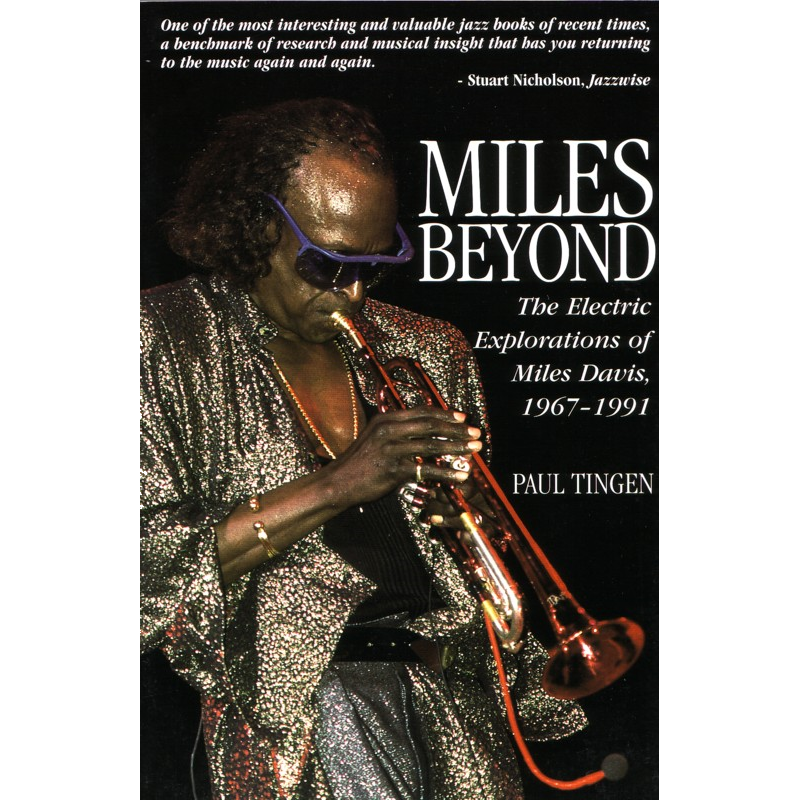
Below Chapter 1 from my book Miles Beyond, the Electric Explorations of Miles Davis, 1967-1991. In a review, Allaboutjazz.com wrote: “The chapter, ‘Listen,’ is captivating and charismatic. It’s like an elevator, taking the reader up to the 26h floor where the rest of the story will be told.”
LISTEN
“I was put here to play music, and interpret music… I might do a lot of other things, but the main thing that I love, that comes before everything, even breathing, is music.” – Miles Davis.
“Listen.” Miles, The Autobiography, opens with this word, immediately hitting bull’s eye. It goes straight to the heart of Miles Davis.
Listen before breathing. Miles had a different way of listening. To music. To sound. To people. To the rhythm of the times. To time and space. To understand Miles, we have to listen to the way he expressed himself, in music, words, life-style, and life-choices. Listening is central. It’s what he taught the musicians who played with him. It’s what he taught his audiences as well.
Bassist Gary Peacock described Miles as “by far the greatest listener that I have ever experienced in a musical group.” His colleague Dave Holland observed that Miles had “the best understanding of time, space, and movement of anybody I have ever worked with.” Keyboardist Adam Holzman stated, “It may be a funny thing to say for a musician, but Miles taught me how to listen.” Percussionist Badal Roy said that the main thing he learnt from Miles was “to play from the heart and to listen.”
Miles used to tell his musicians, “When you play music, don’t play the idea that’s there, play the next idea. Wait. Wait another beat, or maybe two, and maybe you’ll have something that’s more fresh. Don’t just play from the top of your head, but listen and try to play a little deeper.” Miles also advised his musicians, “Don’t play what’s there. Play what’s not there.” He might have said: “Don’t listen to what’s there, listen to what’s not there.”
Aside from during the second half of the ‘80s, Miles rarely rehearsed his bands, instead instructing his musicians to practice on the bandstand. He got angry with them if they practiced at home or in their hotel rooms, saying, “How are you going to rehearse the future?” He wanted them to be fully present with, to listen to, the music in the present moment. “Of all of those in the band, Miles is the most easily influenced by outside events. He reflects everything he feels in his playing immediately,” remarked an unnamed band member.
Miles wanted his sidemen to enter into a relationship with music with what Zen calls “beginner’s mind,” never on auto-pilot, never just following habit energy, but always alert, ready for the unexpected, right here, right now. “Miles did not want me to come to the rehearsals,” guitarist Pete Cosey recalled. “He wanted to keep things fresh. Part of that is knowing what to play and what not to play. The way you do that is to be able to listen what is going on around you. When you come into any situation, it’s the best thing to do: to listen. That is how you learn.”
Listening requires awareness, paying attention. Miles taught both by example. A word used by many musicians who worked with him is “focus.” Dave Holland said, “There was a tremendous sense of focus coming from him that influenced everybody. We were all drawn in by it, it was almost like a vortex. Once you were in its sphere of influence, there was a certain magic that seemed to be happening.” Drummer Jack DeJohnette remarked, “Playing with Miles was about being focused. And about being open to where the music takes you. His sound focused your attention on him and the music. Sometimes this meant leading and sometimes this meant following. He just had that magic, he had that power, that special gift.”
Miles’s unique listening awareness rubbed off on the musicians around him. In his presence they often found themselves raising their awareness and playing to new and unexpected heights. In doing so they exemplified Miles’s adage: “Play what you know and play above what you know.” Guitarist Sonny Sharrock only played with Miles one day in 1970, but this was enough to change his approach to the guitar, making him realize that playing music is about “really listening, the way Miles listened; to hear the piece to the end right from the first note, and to see what the space is going to be in the piece.” Guitarist John McLaughlin commented, “Miles has the capacity to draw out of people things that even surprise the musicians themselves. He’s been a guru of sorts to a lot of people. He was certainly a musical mentor to me.”
Miles stated that when listening to his music, “I always listen to what I can leave out.” He listened to what’s not there, to the space behind the notes, the silence from which music emerges and in which it is framed, trying to find the best balance between that space and the notes that furnish it. One of Miles’s big discoveries was that this often requires fewer notes, rather than more. As a result, his economy of playing and usage of space became legendary. Miles always played between the lines, implying notes, suggesting a mood with minimal material, stretching the “less is more” maxim to new levels.
Early 1985, when working on the album Aura, Miles told a Danish interviewer: “I don’t believe in wasting any phrases, no matter how small, how soft. With phrases comes rhythm. I don’t waste rhythm either. The rhythm can throw off the melody and it gets lost. So you have to know what the phrases mean, what the notes mean. A lot of musicians don’t! They play a note, and they don’t know what it means, they just know ‘that’s a raised 9th, that’s a…’ whatever. You should tell them what it means, then musicians won’t go to sleep. That’s very important.”
Guitarist John Scofield said, “He expressed himself in a virtuoso way, but not with a lot of notes. He had this ability to strip things down and to make it profound. When most people play just one note, it’s not so hot. But he found the right one to play. It was impossible for anybody else to do what he did because he was so unique. He was a teacher for us all.” Jack DeJohnette, Gary Peacock, and Keith Jarrett wrote, “Miles was the authentic minimalist (where, although there are so few notes, there was so much in those notes). No matter how much noise there was around him, Miles always came from silence, the notes existing in a purity all their own.” Producer and arranger Quincy Jones, concurred, “Miles always played the most unexpected note, and the one that is the perfect note.”
By contrast, many musicians tend to overplay, and Miles joked that because “they play too many fucking notes,” they need to go to “Notes Anonymous.” He spent much of his life teaching musicians the virtues of space, of silence, of phrasing, of waiting, of economy of notes and ideas, and most of all, of focus and listening. He remembered about percussionist Airto Moreira, “When he first came with me he played too loud and didn’t listen to what was happening with the music. I would tell him to stop banging and playing so loud, and just to listen more.” According to Moreira, Miles just instructed him with the one-liner, “Don’t bang, just play,” leaving him to figure out what this meant. Moreira concluded, “He wanted me to hear the music, and then play some sounds.”
Illustrating how his listening awareness was always present, not just in music, but in everyday life, Miles once remarked, “Rhythm is all around us, even if you stumble.” An anecdote from his time in Malibu in the late ‘80s illustrates the same point. One day Miles was stopped for speeding. “My speedometer isn’t working,” Miles proclaimed. “So how can you know how fast you’re going?” the police officer asked. “I can hear it,” Miles replied.
***
“Listen. The greatest feeling I ever had in my life—with my clothes on—was when I first heard Diz and Bird together in St. Louis, Missouri, back in 1944… Music all up in my body, and that’s what I wanted to hear… I’m always looking for it, listening to it and feeling for it, though, trying to feel it in and through the music I play every day.”
Throughout his life, Miles’s main focus was unearthing the meaning of music, delving for the feeling of that moment in 1944, which is the ultimate a musician can experience. Guitarist Robert Fripp described it as the point at which “we are fully alive in the present moment and totally alert to the musical impulse.” Miles was single-minded and ego-less in the pursuit of this aim, saying, “You gotta get rid of your ego,” and, “Men have the biggest egos! … All of them will listen, but if they do it, they’ll do it once. Then the ego comes back. A man’s ego is something else.”
Jo Gelbard, the artist who worked with Miles when he got into painting during the ‘80s, and who was also his life partner from 1986 to his death, commented, “He had no ego in music. That’s why he had his back to the audience, because he could hear the band better and direct them. As opposed to, ‘This is Miles Davis, and who cares who’s behind me.’ It was never just about him and his horn. He was always part of the group that was with him.”
Lydia DeJohnette, wife of Jack, knew Miles well. “In music there was no arrogance to his ego,” she remarked. “Being on stage was never about him, but always about musical inspiration, no matter where it came from. It made him happy to feel that inspiration. Sometimes he’d look at Jack and said, ‘You know?’ and Jack would go, ‘Yeah, I know.’ There was a knowing that they shared about the musical field, and it is where Miles felt connected with other people.”
Jack DeJohnette added: “People were often worried about their personal contributions and their egos, but Miles was thinking of it as a team. He also knew that whatever was going on, the sound of his horn could galvanize everything. Miles heard the finished thing.” Keyboardist Herbie Hancock made a similar point: “Miles is an incredible team worker. He listens to what everybody does, and he uses that and what he plays makes what everybody does sound better.”
Miles’s talent to focus and raise the level of awareness and of his bands was perplexing. Countless musicians who worked with Miles recounted stories of how he had a life-changing impact on them, and many talk about him in near-transcendental terms. DeJohnette, Peacock, and Jarrett called Miles “a medium, a transformer, a touchstone, a magnetic field.” The interviewees in this book used words like “mystical, “guru,” “sorcerer,” “shaman,” “teacher,” “magician,” “Merlin,” and “Zen teacher.”
“Miles gave me myself,” bassist Michael Henderson said. “He gave me something that belonged to me. When I came to play with him, I became ‘me.’ Like everybody else who was with him. We all found ourselves. We found exactly who we were and what we should be doing as far as being in the music industry, and in life.”
“I found my musical identity through playing with Miles,” echoed Henderson’s colleague Marcus Miller. “The first time I played with him, in 1980, I was scared like hell. We were recording a track called ‘Aida.’ He played me F# and G and said, ‘that’s it.’ So I asked, ‘that’s it?’ ‘Yeah.’ So I played only F# and G. Miles stopped the band and said, ‘What are you doing, man? Are you just going to play these two notes, is that all you’re going to do?’ So I started to do all sorts of variations. He stopped the band again, and asked, ‘man, why are you playing so much, just play F# and G, and then shut up’. So I thought: ‘Oh, he’s just playing with me, this is a test.’ I realised I just had to play and not worry about him. That’s what I did and this time he let the whole take go by. Miles had great people skills in the sense of bringing out the best in you as a musician. He was great precisely because he wasn’t communicating that much verbally. He made you find it on your own. Just like those martial arts teachers who point you in a direction and tell you a puzzling story that you have to analyze yourself. Or like those student-master relationships where the student can’t understand why the master has him painting fences, and later on realizes, ‘Oh yes, it’s because…’ It was the same thing with Miles.”
Miller’s analogy with fence painting is taken from the movie The Karate Kid, in which a Zen-like Asian martial arts teacher has his pupil painting fences as part of his apprenticeship. John McLaughlin drew a similar parallel, saying, “Miles in the studio directed very closely, but with very obscure statements. He was like a Zen master. He would give you very strange directions that were very difficult to understand, very obscure. But I think that was his intention, as it is with a Zen master. They will say something to you, and your mind will not be able to deal with it on a rational level. And so he made you act in a subconscious way, which was the best way. He had this great gift of pulling the best things out of people, without them even realizing.”
Palle Mikkelborg, the Danish trumpeter and composer who worked with Miles on Aura, wrote on in his cover notes, “Musically, Miles is to me what a Zen teacher is spiritually.” Mikkelborg explained, “I have talked to a lot of people who have been to Japan and who have studied Zen. They say that sometimes in Zen you’ll be told things which you don’t understand, but you just have a feeling that what they say… is right. The same with Miles, he often said things that were very cryptic, but had a deeper meaning. During our first rehearsal for the performance of Aura in December 1984 he said to me about the drummer, ‘Let him play as if he plays to a tap dancer.’ We were working on ‘Violet,’ the last piece for the album, a very very slow piece. I told the drummer what Miles had said and he asked me: ‘What does he mean?’ And I said, ‘I don’t know.’ We thought about it, and we guessed that Miles wanted him to keep some energy back, and play with a mental awareness of a hidden, faster energy. It changed something in our attitude, and made the very slow rhythm lift off. I don’t see it as anything else than a way of getting the best out of the present musical situation. I think it was an intuitive feeling he had for getting where he wanted to go. He once said to me, ‘When you conduct an orchestra, you have to smell good.’ At the time, I thought, ‘What the hell does he mean?’ Later on I understood that it means to be ‘on’ all the time. ‘Smell good’ means ‘be aware,’ awareness. He was ‘on’ all the time.”
By being “‘on’ all the time,” Miles exemplified the unsurpassed dedication and concentration with which he approached music. His attitude expresses a deep reverence and respect, demanding his total, ego-less, here and now presence, almost as if music was sacred to him. Pianist Chick Corea touched on this when he said, “Miles set an example by the way he loved to make music. He was about making music. That kind of attitude created an atmosphere in which we all joined, because we all wanted to make music in such a very concentrated way.” Guitarist Robben Ford recalled, “His presence created such an edge. I’d never been with anyone who could be so demanding just by his mere presence.”
Twenty-five years after working with Miles, saxophonist Sonny Fortune’s voice dropped to a whisper when he said: “The whole time I worked with him I was in awe over the magic he had. I walked away from the experience of playing with him feeling that it was something that I would never forget. I can’t explain it at all. Because of this magic, he didn’t have to say much, and he didn’t say much. He was one of the persons that I’ve met who expressed the least amount of trivia. He didn’t talk about much, he didn’t gossip, he didn’t seem to be affected by a whole lot of things. He was a cat that only said one or two phrases, but it would summarize what you were trying to get to. And he had a knowing about music that you could sense and feel, even as it wasn’t necessarily visible or describable.”
These quotes all describe the same essence, the same attitude, from different perspectives. The analogy with Zen, alluded to by Miller, McLaughlin, and Mikkelborg, is a good way of portraying this. It makes it possible to draw together the perspectives from many observers, and create a comprehensive framework for understanding the many characteristics that made Miles such a great musical teacher and innovator. The importance of minimalism, of here and now presence, of being awake, of awareness, of going beyond habit energies, of ego-less service to a greater purpose, of teaching by example, are all at the heart of Zen. Miles’s love of boxing also has parallels with the martial arts aspects of Zen. And like Miles, Zen teachers are traditionally men of few words, whilst Miles’s penchant for cryptic one-liners has parallels with Zen koans.
The listening sense, especially inner listening, is often associated with Zen, and spiritual awareness in general. “Be still, and know that I am God,” is a central phrase in Christianity. The original title of The Tibetan Book Of The Dead contains the word hearing, and its most used invocation is “Listen, ye man of noble birth.” In his book The World Is Sound, the German author and jazz critic Joachim-Ernst Berendt elaborated on many aspects of the listening sense in a widely known chapter called “The Temple In The Ear.” Behrendt argued that our TV-obsessed culture has become overly focused on the visual sense, reducing the ears to an “auxiliary organ.” He quoted scientific evidence suggesting that the listening sense is more pronounced in women, and reasoned that it reflects feminine qualities of receptivity and awareness, whereas the penetrating and projecting visual-spatial sense is a masculine trait. According to Behrendt, re-valuing our listening sense is crucial if we want to rebalance and heal our off-kilter culture, and he saw Zen practice as one way of achieving this, since it is about “wakefulness,” and “listening to silence.” With his focus on the listening sense, Miles contributed to this re-balancing process.
***
The aim of introducing spiritual perspectives and making the analogy with Zen is not to put Miles on a spiritual pedestal. To his great credit, Miles undermined any attempts by others to turn him into a guru. “I stood next to him in Japan when somebody began kissing his feet, literally,” Lydia DeJohnette remembered. “Miles was like, ‘Stop it!’ Miles was aware of levels that other people aren’t, he understood the vibration of music, what Jack called the ‘essence’ of music, so he could have been a guru if he wanted to. The ‘60s and the ‘70s were the era of gurus. But he didn’t want to be a guru. I think some of his obnoxious side came from that.”
The era of gurus may be over, but the spiritual and transcendental aspects of Miles’s being are hinted at too frequently to be ignored. Things transcendental get dozens of mentions in Miles’s autobiography, for example in how he believes in “mystery and the supernatural,” in “superstition” and “numerology,” and can “predict the future.” Miles also stated, “I do believe in being spiritual and do believe in spirits … music is about the spirit and the spiritual, and about feeling, ” and repeatedly referred to his clairvoyant side.
Eric Nisenson related how Miles often knew who called before picking up the phone and could sense someone walking towards his house when they were still a block away. “Real Twilight Zone stuff,” Nisenson commented. Quincy Troupe claimed in miles and me that Miles had a “spiritual, mystical” effect on him, and related how Miles talked to Gil Evans, Coltrane, Parker and others after they died. “He saw and understood things differently,” Troupe wrote, “and he seemed to feel and know things spiritually, almost to the point of having extrasensory perception.”
Miles always seemed to know much more than he articulated, and his often short expressions were so enticing because they always hinted at a much larger, hidden awareness, an intuitive “knowing,” as Sonny Fortune and Lydia DeJohnette called it. Miles’s nephew, drummer Vince Wilburn Jr., said, “It was innate, a ‘knowing’ gifted people have. With Miles it was almost a clairvoyant thing.” And Miles’s partner of 1969-1971, Marguerite Eskridge, remembered how he always gave the impression of knowing much more than he expressed. She added “I honestly couldn’t say whether this was because he was searching for the right words, or didn’t want to talk about it, or maybe thought something like, ‘doesn’t everybody also know these things and understand them?’”
Spirituality does not necessarily overlap with organized religion, for which Miles had little time. “He was not one for God,” Jo Gelbard commented. “But he was convinced that all the concerts and all the sounds he’d ever made were still there, floating around somewhere. That, for instance, his concert on November 12th, 1956 was intact somewhere in space, and that they would one day invent a machine to play it again. He loved that idea!” Miles’s idea of music floating around in eternity conjures up associations with the notion of “music of the spheres,” and has a striking parallel with the idea of the “Akashic Records” (an alleged huge cosmic database of everything that ever happened, and a popular concept in New Age circles).
***
Robert Fripp, who, like Miles, has a predilection for cryptic but captivating statements, wrote about the difference between the “understanding musician” and the “knowing musician.” “Knowing is an ordering of experience on the outside of our perceptions; understanding is an ordering of our experience on the inside of our perceptions.”
In this sense, Miles was a “knowing musician.” When listening to the essence of music, Miles had the capacity to hear things that eluded others. He heard “meaning” in notes other musicians missed. He was the aural equivalent of a visionary. This made Miles a great teacher and a great musician. It gave him the ability to spot potentially great musicians, and also to play the kid in the story of the emperor’s clothes, ruthlessly pointing out when music or musicians were out of touch with “the musical impulse.” Yet crucially, his strength was not in musical conception. He didn’t conceive of the many musical innovations that he spearheaded. Instead he recognized the unique creative possibilities in what was being done by his contemporaries, appropriated and developed these in highly imaginative ways, and communicated his findings to a world-wide audience.
Miles’s role was reminiscent to that of the English writer John Aubrey, who, one day in 1648, walked up a hill next to the English village of Avebury, looked down, and saw something that no one had ever seen before. As long as people could remember, Avebury had included a mysterious circular earthwork and a collection of huge stones. On that day Aubrey suddenly saw the meaning of the stones and earthworks: they made up a pre-historic site — a larger sister to Stonehenge. When his contemporaries went up to have a look they invariably recognized it too, and could hardly believe that they had never noticed it before.
A shift in perspective like this is often known as an “aha” or “eureka” experience, we suddenly “get” something. Moreover, insofar as the new outlook also changed the view the villagers had of themselves and of their world, it can be called a “paradigm shift.” The scientist Thomas Kuhn introduced the idea of “paradigm shifts,” defining paradigms as sets of fundamental assumptions and concepts on which particular views of the world are based. For most of the time, human knowledge is deepened by working from a particular set of generally agreed premises. But periodically new paradigms emerge. For example, at one point describing the movements of the sun and the planets became too complex from the premise that the earth is the centre of the universe, and a new scientific paradigm was accepted that sees the earth as circling around the sun. What made this into a paradigm shift, rather than just a shift in perspective on a particular issue, were the enormous ramifications for the way mankind looked at itself and its place in the universe. Another, very literal, example, is the discovery of the law of perspective in the early Renaissance. Suddenly, all earlier drawings and paintings with their wrong perspectives appeared hopelessly naïve. Human evolution progresses through these kinds of paradigm shifts. The term can apply as much to new ways of looking at the world, at art or music, as to, on a smaller scale, new ways of looking at our village, or our personal life. To discover, say, that we have a different father than we thought we had, can be a paradigm shift for an individual.
Paradigm shifts are usually preceded by a prolonged period of personal, political, or cultural turmoil, signalling that the old paradigm doesn’t fit anymore. We tend to forget about these wider cultural contexts in which paradigms shifts occur, only remembering the individual pioneers. Their names are familiar. Einstein brought about a paradigm shift in our thinking about the universe, at a time when the natural sciences were feverishly trying to find new solutions to emerging problems. As part of the rising political awareness in the ‘60s, Martin Luther King Jr. helped shift the American psyche on race issues. Darwin changed our thinking about our origins in a society that was trying to make sense of the data provided by numerous fossil finds. The Beatles, embedded in the historic events of the ’60s, brought about a paradigm shift in the music and culture of their era.
Miles Davis, surrounded by the cascading musical and political developments of 1945-75, was one of the select group of 20th century musicians who initiated several paradigm shifts. He had a remarkable capacity for capturing and transforming the zeitgeist, for pointing his finger at the stone circle at a time when people were ready to recognize it. It was this that made him into one of the great artists of the 20th century, rather than an obscure visionary remembered only by music historians.
Miles’s cool jazz, hardbop, and modal jazz experiments each changed the musical perspective of the jazz-community, leading respected jazz writer Leonard Feather to proclaim, “He has manifestly changed the entire course of an art form three or four times in twenty-five years—an accomplishment no other jazz musician can claim.” Miles’s explorations into jazz-rock and ambient jazz were paradigm shifts that did not only affect the jazz community, but also those beyond. In the context of a visually-orientated culture, his listening awareness can also be described in paradigm terms.
In addition, being the first black jazz musician who consistently crossed over into other music genres, other cultures, and other countries, Miles transcended the paradigm of musical, cultural, and racial segregation. He was one of the first truly universal musicians, who went beyond categories, boundaries, and borders of any kind. The effects of his musical and personal odyssey rippled into the whole of 20th century music and culture, and are still with us today.
And finally, Miles instigated a paradigm shift on his musical instrument. Before Miles, the trumpet was mostly played with a bright, brassy sound, rich in vibrato. But through Miles’s stylistic developments we today hear the trumpet very differently, sounding more vulnerable, soulful, like a cri du coeur. Trumpeter Olu Dara observed, “He’s singing rather than playing the trumpet. He was using it like the human voice. He transformed the mechanical aspect of the instrument. He made it sound like a breath.” Saxophonist Wayne Shorter remembered simply, “They called him the guy with the strange sound on the trumpet.”
The absence of vibrato was the most characteristic aspect of Miles’s style, resulting in an unadorned, introverted sound, often with a crack at the beginning of his notes, giving the impression of vulnerability. Miles also tended to play in the gentler, rounder-sounding middle and low register, because he couldn’t “hear” the trumpet’s high notes. And in 1954, Miles popularized the sound of the trumpet played with a Harmon mute without the stem. Combined with the lack of vibrato, and played closely to a microphone, it allows for an intimate, tender, but very expressive sound.
There is a widespread misunderstanding that Miles conceived of these approaches because of limitations in his trumpet technique, but he already displayed awesome chops on some recordings in the ‘40s. It is more likely that his innovations emerged from his astute listening awareness, which made him recognize the significance of sound. “Sound is the most important thing a musician can have, because you can’t do anything without a sound,” Miles remarked. “If a musician is interested in his sound, then you can look for ward to some good playing.”
Miles kept developing as a trumpeter until he reached his technical peak in the late ‘60s, playing a more extroverted and virtuoso form of power trumpet that included its high register. He also established a very personal, wah-wah inspired electric trumpet style in the ‘70s. Both his power and his electric trumpet styles retained recognizable elements of his characteristic, cracked, voice-like, vibratoless sound, but neither was as influential. In the ‘80s Miles returned to his original trumpet style, often sounding more cracked and vulnerable than before, because his technique only occasionally rose to its previous heights.
It was Miles’s “strange” cri du coeur on the trumpet that had the most universal resonance, and added another color to the palette of human experience. Even if he hadn’t spearheaded several musical revolutions, his place in posterity would be secured purely for introducing this horn sound. It was the focal point, the pivot that drew everything he did together, the common thread at the heart of all the disparate musical styles and experiments that he traversed during his epic 46-year long recording career. In an echo of the Pied Piper of Hamelin, the charismatic sound of Miles’s horn made millions follow him into the undiscovered territory he probed.
“When Miles played his horn, everything fell into place… [and] he spoke to the whole world,” Jack DeJohnette remarked. His wife Lydia added, “Miles spoke more with his horn than with his mouth. His inner life came out in his music. When you listen to his horn you can hear sadness, you can hear pain, you can hear everything else. This is where he revealed himself.”
Miles’s touching, deeply human trumpet sound is so moving and compelling because of its apparent contradiction with the tough, inscrutable, macho persona that he displayed to the world. The poignant irony of the hard man with the legendary rough, raspy, almost demonic voice –the aftermath of a throat operation in the ‘50s—playing his instrument with voice-like lyricism, has inflated this contradiction to almost mythical proportions.
Miles’s many contradictions, his fierce independence and his leadership abilities, his sensitive, vulnerable sound, his awareness and his listening capacities, and his violence and drug addiction, epitomized some of the extremes of our human nature
Marguerite Eskridge recounted how Miles expressed aspects of these extremes privately. “Miles was the epitome of the Gemini, Jekyll & Hyde personality. The positive one was golden; would give anybody anything that they needed, open his door and take in guys who were out of work, or homeless. The opposite one was just as extreme, had a very violent temper, and could be very violent.”
A sense of unfathomable darkness and imminent danger often surrounded Miles. It is hinted at by the more ominous epithets that he received, such as “dark magus,” “prince of darkness,” and “a puzzle wrapped in an enigma.” But the melancholy and vulnerability always shone through. In Miles’s horn sound we can always sense the delicate sensitivity that was also there. We sense his spiritual qualities, the fire of his creativity and the light of his honesty and “knowing,” as much as the surrounding looming shadows. We sense his deep humanity, which makes us feel for him and sympathize with him, and we sense the “unexplainable,” larger-than-life qualities that urged him to go into places where most of us wouldn’t dream of going. He was both one of us, and a stranger in a strange land. He was someone on the brink of several paradigms conveying mysterious tales to which we can not but listen.
© 2001, Paul Tingen.


 I have long thought of writing a book about my journey, and how it culminated in the Beethoven Marathon. Instead I wrote a