Miles Beyond – Chapter 1

milescrop

Below Chapter 1 from my book Miles Beyond, the Electric Explorations of Miles Davis, 1967-1991. In a review, Allaboutjazz.com wrote: “The chapter, ‘Listen,’ is captivating and charismatic. It’s like an elevator, taking the reader up to the 26h floor where the rest of the story will be told.”

LISTEN

“I was put here to play music, and interpret music… I might do a lot of other things, but the main thing that I love, that comes before everything, even breathing, is music.” – Miles Davis.  

“Listen.” Miles, The Autobiography, opens with this word, immediately hitting bull’s eye. It goes straight to the heart of Miles Davis.

Listen before breathing. Miles had a different way of listening. To music. To sound. To people. To the rhythm of the times. To time and space. To understand Miles, we have to listen to the way he expressed himself, in music, words, life-style, and life-choices. Listening is central. It’s what he taught the musicians who played with him. It’s what he taught his audiences as well.

Bassist Gary Peacock described Miles as “by far the greatest listener that I have ever experienced in a musical group.”  His colleague Dave Holland observed that Miles had “the best understanding of time, space, and movement of anybody I have ever worked with.” Keyboardist Adam Holzman stated, “It may be a funny thing to say for a musician, but Miles taught me how to listen.” Percussionist Badal Roy said that the main thing he learnt from Miles was “to play from the heart and to listen.”

Miles used to tell his musicians, “When you play music, don’t play the idea that’s there, play the next idea. Wait. Wait another beat, or maybe two, and maybe you’ll have something that’s more fresh. Don’t just play from the top of your head, but listen and try to play a little deeper.”  Miles also advised his musicians, “Don’t play what’s there. Play what’s not there.”  He might have said: “Don’t listen to what’s there, listen to what’s not there.”

Aside from during the second half of the ‘80s, Miles rarely rehearsed his bands, instead instructing his musicians to practice on the bandstand. He got angry with them if they practiced at home or in their hotel rooms, saying, “How are you going to rehearse the future?”  He wanted them to be fully present with, to listen to, the music in the present moment. “Of all of those in the band, Miles is the most easily influenced by outside events. He reflects everything he feels in his playing immediately,” remarked an unnamed band member.

Miles wanted his sidemen to enter into a relationship with music with what Zen calls “beginner’s mind,” never on auto-pilot, never just following habit energy, but always alert, ready for the unexpected, right here, right now. “Miles did not want me to come to the rehearsals,” guitarist Pete Cosey recalled. “He wanted to keep things fresh. Part of that is knowing what to play and what not to play. The way you do that is to be able to listen what is going on around you. When you come into any situation, it’s the best thing to do: to listen. That is how you learn.”

Listening requires awareness, paying attention. Miles taught both by example. A word used by many musicians who worked with him is “focus.” Dave Holland said, “There was a tremendous sense of focus coming from him that influenced everybody. We were all drawn in by it, it was almost like a vortex. Once you were in its sphere of influence, there was a certain magic that seemed to be happening.” Drummer Jack DeJohnette remarked, “Playing with Miles was about being focused. And about being open to where the music takes you. His sound focused your attention on him and the music. Sometimes this meant leading and sometimes this meant following. He just had that magic, he had that power, that special gift.”

Miles’s unique listening awareness rubbed off on the musicians around him. In his presence they often found themselves raising their awareness and playing to new and unexpected heights. In doing so they exemplified Miles’s adage: “Play what you know and play above what you know.”  Guitarist Sonny Sharrock only played with Miles one day in 1970, but this was enough to change his approach to the guitar, making him realize that playing music is about “really listening, the way Miles listened; to hear the piece to the end right from the first note, and to see what the space is going to be in the piece.”  Guitarist John McLaughlin commented, “Miles has the capacity to draw out of people things that even surprise the musicians themselves. He’s been a guru of sorts to a lot of people. He was certainly a musical mentor to me.”

Miles stated that when listening to his music, “I always listen to what I can leave out.”  He listened to what’s not there, to the space behind the notes, the silence from which music emerges and in which it is framed, trying to find the best balance between that space and the notes that furnish it. One of Miles’s big discoveries was that this often requires fewer notes, rather than more. As a result, his economy of playing and usage of space became legendary. Miles always played between the lines, implying notes, suggesting a mood with minimal material, stretching the “less is more” maxim to new levels.

Early 1985, when working on the album Aura, Miles told a Danish interviewer: “I don’t believe in wasting any phrases, no matter how small, how soft. With phrases comes rhythm. I don’t waste rhythm either. The rhythm can throw off the melody and it gets lost. So you have to know what the phrases mean, what the notes mean. A lot of musicians don’t! They play a note, and they don’t know what it means, they just know ‘that’s a raised 9th, that’s a…’ whatever. You should tell them what it means, then musicians won’t go to sleep. That’s very important.”

Guitarist John Scofield said, “He expressed himself in a virtuoso way, but not with a lot of notes. He had this ability to strip things down and to make it profound. When most people play just one note, it’s not so hot. But he found the right one to play. It was impossible for anybody else to do what he did because he was so unique. He was a teacher for us all.” Jack DeJohnette, Gary Peacock, and Keith Jarrett wrote, “Miles was the authentic minimalist (where, although there are so few notes, there was so much in those notes). No matter how much noise there was around him, Miles always came from silence, the notes existing in a purity all their own.”  Producer and arranger Quincy Jones, concurred, “Miles always played the most unexpected note, and the one that is the perfect note.”

By contrast, many musicians tend to overplay, and Miles joked that because “they play too many fucking notes,” they need to go to “Notes Anonymous.”  He spent much of his life teaching musicians the virtues of space, of silence, of phrasing, of waiting, of economy of notes and ideas, and most of all, of focus and listening. He remembered about percussionist Airto Moreira, “When he first came with me he played too loud and didn’t listen to what was happening with the music. I would tell him to stop banging and playing so loud, and just to listen more.”   According to Moreira, Miles just instructed him with the one-liner, “Don’t bang, just play,”  leaving him to figure out what this meant. Moreira concluded,  “He wanted me to hear the music, and then play some sounds.”

Illustrating how his listening awareness was always present, not just in music, but in everyday life, Miles once remarked, “Rhythm is all around us, even if you stumble.”   An anecdote from his time in Malibu in the late ‘80s illustrates the same point. One day Miles was stopped for speeding. “My speedometer isn’t working,” Miles proclaimed. “So how can you know how fast you’re going?” the police officer asked. “I can hear it,” Miles replied.

***

“Listen. The greatest feeling I ever had in my life—with my clothes on—was when I first heard Diz and Bird together in St. Louis, Missouri, back in 1944… Music all up in my body, and that’s what I wanted to hear… I’m always looking for it, listening to it and feeling for it, though, trying to feel it in and through the music I play every day.”

Throughout his life, Miles’s main focus was unearthing the meaning of music, delving for the feeling of that moment in 1944, which is the ultimate a musician can experience. Guitarist Robert Fripp described it as the point at which “we are fully alive in the present moment and totally alert to the musical impulse.”  Miles was single-minded and ego-less in the pursuit of this aim, saying, “You gotta get rid of your ego,”  and, “Men have the biggest egos! … All of them will listen, but if they do it, they’ll do it once. Then the ego comes back. A man’s ego is something else.”

Jo Gelbard, the artist who worked with Miles when he got into painting during the ‘80s, and who was also his life partner from 1986 to his death, commented, “He had no ego in music. That’s why he had his back to the audience, because he could hear the band better and direct them. As opposed to, ‘This is Miles Davis, and who cares who’s behind me.’ It was never just about him and his horn. He was always part of the group that was with him.”

Lydia DeJohnette, wife of Jack, knew Miles well. “In music there was no arrogance to his ego,” she remarked. “Being on stage was never about him, but always about musical inspiration, no matter where it came from. It made him happy to feel that inspiration. Sometimes he’d look at Jack and said, ‘You know?’ and Jack would go, ‘Yeah, I know.’ There was a knowing that they shared about the musical field, and it is where Miles felt connected with other people.”

Jack DeJohnette added: “People were often worried about their personal contributions and their egos, but Miles was thinking of it as a team. He also knew that whatever was going on, the sound of his horn could galvanize everything. Miles heard the finished thing.” Keyboardist Herbie Hancock made a similar point: “Miles is an incredible team worker. He listens to what everybody does, and he uses that and what he plays makes what everybody does sound better.”

Miles’s talent to focus and raise the level of awareness and of his bands was perplexing. Countless musicians who worked with Miles recounted stories of how he had a life-changing impact on them, and many talk about him in near-transcendental terms. DeJohnette, Peacock, and Jarrett called Miles “a medium, a transformer, a touchstone, a magnetic field.”  The interviewees in this book used words like “mystical, “guru,” “sorcerer,” “shaman,” “teacher,” “magician,” “Merlin,” and “Zen teacher.”

“Miles gave me myself,” bassist Michael Henderson said. “He gave me something that belonged to me. When I came to play with him, I became ‘me.’ Like everybody else who was with him. We all found ourselves. We found exactly who we were and what we should be doing as far as being in the music industry, and in life.”

“I found my musical identity through playing with Miles,” echoed Henderson’s colleague Marcus Miller. “The first time I played with him, in 1980, I was scared like hell. We were recording a track called ‘Aida.’ He played me F# and G and said, ‘that’s it.’  So I asked, ‘that’s it?’ ‘Yeah.’ So I played only F# and G. Miles stopped the band and said, ‘What are you doing, man? Are you just going to play these two notes, is that all you’re going to do?’ So I started to do all sorts of variations. He stopped the band again, and asked, ‘man, why are you playing so much, just play F# and G, and then shut up’. So I thought: ‘Oh, he’s just playing with me, this is a test.’ I realised I just had to play and not worry about him. That’s what I did and this time he let the whole take go by. Miles had great people skills in the sense of bringing out the best in you as a musician. He was great precisely because he wasn’t communicating that much verbally. He made you find it on your own. Just like those martial arts teachers who point you in a direction and tell you a puzzling story that you have to analyze yourself. Or like those student-master relationships where the student can’t understand why the master has him painting fences, and later on realizes, ‘Oh yes, it’s because…’ It was the same thing with Miles.”

Miller’s analogy with fence painting is taken from the movie The Karate Kid, in which a Zen-like Asian martial arts teacher has his pupil painting fences as part of his apprenticeship. John McLaughlin drew a similar parallel, saying, “Miles in the studio directed very closely, but with very obscure statements. He was like a Zen master. He would give you very strange directions that were very difficult to understand, very obscure. But I think that was his intention, as it is with a Zen master. They will say something to you, and your mind will not be able to deal with it on a rational level. And so he made you act in a subconscious way, which was the best way. He had this great gift of pulling the best things out of people, without them even realizing.”

Palle Mikkelborg, the Danish trumpeter and composer who worked with Miles on Aura, wrote on in his cover notes, “Musically, Miles is to me what a Zen teacher is spiritually.” Mikkelborg explained, “I have talked to a lot of people who have been to Japan and who have studied Zen. They say that sometimes in Zen you’ll be told things which you don’t understand, but you just have a feeling that what they say… is right. The same with Miles, he often said things that were very cryptic, but had a deeper meaning. During our first rehearsal for the performance of Aura in December 1984 he said to me about the drummer, ‘Let him play as if he plays to a tap dancer.’ We were working on ‘Violet,’ the last piece for the album, a very very slow piece. I told the drummer what Miles had said and he asked me: ‘What does he mean?’ And I said, ‘I don’t know.’ We thought about it, and we guessed that Miles wanted him to keep some energy back, and play with a mental awareness of a hidden, faster energy. It changed something in our attitude, and made the very slow rhythm lift off. I don’t see it as anything else than a way of getting the best out of the present musical situation. I think it was an intuitive feeling he had for getting where he wanted to go. He once said to me, ‘When you conduct an orchestra, you have to smell good.’ At the time, I thought, ‘What the hell does he mean?’  Later on I understood that it means to be ‘on’ all the time. ‘Smell good’ means ‘be aware,’ awareness. He was ‘on’ all the time.”

By being “‘on’ all the time,” Miles exemplified the unsurpassed dedication and concentration with which he approached music. His attitude expresses a deep reverence and respect, demanding his total, ego-less, here and now presence, almost as if music was sacred to him. Pianist Chick Corea touched on this when he said,  “Miles set an example by the way he loved to make music. He was about making music. That kind of attitude created an atmosphere in which we all joined, because we all wanted to make music in such a very concentrated way.” Guitarist Robben Ford recalled, “His presence created such an edge. I’d never been with anyone who could be so demanding just by his mere presence.”

Twenty-five years after working with Miles, saxophonist Sonny Fortune’s voice dropped to a whisper when he said: “The whole time I worked with him I was in awe over the magic he had. I walked away from the experience of playing with him feeling that it was something that I would never forget. I can’t explain it at all. Because of this magic, he didn’t have to say much, and he didn’t say much. He was one of the persons that I’ve met who expressed the least amount of trivia. He didn’t talk about much, he didn’t gossip, he didn’t seem to be affected by a whole lot of things. He was a cat that only said one or two phrases, but it would summarize what you were trying to get to. And he had a knowing about music that you could sense and feel, even as it wasn’t necessarily visible or describable.”

These quotes all describe the same essence, the same attitude, from different perspectives. The analogy with Zen, alluded to by Miller, McLaughlin, and Mikkelborg, is a good way of portraying this. It makes it possible to draw together the perspectives from many observers, and create a comprehensive framework for understanding the many characteristics that made Miles such a great musical teacher and innovator. The importance of minimalism, of here and now presence, of being awake, of awareness, of going beyond habit energies, of ego-less service to a greater purpose, of teaching by example, are all at the heart of Zen. Miles’s love of boxing also has parallels with the martial arts  aspects of Zen. And like Miles, Zen teachers are traditionally men of few words, whilst Miles’s penchant for cryptic one-liners has parallels with Zen koans.

The listening sense, especially inner listening, is often associated with Zen, and spiritual awareness in general. “Be still, and know that I am God,” is a central phrase in Christianity. The original title of The Tibetan Book Of The Dead contains the word hearing, and its most used invocation is “Listen, ye man of noble birth.”  In his book The World Is Sound, the German author and jazz critic Joachim-Ernst Berendt elaborated on many aspects of the listening sense in a widely known chapter called “The Temple In The Ear.” Behrendt argued that our TV-obsessed culture has become overly focused on the visual sense, reducing the ears to an “auxiliary organ.”  He quoted scientific evidence suggesting that the listening sense is more pronounced in women, and reasoned that it reflects feminine qualities of receptivity and awareness, whereas the penetrating and projecting visual-spatial sense is a masculine trait. According to Behrendt, re-valuing our listening sense is crucial if we want to rebalance and heal our off-kilter culture, and he saw Zen practice as one way of achieving this, since it is about “wakefulness,” and “listening to silence.”   With his focus on the listening sense, Miles contributed to this re-balancing process.

***

The aim of introducing spiritual perspectives and making the analogy with Zen is not to put Miles on a spiritual pedestal. To his great credit, Miles undermined any attempts by others to turn him into a guru. “I stood next to him in Japan when somebody began kissing his feet, literally,” Lydia DeJohnette remembered. “Miles was like, ‘Stop it!’ Miles was aware of levels that other people aren’t, he understood the vibration of music, what Jack called the ‘essence’ of music, so he could have been a guru if he wanted to. The ‘60s and the ‘70s were the era of gurus. But he didn’t want to be a guru. I think some of his obnoxious side came from that.”

The era of gurus may be over, but the spiritual and transcendental aspects of Miles’s being are hinted at too frequently to be ignored. Things transcendental get dozens of mentions in Miles’s autobiography, for example in how he believes in “mystery and the supernatural,” in “superstition” and “numerology,” and can “predict the future.” Miles also stated, “I do believe in being spiritual and do believe in spirits … music is about the spirit and the spiritual, and about feeling, ”  and repeatedly referred to his clairvoyant side.

Eric Nisenson related how Miles often knew who called before picking up the phone and could sense someone walking towards his house when they were still a block away. “Real Twilight Zone stuff,”  Nisenson commented. Quincy Troupe claimed in miles and me that Miles had a “spiritual, mystical” effect on him, and related how Miles talked to Gil Evans, Coltrane, Parker and others after they died. “He saw and understood things differently,” Troupe wrote, “and he seemed to feel and know things spiritually, almost to the point of having extrasensory perception.”

Miles always seemed to know much more than he articulated, and his often short expressions were so enticing because they always hinted at a much larger, hidden awareness, an intuitive “knowing,” as Sonny Fortune and Lydia DeJohnette called it. Miles’s nephew, drummer Vince Wilburn Jr., said, “It was innate, a ‘knowing’ gifted people have. With Miles it was almost a clairvoyant thing.” And Miles’s partner of 1969-1971, Marguerite Eskridge, remembered how he always gave the impression of knowing much more than he expressed. She added “I honestly couldn’t say whether this was because he was searching for the right words, or didn’t want to talk about it, or maybe thought something like, ‘doesn’t everybody also know these things and understand them?’”

Spirituality does not necessarily overlap with organized religion, for which Miles had little time. “He was not one for God,” Jo Gelbard commented. “But he was convinced that all the concerts and all the sounds he’d ever made were still there, floating around somewhere. That, for instance, his concert on November 12th, 1956 was intact somewhere in space, and that they would one day invent a machine to play it again. He loved that idea!” Miles’s idea of music floating around in eternity conjures up associations with the notion of “music of the spheres,” and has a striking parallel with the idea of the “Akashic Records” (an alleged huge cosmic database of everything that ever happened, and a popular concept in New Age circles).

***

Robert Fripp, who, like Miles, has a predilection for cryptic but captivating statements, wrote about the difference between the “understanding musician” and the “knowing musician.” “Knowing is an ordering of experience on the outside of our perceptions; understanding is an ordering of our experience on the inside of our perceptions.”

In this sense, Miles was a “knowing musician.” When listening to the essence of music, Miles had the capacity to hear things that eluded others. He heard “meaning” in notes other musicians missed. He was the aural equivalent of a visionary. This made Miles a great teacher and a great musician. It gave him the ability to spot potentially great musicians, and also to play the kid in the story of the emperor’s clothes, ruthlessly pointing out when music or musicians were out of touch with “the musical impulse.” Yet crucially, his strength was not in musical conception. He didn’t conceive of the many musical innovations that he spearheaded. Instead he recognized the unique creative possibilities in what was being done by his contemporaries, appropriated and developed these in highly imaginative ways, and communicated his findings to a world-wide audience.

Miles’s role was reminiscent to that of the English writer John Aubrey, who, one day in 1648, walked up a hill next to the English village of Avebury, looked down, and saw something that no one had ever seen before. As long as people could remember, Avebury had included a mysterious circular earthwork and a collection of huge stones. On that day Aubrey suddenly saw the meaning of the stones and earthworks: they made up a pre-historic site — a larger sister to Stonehenge. When his contemporaries went up to have a look they invariably recognized it too, and could hardly believe that they had never noticed it before.

A shift in perspective like this is often known as an “aha” or “eureka” experience, we suddenly “get” something. Moreover, insofar as the new outlook also changed the view the villagers had of themselves and of their world, it can be called a “paradigm shift.” The scientist Thomas Kuhn introduced the idea of “paradigm shifts,” defining paradigms as sets of fundamental assumptions and concepts on which particular views of the world are based. For most of the time, human knowledge is deepened by working from a particular set of generally agreed premises. But periodically new paradigms emerge. For example, at one point describing the movements of the sun and the planets became too complex from the premise that the earth is the centre of the universe, and a new scientific paradigm was accepted that sees the earth as circling around the sun. What made this into a paradigm shift, rather than just a shift in perspective on a particular issue, were the enormous ramifications for the way mankind looked at itself and its place in the universe. Another, very literal, example, is the discovery of the law of perspective in the early Renaissance. Suddenly, all earlier drawings and paintings with their wrong perspectives appeared hopelessly naïve. Human evolution progresses through these kinds of paradigm shifts. The term can apply as much to new ways of looking at the world, at art or music, as to, on a smaller scale, new ways of looking at our village, or our personal life. To discover, say, that we have a different father than we thought we had, can be a paradigm shift for an individual.

Paradigm shifts are usually preceded by a prolonged period of personal, political, or cultural turmoil, signalling that the old paradigm doesn’t fit anymore. We tend to forget about these wider cultural contexts in which paradigms shifts occur, only remembering the individual pioneers. Their names are familiar. Einstein brought about a paradigm shift in our thinking about the universe, at a time when the natural sciences were feverishly trying to find new solutions to emerging problems. As part of the rising political awareness in the ‘60s, Martin Luther King Jr. helped shift the American psyche on race issues. Darwin changed our thinking about our origins in a society that was trying to make sense of the data provided by numerous fossil finds. The Beatles, embedded in the historic events of the ’60s, brought about a paradigm shift in the music and culture of their era.

Miles Davis, surrounded by the cascading musical and political developments of 1945-75, was one of the select group of 20th century musicians who initiated several paradigm shifts. He had a remarkable capacity for capturing and transforming the zeitgeist, for pointing his finger at the stone circle at a time when people were ready to recognize it. It was this that made him into one of the great artists of the 20th century, rather than an obscure visionary remembered only by music historians.

Miles’s cool jazz, hardbop, and modal jazz experiments each changed the musical perspective of the jazz-community, leading respected jazz writer Leonard Feather to proclaim, “He has manifestly changed the entire course of an art form three or four times in twenty-five years—an accomplishment no other jazz musician can claim.”   Miles’s explorations into jazz-rock and ambient jazz were paradigm shifts that did not only affect the jazz community, but also those beyond. In the context of a visually-orientated culture, his listening awareness can also be described in paradigm terms.

In addition, being the first black jazz musician who consistently crossed over into other music genres, other cultures, and other countries, Miles transcended the paradigm of musical, cultural, and racial segregation. He was one of the first truly universal musicians, who went beyond categories, boundaries, and borders of any kind. The effects of his musical and personal odyssey rippled into the whole of 20th century music and culture, and are still with us today.

And finally, Miles instigated a paradigm shift on his musical instrument. Before Miles, the trumpet was mostly played with a bright, brassy sound, rich in vibrato. But through Miles’s stylistic developments we today hear the trumpet very differently, sounding more vulnerable, soulful, like a cri du coeur. Trumpeter Olu Dara observed, “He’s singing rather than playing the trumpet. He was using it like the human voice. He transformed the mechanical aspect of the instrument. He made it sound like a breath.”  Saxophonist Wayne Shorter remembered simply, “They called him the guy with the strange sound on the trumpet.”

The absence of vibrato was the most characteristic aspect of Miles’s style, resulting in an unadorned, introverted sound, often with a crack at the beginning of his notes, giving the impression of vulnerability. Miles also tended to play in the gentler, rounder-sounding middle and low register, because he couldn’t “hear” the trumpet’s high notes. And in 1954, Miles popularized the sound of the trumpet played with a Harmon mute without the stem. Combined with the lack of vibrato, and played closely to a microphone, it allows for an intimate, tender, but very expressive sound.

There is a widespread misunderstanding that Miles conceived of these approaches because of limitations in his trumpet technique, but he already displayed awesome chops on some recordings in the ‘40s.  It is more likely that his innovations emerged from his astute listening awareness, which made him recognize the significance of sound. “Sound is the most important thing a musician can have, because you can’t do anything without a sound,” Miles remarked. “If a musician is interested in his sound, then you can look for ward to some good playing.”

Miles kept developing as a trumpeter until he reached his technical peak in the late ‘60s, playing a more extroverted and virtuoso form of power trumpet that included its high register. He also established a very personal, wah-wah inspired electric trumpet style in the ‘70s. Both his power and his electric trumpet styles retained recognizable elements of his characteristic, cracked, voice-like, vibratoless sound, but neither was as influential. In the ‘80s Miles returned to his original trumpet style, often sounding more cracked and vulnerable than before, because his technique only occasionally rose to its previous heights.

It was Miles’s “strange” cri du coeur on the trumpet that had the most universal resonance, and added another color to the palette of human experience. Even if he hadn’t spearheaded several musical revolutions, his place in posterity would be secured purely for introducing this horn sound. It was the focal point, the pivot that drew everything he did together, the common thread at the heart of all the disparate musical styles and experiments that he traversed during his epic 46-year long recording career. In an echo of the Pied Piper of Hamelin, the charismatic sound of Miles’s horn made millions follow him into the undiscovered territory he probed.

“When Miles played his horn, everything fell into place… [and] he spoke to the whole world,” Jack DeJohnette remarked. His wife Lydia added, “Miles spoke more with his horn than with his mouth. His inner life came out in his music. When you listen to his horn you can hear sadness, you can hear pain, you can hear everything else. This is where he revealed himself.”

Miles’s touching, deeply human trumpet sound is so moving and compelling because of its apparent contradiction with the tough, inscrutable, macho persona that he displayed to the world. The poignant irony of the hard man with the legendary rough, raspy, almost demonic voice –the aftermath of a throat operation in the ‘50s—playing his instrument with voice-like lyricism, has inflated this contradiction to almost mythical proportions.
Miles’s many contradictions, his fierce independence and his leadership abilities, his sensitive, vulnerable sound, his awareness and his listening capacities, and his violence and drug addiction, epitomized some of the extremes of our human nature

Marguerite Eskridge recounted how Miles expressed aspects of these extremes privately. “Miles was the epitome of the Gemini, Jekyll & Hyde personality. The positive one was golden; would give anybody anything that they needed, open his door and take in guys who were out of work, or homeless. The opposite one was just as extreme, had a very violent temper, and could be very violent.”

A sense of unfathomable darkness and imminent danger often surrounded Miles. It is hinted at by the more ominous epithets that he received, such as “dark magus,” “prince of darkness,” and “a puzzle wrapped in an enigma.”   But the melancholy and vulnerability always shone through. In Miles’s horn sound we can always sense the delicate sensitivity that was also there. We sense his spiritual qualities, the fire of his creativity and the light of his honesty and “knowing,” as much as the surrounding looming shadows. We sense his deep humanity, which makes us feel for him and sympathize with him, and we sense the “unexplainable,” larger-than-life qualities that urged him to go into places where most of us wouldn’t dream of going. He was both one of us, and a stranger in a strange land. He was someone on the brink of several paradigms conveying mysterious tales to which we can not but listen.

© 2001, Paul Tingen.

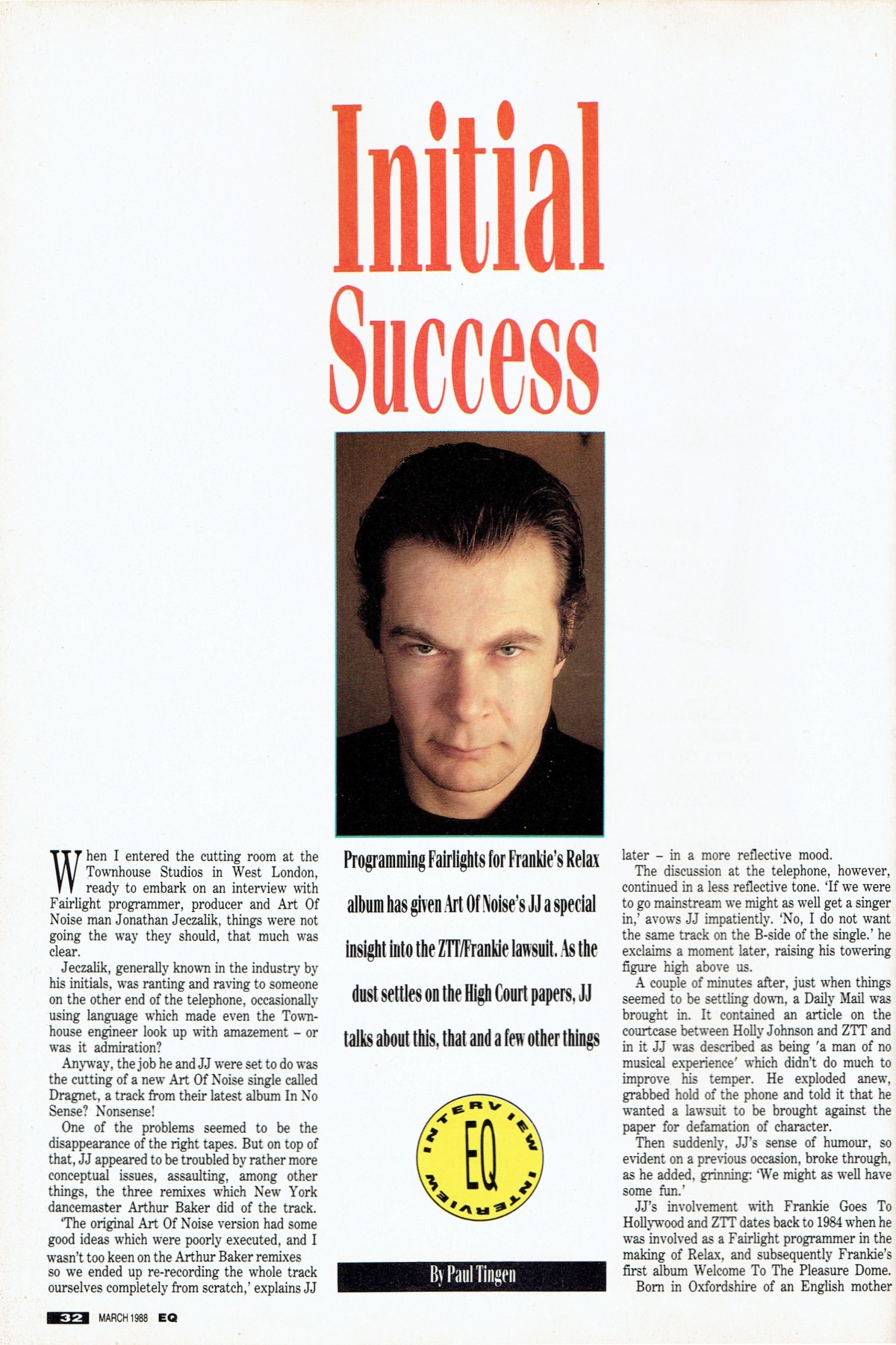
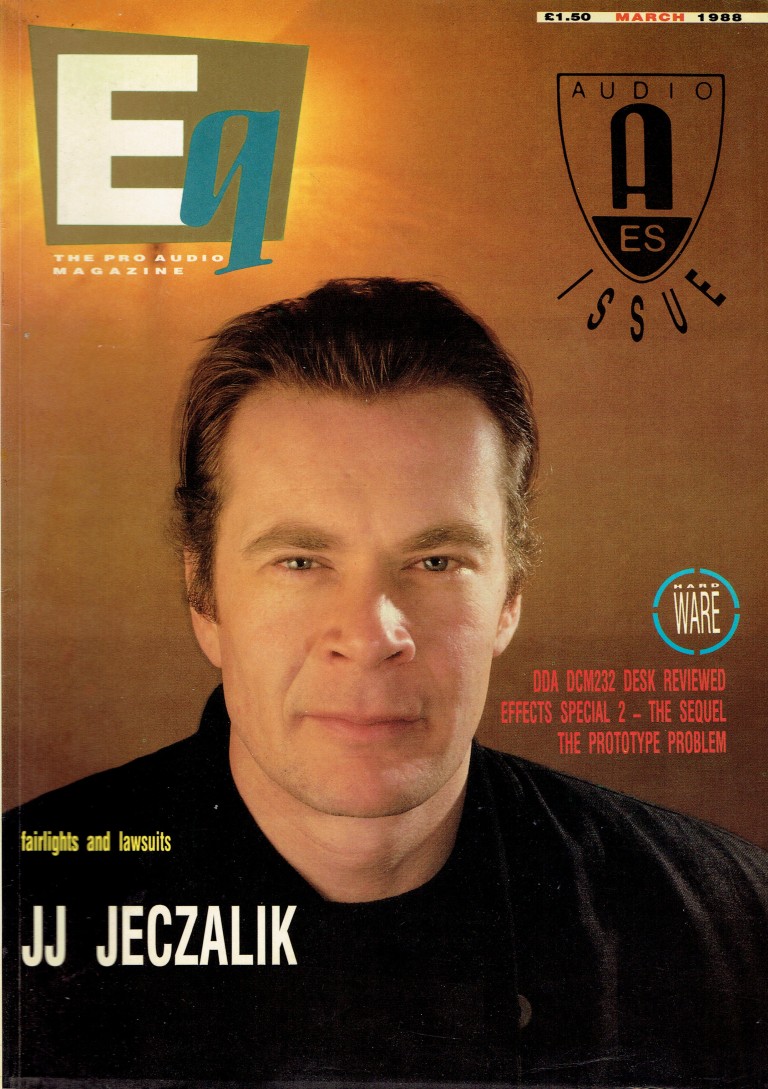
1988 – from the archives:JJ Jeczalik fumes about Fairlights and Lawsuits

JJcovertransparant500

HERE’S A GEM FROM THE EARLY DAYS OF MY WRITING CAREER.  IT’S A COVER STORY IN THE MARCH 1988 ISSUE OF EQ MAGAZINE ON SELF-DECLARED “NON-MUSICIAN” JJ JECZALIK, WHO WAS A MEMBER OF THE ART OF NOISE AND PROGRAMMED THE FAIRLIGHT CMI SAMPLER ON MANY BIG 1980’S HITS, BY YES, ABC, AND MOST NOTABLY ON FRANKIE GOES TO HOLLYWOOD’S “RELAX.” THE HILARIOUS STORY EPITOMIZES THE HEADY DAYS OF THE 1980S, AND HOW EMERGING MUSIC TECHNOLOGY WAS ALREADY ROCKING THE VERY FOUNDATIONS OF THE MUSIC INDUSTRY. SMALL WONDER, GIVEN JJ’S BAD-TEMPERED STATE OF MIND AT THE TIME, THAT HE EVENTUALLY (RE-)TIRED FROM THE MUSIC INDUSTRY AND WENT ON TO TEACH IT AT OXFORD HIGH SCHOOL.

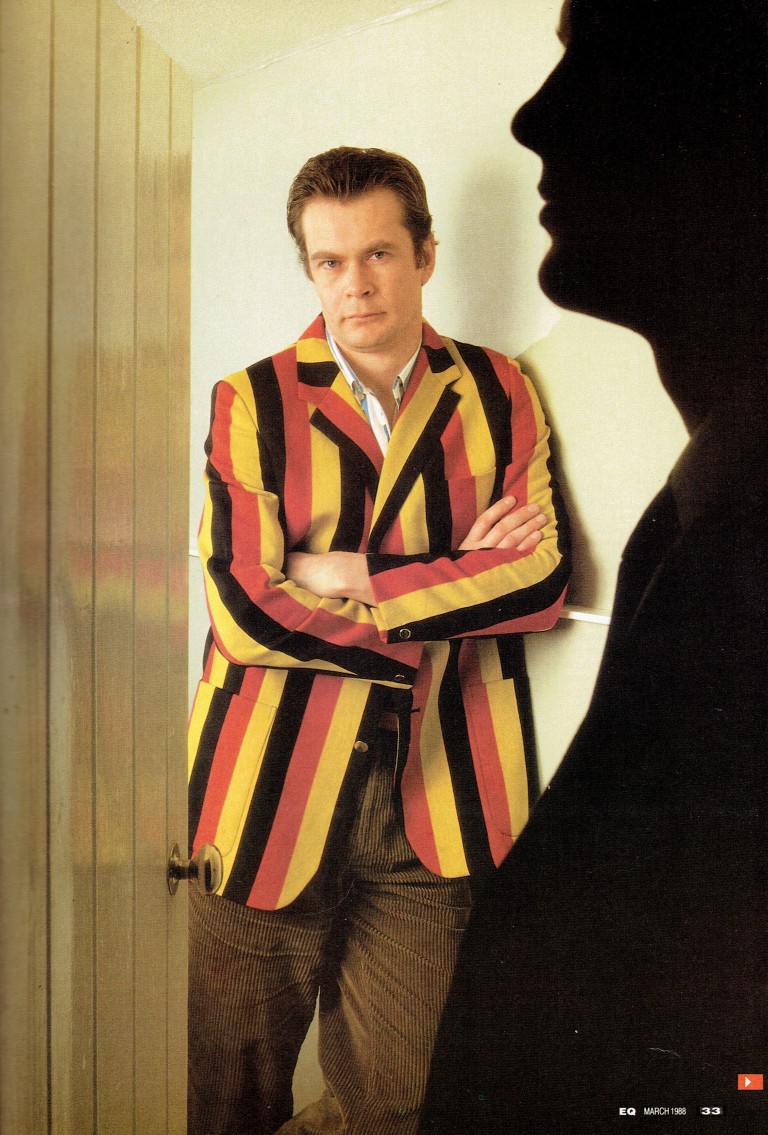
JJJ1JJJ EQ 1988 4 768widthJJJ EQ 1988 5 768width

Photos by Barry Marsden

The glossy pics were taken by Barry Marsden, and presumably commanded a hefty fee. Those were heady days for music mags as well!

JJJ EQ 1988 3 768width

The Making of the Justin Bieber “Despacito” Remix

bieberrecordplant600

“DESPACITO WAS THE BIGGEST SUMMER HIT OF 2017.  ITS ENORMOUS SUCCESS WAS MADE POSSIBLE WITH SOME HELP FROM A CERTAIN JUSTIN BIEBER AND HIS ENGINEER AND MIXER JOSH GUDWIN. IN THE EXCLUSIVE INTERVIEW BELOW, GUDWIN RELATES THE INSIDE STORY OF THE MAKING OF THE BIEBER VERSION OF “DESPACITO,” INCLUDING HOW HE MIXED THE TRACK IN AN AIRPORT LOUNGE.

“Despacito” was the second best-selling single of 2017 (after Ed Sheeran’s “Shape Of You”) and broke many records as a rare example of a worldwide hit sung in Spanish. The song was a number one in over 40 countries, in many cases hogging the top spot for weeks, if not months. In Australia it spent 16 weeks at #1 on the Aria singles chart, and in the US 15 weeks at the top of the Billboard singles charts. Already last July, “Despacito” was declared the most streamed-song in history, and one unexpected illustration of the impact the extraordinary success of the song has had is that it has reportedly increased tourism to Puerto Rico this year by a staggering 45%!

One of many publicity shots of Louis Fonsi and Daddy Yankee for Despacito

One of many publicity shots of Louis Fonsi and Daddy Yankee for Despacito

The latter is the result of the fact that the original version of the song was released in January of 2017 as a single by Puerto Rican singer Luis Fonsi, featuring fellow Puerto Rican rapper Daddy Yankee (the two co-wrote the song with Panamanian singer and songwriter Erika Ender). This original Spanish language version already was a big hit in most of South America by the time it received the Midas touch from Justin Bieber, and his trusted right-hand studio man, Josh Gudwin. As has been the case with several other songs during the last two years, Bieber’s involvement steered “Despacito” into the worldwide stratosphere, adding to the singer’s seemingly endless chart presence, with the top of the singles charts everywhere often featuring several songs that bear his name.

Bieber’s astonishingly high-profile run as a featured guest singer started in 2016, after the staggering success of his fourth album, Purpose, released in November 2015, which itself spawned four big, worldwide hit singles—“Where are Ü Now,” “What Do You Mean,” “Sorry,” and “Love Yourself.” Since then Bieber’s involvement helped propel songs to the top like Major Lazer’s “Cold Water,” DJ Snake’s “let Me Love You,” “Despacito,” DJ Khaled’s “I’m The One” and most recently David Guetta’s “2U.” Gudwin was the main engineer, the mixer and the album producer on Purpose, and also was at Bieber’s side for the recording and production of the singer’s vocals in each of the above-mentioned guest appearances. Gudwin called these collaborations “strategic planning,” that help keep Bieber in the public eye.

Josh Gudwin. Photograph by Brian A. Petersen.

Josh Gudwin. Photograph by Brian A. Petersen.

According to Gudwin, all Bieber’s collaborations came into being in a different way. In the case of his and Bieber’s “remix” of “Despacito” it involved the epitome of 21st century album-making, with Gudwin flying around the world with just a laptop, an expansion chassis, and headphones, editing and mixing on them, with files being sent around the world via the Internet. The entire process, from the first phone call on April 11 to the remix release on April 17, taking a mere six days! Via Skype from his mix room at Henson recording studios, Gudwin retraced one of the most intense weeks of his already extraordinarily busy music career, which started with a phone call from Bieber’s manager, Scooter Braun, just as Gudwin was preparing to go on holiday.

“Last April, Justin was on tour in South-America and heard the song. He really liked it and wanted to do a remix. So when he was in Columbia he called Scooter, and on Tuesday, April 11th, Scooter called me, saying: ‘have you heard from Justin? He needs you to cut this remix for him.’ I asked whether it could wait until Monday when I’d be back from a short holiday I had booked to go to Parrot Cay, at the Turks and Caicos Islands in the Caribbean, but the answer was, ‘please go to Bogota tonight if you can.’ So I took a 3am flight from LA to Bogota, took a nap after I arrived, and went straight to Estudios Audiovision there to meet Justin.”

Back in LA, while Gudwin was on his way to Bogota, Jason “Poo Bear” Boyd, one of Bieber’s main writing collaborators on Purpose, was working on the melody and lyrics for Bieber’s contribution to “Despacito.” By the time Gudwin and Bieber arrived in Audiovision, the vocal producer and mixer had received Boyd’s outlines for Bieber to work with, as well as an instrumental version of “Despacito,” and Bieber and Gudwin were ready to go.

Josh Gudwin looks on as Justin Bieber sings a take at the Record Plant in LA. This picture was taken during the sessions for the Purpose album.

Josh Gudwin looks on as Justin Bieber sings a take at the Record Plant in LA. This picture was taken during the sessions for the Purpose album.

“I always travel with my laptop and an expansion chassis with HDX and UAD cards, which fits in a small duffle bag,” explained Gudwin. “So I plugged my laptop in the studio’s I/O and looked around Audiovision for mics and mic pres. They had some nice vintage mics there, and I picked a Neumann U47, a Neve 1081 mic pre and a Tube-Tech CL1B compressor to record JB with. It’s a chain I also used to record his vocals on Purpose. Justin and I then worked on the parts, with help from Juan Felipe Samper, who coached him with his Spanish pronunciation. After four hours we were done. I went back to the hotel, comped the vocal, did some last-minute bounces for Justin, so he could listen to what we had done, checked out of the hotel, and flew to Miami, on my way to Turks and Caicos.”

The recording session in Bogota was only the start of Gudwin’s work on the remix of “Despacito.” Next up were re-arranging and remixing the song, all of which he did while he continued to be on the road. Gudwin is an eminent vocal producer, who has studied with the great Kuk Harrell (Mary J Blige, Rihanna, Celine Dion), but for logistical reasons he sent his vocal comp of his recordings of Bieber’s vocals to Chris “Tek” O’Ryan, an engineer who also has a stellar reputation as one of the world’s foremost vocal producers, and who specializes in vocal tuning—something which he has done for the likes of Bieber, Katy Perry, Mary J. Blige, Ciara and Mariah Carey. Fitting Bieber’s comped and tuned vocals in with the track also involved some re-arranging work. For this, Gudwin worked with a stem version of the original mix session, which had been conducted by LA star mixer Jaycen Joshua.

AA Club at Miami Airport

American Airlines Lounge at Miami Airport

“I had a five-hour lay-over at Miami International airport before my connecting flight to Parrot Cay,” revealed Gudwin, “so while I was waiting in the American Airlines lounge I completed re-arranging the track and mixed it. I was working on my laptop with the expansion chassis, and on Audio Technica ATH-M50 headphones, which sound great. I did not record any instruments for the remix. I adjusted the levels of some of the instrumental parts and needed to arrange and mute parts of the original vocals to make space for Justin. The beginning of the song belonged to him! I also turned up the levels of some stems, like of the guitars and the timbales. I did this using clip gain, and did nothing else. I did not use any EQ or things like that. I was not going to change a great mix!”

DESPACITO: THE MIX SESSION

An overview of the edit window of Gudwin's "Despacito" mix session

An overview of the edit window of Gudwin’s “Despacito” mix session

Gudwin’s “remix” Pro Tools session of “Despacito” totals 67 tracks and is very tidily laid out, with Jaycen Joshua’s stems at the top (37 tracks), then the new vocal tracks Gudwin mixed in (12 tracks), next his vocal aux tracks (13 tracks), and finally his master track. Joshua’s stem tracks break down in the instrumentation, which was realised by producers Mauricio Rengifo and Andrés Torres and include some guitar/cuatro parts played by Christian Nieves. The instrumental tracks consist of 8 percussion stems (yellow), 5 guitar stems (blue) and 11 synth and sample stems (green). Louis Fonsi and Daddy Yankee’s original vocal stems take up another 13 tracks (red), plus three reverb stem tracks (grey-green), which are prints from Joshua’s Bricasti and Lexicon 480L outboard units. Gudwin’s sonic contribution to the “Despacito” remix centers on the way he treated Bieber’s vocals (light green and light blue), as well as some new English vocal tracks by Fonsi in the third chorus (red), and on his master bus chain.

All Bieber’s vocals are sent to the $JB BUSS$ group track (purple) at the top of the new vocals section. This group track has most of the processing, with six inserts and five effect sends. JB’s vocal tracks are numbered 01-08, with 03 being his main intro vocal part, with a couple of words pulled out to track 04, for a different EQ. Tracks 01 and 02 (in light green) are individual words with SoundToys EchoBoys delay throws, one ¼ note and one 1/8 note, while track 08 is a copy of Bieber’s entire vocal part, which has the Waves REQ4 and Doubler, for a vocal widening and doubling effect in the background: the level of the track is pulled down to -20dB. The plugins on Bieber’s vocal comp tracks, 01-08, consist of just three instances of the FabFilter Pro-Q2 EQ and one Waves RDeEsser. Gudwin explained the nature of the heavy lifting on the group track…

Justin Bieber's vocal tracks in the Despacito mix session

Justin Bieber’s vocal tracks in the Despacito mix session

“First in the chain is the UAD SSL E-Series Channel Strip, doing some light compression [Ratio 3, Threshold -12], and light EQ [approx +2dB @4.5KHz and -3dB@250Hz], then the UAD LA2A Silver to smooth things out [peak reduction is 25], the Waves C6 multiband compressor with some very light EQ with compression, the Pro-Q2 fixes some weird things that were brought out by the C6 [it has a hi-pass with some cuts in the low mids], then the Waves Rcompressor again does some super-light touching [Ratio 2.13, threshold -11.1], and the FabFilter De-esser takes away some high frequencies [at 7KHz and 14KHz]. That’s it on the inserts.”

Effects on Bieber's voice

Effects on Bieber’s voice

“The sends go to a series of aux tracks that are pretty standard. Everyone uses combinations of this stuff. The first send goes to the HALL aux, on which I have the UAD EMT140 and a UAD Harrison 32 EQ. Then there’s the PING SHORT aux which has the Echoboy, Air Chorus and Waves RVerb, the 1/8 aux with the Waves H-Delay, the WIDENER aux with the SoundToys Microshift for some width and Brainworx bx_digital for a bit of an MS effect, and the DIMENSION D aux with the UAD Dimension D chorus, and Waves REQ4 and RCompressor. Other aux effect tracks which I did not use, but which are part of my template, were the PLATE aux, with the UAD EMT 140, the MILLI aux with the Waves Trueverb set to a ‘millennium’ preset, half and quarter note aux tracks both with the HDelay, and a PING MOO aux with the EchoBoy, Waves Enigma modulation effect and RVerb. There are also are SPACE FLANGE and UNDERWATER aux tracks which everyone has who’s worked with Dave Pensado.”

“I actually finalised the mix while I was on the islands, on Parrot Cay, where I was working on a Bose bluetooth speaker. I sent it out for approvals, and then first needed to make some changes, because I got a new vocal by Louis [Fonsi] while I was there, with the English text written by Marty James. Once Louis heard Justin on it, he wanted to add something himself, so I added that at the last minute. Louis’ vocals are called V and VDbl in the session, and they came in tuned. They already had the Waves D3 DeEsser on it, and the RVox, so I kept them. I then added the SSL E-Channel, the C6 and the Pro-Q2. They’re all doing light things, because Louis’ vocals also go back through the main $JB Buss$ again.”

Plugins on the Master Bus

Plugins on the Master Bus

Gudwin’s master bus chain is different from Jaycen Joshua’s, which explains why the remix of “Despacito” sounds slightly different than the original. Gudwin elaborated. “The chain starts with the UAD Neve 33609 compressor. I go back and forth between that and the SSL compressor.  Then the signal goes through the Plugin Alliance HG-2 Black Box, which has two virtual 12AX7 tubes, and adds a kind of tube vibe. It’s a cool box that lifts everything up a bit. The UAD Brainworx bx_digital V3 does some light MS processing to bring some of the elements on the side forward, and spread things out a bit. The iZotope Ozone 7 Stereo Imager also helps to widen the image. Finally there are the FabFilter Pro-L and UAD Sonnox Oxford Inflator for more volume. You also can put the Inflator before the Pro-L, it works both ways.”

“I take the Pro-L off when I send my mixes for mastering, but I sometimes also include it as an option. With the Inflator I set the Effect between 5 and 15 and the Curve between 5 and 10. When you go light on it, it still works. With the Pro-L I start with a preset, and I’ll tweak it if I need to. The song was mastered by David Kutch, who also mastered the original, who told me that he used slightly different settings on our remix than he had on the original.”

End of main article.

ABOUT JOSH GUDWIN

Josh Gudwin. Photo by Sam Agbesi

Josh Gudwin. Photo by Sam Agbesi

For a long time Josh Gudwin wrote and played music as a hobby, mostly playing guitar. He spent some time in the Marines, and it wasn’t until after this, when he went to college in Miami Dade and a teacher suggested that he make a career out of it, that he took it serious. He attended Florida’s Full Sail University for a year in 2005/6 and then moved to LA to pursue a career as an engineer and mixer. His first step was to be an intern at Track Record Studios, then an assistant engineer at the Record Plant, where he worked with songwriter Esther Dean. He later worked for two years with top vocal producer Kuk Harrell. A recording session with Justin Bieber in 2010 changed Gudwin’s career path, and he has worked on almost every Bieber release since then.

When he’s not working with Bieber, Gudwin is engineering, (vocal) producing and mostly mixing for others. He currently works from his own room at Henson Studios in LA, where he monitors using ATC SMC25A, NS10 and little Bose Freestyle monitors, and where he has a small but choice collection of outboard, including preamps, compressors, a summing mixer. His recent credits include Diplo, Skrillex, Blood Pop, Carla Rae Jepsen, Pete Yorn, Dua Lipa, Bebe Rexha, and 5th Harmony.  At the time of writing Gudwin’s mix of Dua Lipa’s most recent single, “New Rules,” was a number one in the UK and a #15 in Australia.

Gudwin’s gear at his studio in Henson: Avid HD io 8x8x8, Apogee Symphony 16 io, SPL Mix Dream, BURL B2, Bricasti, Neve 1073, API 3124, ALTEC 1566a, Dolby 740, Retro 176, Tube-Tech CL1b x2, Crane Song Avocet, LG 34” Display, Modular Synthesis.

© 2017 Paul Tingen.

All Despacito screen shots in original resolution

Download all Despacito screen shots of both full mix and edit windows and the above plugins, in original resolution

Russell Elevado and D’Angelo:
analogue messiahs or martyrs?

D'Angelo and Russell Elevado /

A 13-YEAR-ALBUM WAS RECORDED AND MIXED ENTIRELY WITHOUT PLUGINS, AUTOMATION OR INSTANT RECALL. D’ANGELO MIGHT BE CALLING FOR A BLACK MESSIAH, BUT IS ENGINEER RUSSELL ELEVADO THE SAVIOUR OF ANALOGUE OR A MARTYR PAYING THE PRICE FOR HIS BELIEFS? WAS THE MAKING OF THE ALBUM 13 YEARS OF MASTERY OR MADNESS? IN THIS UNIQUE AND EXCLUSIVE INTERVIEW, ELEVADO LIFTS SOME OF THE VEIL…

The liner notes of D’Angelo’s third album, Black Messiah, contain the following striking pronouncement: “No digital ‘plug-ins’ of any kind were used in this recording. All of the recording, processing, effects and mixing was done in the analogue domain using tape and mostly vintage equipment.”

It’s the kind of statement that’s rarely seen these days yet that was not uncommon in the nineties, when many people were resisting the digital revolution, convinced that analogue sounded superior. The recording medium war that was raging at the time had started rather belatedly, as most people had initially bought into the digital-is-superior ethos that accompanied the new medium’s introduction in the late seventies. Those who listened with their ears rather than their minds eventually noticed that the new digital emperor was rather lacking in clothes.

As we all know, digital did, eventually and very gradually, get its act together, to the point that fifteen years into the new millennium the analogue versus digital discussion has become virtually non-existent. Almost everyone agrees that today’s pro audio digital gear sounds as good as analogue, and with the obvious and overwhelming practical advantages of DAWs over analogue gear and it’s a small wonder that the latter looks like a sure addition to the ever-lengthening roll call of extinct species.

Russell Elevado at Henson studios in Los Angeles

Russell Elevado at Henson studios in Los Angeles

“ANALOGUE GYPSY”

However, in arguably one of the ultimate cases of plus ça change, plus c’est la même chose, a few analogue diehards are holding out, still arguing that analogue remains the superior audio recording medium. Their arguments mostly center on sound quality, but also often include the view that analogue’s very limitations are actually good for the creative process, while conversely digital’s millions of options and mix recalls, instantly accessible at the touch of a button, are said to encourage lack of decisiveness, imagination and soul-sapping, sterile perfectionism. And while the pro audio analogue proponents are in a small minority, there is general consensus that consumer-level digital has introduced game-changing woes such as precipitous album sales, lossy formats and loudness wars. The digital emperor still is rather skimpily dressed.

On the phone from MSR Studios in New York, Russell Elevado, the main engineer and mixer on Black Messiah, explained why D’Angelo and he continue to belong to the dwindling camp of analogue diehards, and why Black Messiah wears its all-analogue declaration as a badge of honour. Very notable is the fact that it has the word “plug-ins” in quotation marks, as if describing something unknown, suspicious, and smelly, held aloft between the fingertips of one hand, while holding one’s nose with the other. The extremity of the statement is puzzling in itself: why would anyone not want to use any plugins on a mainstream album released in 2014?

“Primarily it is about the sound,” began Elevado. “Analogue just sounds better. I feel even more strongly about that now than I did a few years ago. Digital sounds OK, but I still don’t like the workflow. I hate mixing in the box, for example. All the great albums I have done were mixed on an SSL, using SSL automation. In recent years I’ve had to get used to doing automation in Pro Tools when I’m working on a smaller console with no automation. But I would and will not compromise on using a desk”

“With regards to plugins, I get the arguments all the time that the new generation sounds as good as the analogue gear they often emulate, and that what you record goes to CD or a lossy format in the end anyway, and so why not use these new plugins, especially as it’ll make a recording project easier and cheaper. My reply is that I have over the years invested a lot of money in analogue gear, with some of the best vintage mics and outboard, so why would I buy a plugin package that might or might not be obsolete in a few years? My gear will never be obsolete, and for me it’s funny when people tell me how great their plugins sound because they emulate this or that tape machine or tube compressor, because I have all that stuff! I don’t need to get a plugin of it. I have the originals!”

“My gear is the reason I call myself an ‘analogue gypsy,’ because a lot of my time goes into carrying it around. Every time I go to another studio, I pack my gear into my car. It may take two or three trips, and a few hours to set up, because I don’t trust anyone to transport my gear. That’s how committed I am to the sound. When I get requests from people who want me to do something for them on a more limited budget, I tell them that I’m happy to think with them for solutions, but I can’t give them what they want unless I can use my gear and mix on a desk.”

“I encourage people who want to work with me to make decisions based on a “final mix” mentality. So once we leave the studio, there is no need to go back and change anything. It’s about commitment. Up until 2000, that was the mentality. For me to revise the mix requires paying for the studio again and ‘recalling’ the settings manually on the outboard gear and console. It costs time and money. The only concession I make is that I’ll print instrumental and a cappella versions of the mix, to give people some options. I’ll print stems only on rare occasions. No-one else has the right to do recalls of my mixes. Trying to change a mix after the event is like trying to paint over someone else’s painting. For me a mix is a performance, or a sculpture. Once a sculpture is done, it’s unheard of for someone else to take a chip off it. My approach is very old school. Luckily there are enough people willing to accept my way of working, and they’re usually very happy in the end.”

“HOW DO YOU KEEP PERSPECTIVE WHEN YOU MIX A SONG MORE THAN 10 TIMES AND HOW DO YOU STAY IN TOUCH WITH THE ORIGINAL VIBE 13 YEARS LATER?”

So far so principled, and to add serious weight to his pro-analogue arguments and old school methods Elevado can point at a glittering career, recognized with a whopping nine Grammy Award nominations (for his work with The Roots, Al Green, Roy Hargrove, and others) and five Grammy Awards (Alicia Keys (2x), Erykah Badu, Angelique Kidjo and D’Angelo).

Born in the Philippines in 1966, Elevado and his family moved to New York when he was five. He started playing guitar aged 11, and was very serious about this, but eventually envisioned that a studio career would be more stable than life as a professional musician, and he attended the Institute of Audio Research in New York. Elevado went on to intern at Arthur Baker’s Shakedown Studios and later started assisting at Soundtrack and Skyline, and eventually became staff engineer at Quad Studios. Elevado went free-lance in 1993, and worked his way up from there, in addition to the above-mentioned names, also working with the likes of Roberta Flack, Common, Norah Jones, Mark Ronson, Jay Z, Nikki Costa, Rick Rubin and many others.

Elevado first worked with D’Angelo as a mixer on the latter’s debut album, Brown Sugar (1995), and he was, as engineer and mixer, the sonic mastermind behind D’Angelo’s now-classic second album Voodoo (2000), which was also recorded and mixed entirely in the analogue domain, and which became the most influential and critically-acclaimed album of the neo-soul genre. Expectations were sky high for the follow-up, but no-one, least of all Elevado, could have foreseen that the making of Black Messiah would take a whopping thirteen years.

The length of Black Messiah’s making is matched only by Guns N’ Roses’ Chinese Democracy, which famously, or notoriously, depending on your point of view, took about the same amount of time to make. And that’s not even mentioning the $13m that reportedly was spent by Axl Rose & Co. No details are available on Black Messiah’s final recording tab, but given that work on it was intermittent for part of its 13-year gestation and involved far fewer people than were employed in the making of Chinese Democracy, the final budget is likely to be significantly lower than that of the latter album. But multiple studio lockouts ranging from a couple of weeks to several months in duration each time, at a daily rate that was often as high as $1500, will have pushed the final outlay to well over a million dollars. An article in the New York Times quoted D’Angelo’s tour manager, Alan Leeds, as saying that even those close the fire weren’t quite sure: “25 accountants were still trying to figure it out, and none of them agree.”

Elevado, SSL, and some undefined psychedelic effects

Elevado and an SSL in nightmare mode

TECHNICAL NIGHTMARES

The sprawling excesses that went into the making of Chinese Democracy are well-documented, but the making of Black Messiah for a long time involved only D’Angelo and Elevado, who remained impressively tight-lipped about what they were up to. Reports did circulate that work was impeded for a number of years by drug and alcohol problems on the part of D’Angelo, and The Roots drummer Questlove leaked a track in 2007 (as a result of which the two fell out), but that was more or less all that was known, until the album’s unexpected release last December.

During the two long phone conversations on which this article is based, Elevado sounded relieved to finally be able to spill the beans on the project, even if it meant that he had to relive some of the serious challenges the inordinately long-gestation period had posed him, which included, for example, the vexing question of how to remain objective when laying out the mix of a certain song on the board for the umpteenth time, with different mix versions sometimes spread out over several years.

“D’Angelo would come in and ask me for a mix version dated April 3rd,” recalled Elevado, “which we might have completed a couple of days or a couple of years before, and he’d notice if it didn’t sound exactly like he remembered it! He could focus on the most minuscule detail and would insist on perfecting it until all possibilities were exhausted. Sometimes I had to tell him that it was impossible to get any closer and he’d have to work with what we had. Because of my work on Voodoo I knew D’s ways of working, and I knew that it was crucially important to keep as extensive and detailed notes as possible. In the case of Messiah there were mixes that we had last put on the board 10 years before, and that I had to lay out over the desk again after all that time! We switched between songs all the time, and I always had to be top of my game.”

“To be able to keep our options open I would often have all 80 tracks of a mix session up on the desk, including some of the small faders, because there might be like a blend of a 24-track vocal comp that could change at any time. I did not dare to print a comp and use those faders for something else, sometimes for years! There were times when I printed something and I would just hope that I would not have to go back and find the individual tracks again, but Murphy’s Law dictated that D would come in and want to change! An example is a song for which I had four takes of Questlove’s drums, and D had compiled a drum track from them. We kept that comp for probably a year. And then D suddenly said, ‘you know what, I want to find a new take of Ahmir for the first minute of the song.’ So I had to find a way to match those sounds, and I think we had lost one of the recall sheets, and in the end I could not pull it off and he had to live with it. Things like this did not happen all the time, but it got crazy on a couple of songs.”

“D could suddenly, without any warning, add another overdub that would change the entire outlook of the song again. D is such a perfectionist, and he hears things differently than other people. I can’t guess what is in his mind, and he doesn’t always say, and you might have been working on a song for years, and not have a clue or hint about a last-minute change he’s been planning all along, like a guitar riff or melody that transforms the song. Meanwhile he’s had it in his head for years! That could be frustrating. Some songs were technical nightmares. We had done loads of different sessions in several different places, and most songs went through a number of different permutations, and there could be 1000 technical details  swimming in my head.  So when it finally came down to me finishing, it was like, “ok, now where do I start?”

“On an emotional level mixing a song like ‘Really Love,’ which he began in 2002, became increasingly difficult. How do you keep a perspective when you mix a song more than 10 times, and how do you stay in touch with the original vibe 13 years later? There definitely were moments during this project when I felt that things were getting out of control, certainly on a technical level. Everything was always virtual, but in the analogue domain! There was so much to remember and document, and we had such an unstructured way of working that I at times was quite uneasy about whether the final result would be up to scratch, especially when I really started digging in with the final mixes.”

blackmessiah500PSYCHEDELIC MUSIC INFLUENCES

Given the ecstatic reviews Black Messiah has garnered, Elevado’s fears were unfounded. But the mind nonetheless boggles when imagining the challenges that he faced in the making of Black Messiah, particularly bearing in mind the analogue-yet-virtual route that D’Angelo and he took. With its endless changes and permutations and mix recalls of each song, if ever there was an album screaming out to be made with a DAW, it was Black Messiah. Given that Elevado tells other clients that he only does a couple of recalls for each song, he conceded that the amount of recalls he was doing with D’Angelo definitely is “ironic. Had everything been done in Pro Tools, each change and recall would have been instantaneous.”

The engineer/mixer continued with explaining how he managed one of the most demanding recording projects of all time, first by giving an overview of the thirteen-year time line…

“The earliest sessions for Black Messiah took place in 2001,” recalled Elevado, “right after the Voodoo tour. The moment he came off that tour he made plans to get back into the studio. The first studio we worked at was Sear Sound in New York. It was a crazy time. D was definitely ready for experimentation, and he was really into the black rock thing, like Jimi Hendrix, Parliament Funkadelic, Sly Stone and into psychedelic music like The Beatles and Led  Zeppelin, and I guess there was an element of him experimenting with drugs in the way his heroes had during their classic recordings. ‘Really Love’ was the first new song he wrote for the album, and we recorded it at Sear with a drum machine. ‘Prayer’ also came out of those early sessions.”

“After Sear we bounced around for a while between different studios. We worked at Avatar in New York for a while and at two studios in the San Francisco area, one of them being The Plant Studios in Sausalito and a few studios in LA like Paramount. After that we were in Henson in Los Angeles for a while. Sometimes we were in a studio for a couple of weeks, sometimes much, much longer. We worked for a couple of years on total at Avatar. Then, in 2007, D signed to J Records, which is part of RCA, and we got a new budget. Following this we spent a few more months in San Francisco, and then we were in LA again for several months, working in several studios. Finally we came back to New York in 2010 for the home stretch. For the last 3 ½ years we worked pretty much full-time on the album, more than all the previous years combined.”

“Almost all of these last 3 ½ years were spent at MSR studios. Although the focus on mixing became stronger and stronger towards the end, I had been mixing throughout the project. D likes me to get things in shape so he can get inspired to do other things. He loves it when I do something that gives him ideas. So I did many rough mixes and tried to do cool things. The very last year we were in mix mode all the time, with us going to and fro between MSR Studios A and C, which both have SSL desks. Ben Kane was very involved by this stage as well. He started out as my assistant at Electric Lady Studios, a couple years after Voodoo and eventually he started engineering sessions for D’Angelo when I was out of town or working with other artists. He was my right-hand man during the project and has a mixing credit on ‘The Door.’ He was invaluable to me.”

“For most of the thirteen years it was just D’Angelo and myself in the studio. Voodoo had to a large degree been collaborative and he really needed to experiment and get things out of his system and just craft some songs all by himself. This rather than jamming with musicians and coming up with songs in that way. This changed after sessions in LA in 2008, when D was jamming with [drummer] James Gadson and [bassist] Pino Palladino. ‘Sugah Daddy’ came out of those sessions.”

“He had started breaking the ice with Ahmir and in 2011 they started working together again. The song ‘The Charade’ came out of D and Q jamming at MSR in 2011, after which they were joined by Pino. ‘Till It’s Done (Tutu)’ and ‘Another Life,’ also came out of those sessions. While we were in New York we had quite a few people coming in adding new parts. For example, Quest replaced the machine drums on ‘Really Love,’ and eventually his parts were replaced by James Gadson. This went on all the time. We recorded sketches for many songs, and many were not released, with some closer to being finished than others. You can’t imagine how many reels of tape we used!”

MSR Studios 1, New York, where most of the work on Black Messiah was done

MSR Studio 1, New York, where most of the work on Black Messiah was done

A SPATIAL THING

Apparently the answer is about 200 reels of 24-track tape, made by Quantegy and ATR. With one reel of 2” tape costing US$300 or thereabouts, just the cost of tape used in the making of Black Messiah topped the recording budgets for many of today’s mainstream charting albums. However, while Voodoo was exclusively recorded with tape, without a DAW in sight, Pro Tools was used extensively in the making of Black Messiah. Elevado explained why it became inevitable, despite all their articles of analogue faith, to use some good old digital technology…

“Up until 2010, I was using only tape of this project, with Pro Tools purely for backups. For most of the time we ran two Studer A827’s together, so we had 48-tracks running. I’d also make stems and then transferred these to slave tapes, and we’d record on them. For example, D’Angelo recorded all his vocals, by himself, to 24-track slaves, which I had loaded with stems of the music. He started doing that in the middle of recording Voodoo. I showed him how to run the tape machine, and he sat alone with the remote control in front of him, sometimes in the control room, sometimes in the live room.”

“We set up a little mini studio for him, with the tape machine and a vocal chain of Neumann U67 or U47, going into Neve 1081 or 1073 and then an LA2A. He also has a little Mackie board for monitoring, so he can pull up the tracks he wants from the tape, and then he does all his own vocals. He doesn’t like other people to be around and he does a lot of vari-speeding with tape the way George Clinton and Prince used to do. He’s so used to doing this that he is at this very moment in his hotel room doing some vocal overdubs using my Studer A827 24-track. Everyone uses a laptop these days, but D insists on bringing an A827 into his hotel room!”

“This shows how committed D is to using analogue tape. I am the same, but by 2010 I became afraid that by playing the analogue tapes back too often we would be losing something, so with some of the older songs we started working off Pro Tools. This was a purely a matter of preserving the original tape recordings. We tried to be as diligent as possible in staying on tape as long as we could, but in the end we were always surpassing the 48 tracks of tape, and the most efficient way to handle that is to use Pro Tools. Trying to sync up three or four tape machines is cumbersome! There were a couple of songs for which I had to rent a third tape machine on Voodoo, and the mixes for those songs took forever, because it took 10 to 15 seconds for the machines to sync together, after I hit ‘play’!”

“When we were recording basic tracks after 2010, we still always went to tape, but after that the choice take was transferred to Pro Tools. If somebody came in unexpectedly and wanted to immediately do an overdub, I would record that in Pro Tools, just because it was faster. I’d then bounce it back to tape and back to Pro Tools right afterwards. Everything on Black Messiah, 100% of it, touched analogue tape at some stage or another. Analogue tape definitely adds a colour, but most of all it adds depth. This is what makes the biggest difference for me. There’s a front and back to the sound imagine in analogue, as well as top and bottom, and left and right. It’s a spatial thing.”

“I work at 24/88.1 in Pro Tools. There’s a big difference between 16 bits and 24 bits. We did try Pro Tools at the time we worked on Voodoo, but the sound of the 888’s was atrocious. I could not believe how bad it was. Even ADAT’s and Tascam DA88 sounded better than Pro Tools at the time, because they were using better chips! Apogee converters were an option but you had to rent them and they were expensive. In fact, you had to rent a Pro Tools “rig” in those days as they were still not the standard in the studio. Can you imagine me PAYING to use Pro Tools! But today’s higher quality clocking and converters make a big difference, and higher sampling rates are essential if you’re using plugins. But even then, the moment you start using several plugins, things start sounding weird again, because plugins are not processing things in the right way. You’d be surprised how much character you can add simply by re-amping things instead! So we used Pro Tools purely as a multitrack machine and storage medium, without any plug-ins.”

Russell Elevado

Russell Elevado,  in surprisingly good nick after 13 years of working on Black Messiah

THREE FERRARIS

In the context of Elevado’s pro analogue and anti-plugins convictions and dedication to supreme quality sound, one would expect his recording signal chains to be of prime importance to him. It’s mildly surprising that he in fact doesn’t seem too bothered, provided he uses any of his own vintage and Class A pieces of kit, or an equivalent quality mic or box he finds in the studio he works in. The engineer/mixer elaborated on the rationale behind some of the nearly half million dollars’ worth of gear he has acquired and how he used this and other gear in the making of Black Messiah…

“When I started making money, I began collecting gear that could give me different textures and colours, rather than things that could do surgical things or things that most studios had. So I got vintage mic pres, compressors, EQ’s and effect boxes, and I also got into envelope filters and things that could bring out certain hidden timbres in instruments and that would help me dismantle the frequencies and sounds of any type of instrument that came to me. I now have things like an original Gates Sta-Level compressor, which I had modified, the Gates SA-39B limiter, a crazy mono Altec tube compressor which I call ‘The Bomb’ that has about 25 tubes—it’s one of my favourite pieces of gear—other Altec compressors, like the  436c and 438c, all of them modified. I also have an LA2A, 1178, WSW 601431A, Dynax and Fairman TLC compressors, and my EQ’s include the Quad Eight MM-312, 712 (graphic eq) and 333c, Neve 33115, Helios Type 79 and Telefunken 395A’s. Plus I have reverbs/echos like the Fulltone Tube Tape Echo, Roland Chorus Echo SRE 555, Maestro Tape Echo and Demeter Realverb, and many effect pedals vintage and new, by the likes of Mutron, Maestro, Mooger and so on.”

“I also have tons of mics, like a nice U47 that I paid US$7000 for back in the ‘90s. It looks brand new and it sounds incredible. I have a matched pair of U64 tube mics, and so on. My mic preamps include a vintage Altec 9470a from the designer of the Langevin AM-16, plus Neve, Quad Eight, Telefunken 676A and the Siemens V276. In many cases I don’t mind what preamp I use, as long as it is one of the latter three. I used to be pickier, and I’d love to say that for this album I was mostly using Neve’s, but all these mic pres are of high quality, and I might get a little surprised one day when I have the Telefunken on the snare, instead of the Neve. They’re all good. It’s like having three different Ferraris to choose from. When you get to that level of mic pre with that kind of character, you could be using anything, so I don’t have a go-to mic pre anymore.”

“I changed my signal chains once and a while, but for drums they would have been for the most part a Neumann FET47 on the kick, sometimes by itself, sometimes with a secondary mic, like my vintage AKG D12 or Electro-Voice RE20. The snare would usually have an AKG C451 on the top, and a Shure SM57 on the bottom. I’d occasionally swap them for the harder stuff, with the 57 on the top and the 451 at the bottom. I find that if you swap the mics, you instantly get that rock sound. I usually have just one mono overhead, a Neumann U47, but I will use an AKG C24 or a pair of U64’s if I need to cover more cymbals that might be spread away from each other, and I have Sennheiser 421’s on the toms. I use many different room mics depending on the room and the sound and texture I’m after, and they could be an RCA 44, 77dx or Beyer M160 Neumann U47 or U67.”

“Some of the bass sounds on the album came from D’Angelo’s Ensoniq ASR10, which I recorded DI. I record the bass cabinet usually with a FET47, going through one of my main three mic pres, and then through a compressor, usually an 1176 or an LA2A, but also sometimes a Gates, Altec, or UA 175. On ‘Really Love’ Pino played a semi-acoustic bass with flatwound strings, and I tried to make sound a little bit like an upright. The classical guitar on that track is played by Mark Hammond, and I recorded with a U47, and no compressor. I don’t normally use a compressor in the recording chain, except for bass or for vocals.”

“I also had the U47 or 421 or SM57 or combinations on the electric guitar cabinets, again going through one of my three main preamps. I recorded D’s acoustic piano with the AKG C24 that they have at MSR, and if that’s not available, two KM56’s or two U67’s. I like using tube mics on the piano. It helps when you have a good player, and D is an amazing player who really owns the instrument. Other instruments he played, in addition to guitar and piano, were the Akai MPC2000, on which he did a lot of drum programming, using samples from records and things I have recorded, and the Ensoniq KT-88. But 90% of the synth sounds on the album came from his ASR10, which he has used since Brown Sugar.

Some of the Elevado's outboard used in the making of Black Messiah

Some of the Elevado’s outboard used in the making of Black Messiah

Elevado illustrated his mix process by giving extensive details of his mix of the song “The Charade,” a strutting Prince-like soul-funk track with a sitar motif. As mentioned above, ‘The Charade’ started life in at MSR studios in 2011 with D’Angelo and Questlove jamming (the music is credited to the two), and Pino Palladino joining them soon afterwards. As with all songs on Black Messiah, “The Charade” went through several changes. “I actually did the first mix of ‘The Charade’ at Henson in LA,” stated Elevado, “where we went for a couple of months just to change the pace a bit. I think D did some new vocals, and wanted to hear the song in a more mixed form. I had shipped some of my gear to LA, to be able to match the sounds, and then had it shipped back to NY, where I finished the mix at MSR.”

The final Pro Tools session of “The Charade” is relatively modest, by 21C standards, totalling 63 audio tracks. It has to be noted that Elevado printed quite a few of his analogue effects back into the mix and comped a lot of vocal tracks. Split out these 63 tracks consist of, from top bottom: 13 drum tracks (including several drum effect print tracks), 9 clap tracks, 4 MPC2000 tracks (one clap, one ride and two tom tracks), 3 bass tracks, 2 D’Angelo guitar tracks, 5 Roland Fantom X8 tracks and 2 piano tracks all played by D’Angelo, 2 sitar tracks, 3 D’Angelo lead vocal tracks, 3 Kendra Foster backing vocal tracks, 11 D’Angelo backing vocal tracks, and 5 guitar overdub tracks by Isaiah Sharkey and Jesse Johnson. Finally, at the bottom are several instrumental and a cappella mix tracks, Elevado’s original Henson mix, and other mix print tracks.

Edit window screen shot of the top of the Pro Tools session of 'The Charade.' The complete screen shots are below...

Screen shot of the top of the Pro Tools session of ‘The Charade.’ The complete screen shots are below…

Elevado stressed that a lot of the automation process took place on the SSL board, particularly most level rides, which cannot be seen in the screen shots, of course (barring a few Pro Tools volume rides “for convenience.”) He elaborated, “As you can see, the comment boxes mark that tracks came from ‘tape,’ or were transferred from a slave, ‘xfer from slave,’ or where it says ‘req’, it means that I processed that track and signed off on it. The green drum tracks are all Questlove, and include some effects tracks that I printed back in. I did not use the Tapedbl track, but there are two effect tracks of the toms with tape flanging on them (tomflangeLT, tomflangeRT), which have a nice dirty sound to the drums and added some overall rawness. Every once and a while the crash cymbal would come through in the mix on those flanged tracks.”

“The flange effect is tape flanging, just off-setting a 2 track ½” machine with the 24 track. I had to keep doing it until I got it right! The Gates Sta-Level compressor was a big part of the drum sound, and I had that as parallel compression that I printed back in on the ‘gates drums’ track, with the phase reversed. The reverb on the drums would have been the room sound that came from the compression I used on the overhead, which picked out a lot of the room, and I then added the Roland Chorus Echo or the Fulltone Echo for the tape slap. For the rest it was a matter of using my four channels of 33115, which sound amazing, and MSR’s Neve 1081’s.”

“Below the drums are the claps, starting with a track called ‘reverse reverb clap.’ The neat thing about the A827 is that you don’t need to flip the tape to play it backwards, so you don’t have to deal with all the tracks being flipped, like track 24 is swapped with track 1, 23 is swapped with 2 and so on. So I recorded the clap with the reverb to the tape playing in reverse, and then played it back in normal mode. It’s quite simple, and it sounds better than any of today’s plugins that simulate the process. [Drummer] Chris Dave added a number of claps to the session, which he triggered, using samples, and D then wanted to change the sound and added yet more clap samples.”

“The ‘claps 1.02-2.02’ etc tracks are real claps recorded with D’s mic, and underneath that is the MPC clap, as well as other MPC tracks which were part of the original loop they started off with. I think I just used SSL board EQ on the MPC claps and the toms. They were really dirty sounding and I wanted to keep them like that, nasty and hissy! As a matter of fact, the very first impulse for this track was a shaker sound from Ahmir’s ‘ipad,’ which we put on and aimed to replace later, but we never did.”

“The main bass track, ‘bass dirt,’’ has heavy fuzz from my Univox Uni-fuzz pedal, and ‘pino EQ’ is the bass track with me adding EQ from any number of things, probably a Neve or Quad Eight EQ. I also used the Gates Sta-Level on that. The bass track underneath has the UA 175, but I did not use it. The guitar track underneath the bass track has my Fulltone Deja Vibe pedal for a sort of Hendrix-like sound, and the other guitar track probably had the built-in phaser from my Music Man combo amp, which sounds killer. I often use that amp for re-amping stuff. Next down are the Fantom synth tracks, to which I added a Mutron Flanger for a kind of warbling effect. The sitar was an electric sitar, and it would have had the Fulltone Tube Echo or Roland Chorus Echo. The piano went through a real Leslie cabinet and was printed back in. I probably also used SSL board EQ on the sitar and piano.”

Some of the pedals used...

Some of the pedals used…

“The vocal treatments varied quite a bit across the record. We were going for a consistent vocal sound on Voodoo, but this time round we did what was appropriate for each song. What you see in the session are comped vocal tracks, often distilled from dozens of tracks. The vocal effects on D’s voice in this song were a combination of slap, from the Roland Chorus Echo, and reverb from MSR’s EMT plate. I might also have used the Fulltone or a Maestro for a slap echo. In addition I had compression, from the LA2A, or Altec 438c, or the 1175, or the UA175, I can’t quite recall what I used in this song, but any of them would have been used for vocal compression on this album. EQ would have been from Neve, Telefunken or Quad Eight. Kendra’s backing vocals would have had the Urei 1178 compressor and sometimes the Fairman TLC. Below the vocals are more guitar tracks, which D or I would have muted in and out on the board, and I’d have added similar effects as to D’s two guitar tracks.”

“The final mix went to a ½” tape, and we printed it back to Pro Tools from the repro head for a backup, but the tape versions were always used during mastering. It’s a real problem how so many things are smashed to bits these days during mastering because of the loudness wars. When I do a full album, I am present at the mastering 9 out of 10 times. But I almost always find that I have to make compromises, and eventually I have decided to accept that, otherwise I’d drive myself crazy. It’s the only choice I have. So I get the mixes as good as I can get them, and with minimal compression, and then I have to let it go.”

Clearly, the making of Black Messiah was an epic journey for Elevado and D’Angelo. But any fears that many, including Elevado himself, apparently, had about the end result of thirteen years of work being stodgy and overcooked, or smashed to bits during mastering, proved unfounded, in the context of the glowing reactions from the fans and the many five star reviews the album received, with accolades like “a humblingly brilliant album,” “a warm, expansive masterpiece,” and “not just one of the best records of 2014, but one that will stay with you throughout next year, too.”

One perceptive reviewer, Joe Goggins in Drowned In Sound, noted, “Like Voodoo, Black Messiah’s greatest strength lies in D’Angelo’s understanding of how to create mood by weaving an impossibly complex instrumental palette,” and that “everything from D’Angelo’s voice to the crackle of the snare is treated with a delicate mastery.” The master on this latter front, surely, and someone who played a crucial role in making this “impossibly complex” palette work, was Russell Elevado. He’s managed to make Black Messiah sound truly great, a far cry from the ear-assaulting digital grey that’s everywhere these days. In how far this is due to D’Angelo’s and Elevado’s commitment to the analogue medium is a question that no-one who truly cares about good sound can afford to ignore…

© 2015 Paul Tingen.

The Charade Pro Tools session screen shots

thecharade500athecharade500bthecharade500cthecharade500dthecharade500e

This article appeared in, amongst other places, issue 108 of the Australian music technology magazine Audio Technology, the Polish magazine Estrada i Studio, and the Dutch magazine Interface.

The first three pages of the Audio Technology version of the above article

The first three pages of the Audio Technology version of the above article

The first two pages of the article in Interface

The first two pages of the article in Interface